Executing a standardized cast in heater maintenance protocol is essential to prevent thermal residue buildup, high contact resistance, and unexpected equipment failure on industrial processing lines. A common issue during cast in heater maintenance is abusing standard silicone thermal grease—at temperatures above 250°C, low-grade compounds carbonize into an insulating thermal barrier that traps heat and causes element burnout.
Hongtai Industry Heater provides field-tested SOPs and precision-machined thermal assemblies to help maintenance teams safely clean oxidation layers, apply correct high-temperature transfer media, and maximize overall thermal efficiency.
1. Thermal Compound Carbonization & The Thermal Barrier Paradox
In industrial heating systems, heat conduction across mating surfaces is governed by Fourier’s Law of Thermal Conduction:
q = −k · A · dT dx
Where:
- q = Conductive heat flux (W)
- k = Thermal conductivity of the interface material (W/m·K)
- A = Contact surface area (m²)
- dT/dx = Temperature gradient across the contact boundary (K/m)
The Danger of Carbonized Thermal Compounds
To bridge microscopic air gaps (where air conductivity k ≈ 0.026 W/m·K), technicians often apply thermal paste for cast aluminum heater assemblies. However, using standard zinc-oxide or silicone pastes on high-temperature processing barrels creates severe thermal risks:
- Silicone Matrix Pyrolysis: Standard silicone thermal compounds break down rapidly at temperatures above 200°C – 250°C. The organic polymer matrix evaporates, leaving behind a brittle, carbonaceous silica residue.
- Thermal Barrier Conversion: Once carbonized, the dried compound turns into an insulating layer with thermal conductivity dropping far below the original metal substrate (k < 0.1 W/m·K, compared to cast aluminum at k ≈ 160 – 180 W/m·K).
- Core Element Burnout: Trapped heat cannot transfer effectively into the steel barrel. Internal temperatures spike within the cast metal core, causing the embedded Nichrome resistance wire to overheat and burn out prematurely.
When executing cast in heater maintenance, Hongtai Industry Heater recommends avoiding standard silicone grease on high-temperature units unless utilizing specialized ceramic-metal synthetic compounds rated for continuous operating temperatures up to 600°C.
For a comprehensive overview of how precision inner-bore tolerance minimizes air gap reliance, review Cast in Heater Surface Machining: Minimizing Thermal Contact Resistance.
2. SOP: Removing Oxidation Layers & Reconditioning Surfaces
To safely clean cast in heater components and restore maximum conductive surface contact, maintenance technicians must follow a structured mechanical and chemical cleaning Standard Operating Procedure (SOP).
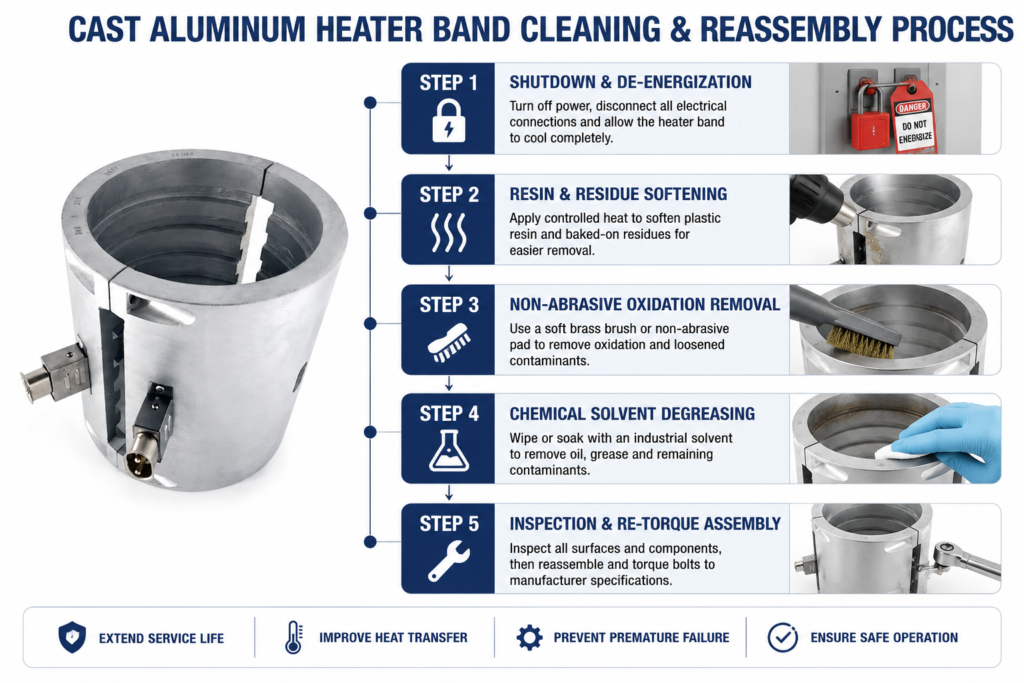
Step-by-Step Surface Reconditioning SOP
- Step 1: System De-energization & Safety Lockout: Safely disconnect power sources, lockout/tagout (LOTO) electrical feed lines, and allow heater casting temperatures to cool down below 40°C.
- Step 2: Polymer & Resin Softening: Apply a industrial solvent or mild localized heat (100°C) to soften baked-on plastic resin and degraded thermal paste residues.
- Step 3: Mechanical Oxidation Layer Removal: To clean cast in heater inner bore surfaces without gouging the soft metal matrix, use non-woven brass wire brushes, fine scotch-brite pads, or precision scrapers. Avoid aggressive steel wire wheels or coarse abrasive disks that alter bore concentricity.
- Step 4: Surface Degreasing & Solvent Wipe: Wipe down mating faces on both the processing barrel and cast heater inner diameter using fast-evaporating isopropyl alcohol (IPA) or acetone to eliminate oil, grease, and micro-particles.
- Step 5: Dimensional & Flatness Check: Inspect cleaned surfaces with a precision straightedge to verify the absence of raised burrs or warping prior to re-installation.
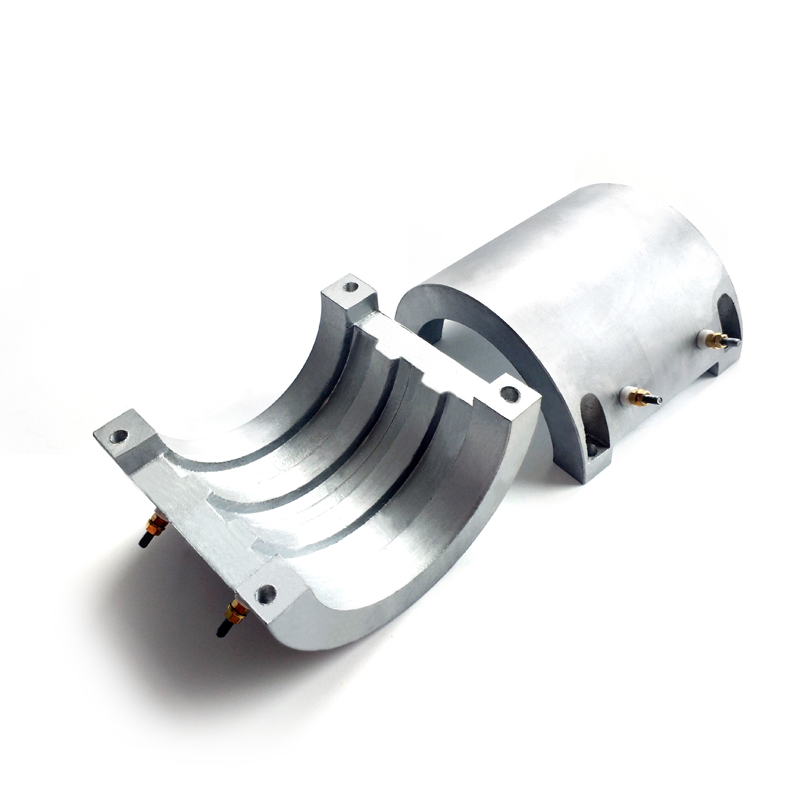
Engineering teams at Hongtai Industry Heater ensure every newly cast aluminum, bronze, and iron heater features precision-machined contact faces to simplify future maintenance and minimize surface oxidation risks.
3. Maintenance Protocols & Material Performance Matrix
| Interface Condition / Treatment | Thermal Conductivity (k) | Maximum Temperature Limit | Carbonization Risk | Impact on Heater Service Life | Maintenance Recommendation |
| Uncleaned / Oxidized Contact Face | 0.05 – 0.2 W/m·K | N/A (Degrades over time) | N/A | Severe Reduction (Localized hot spots) | Strictly prohibited; clean per SOP. |
| Standard Silicone Thermal Paste | 0.8 – 1.5 W/m·K | < 200°C | Extremely High | High Failure Risk (Forms insulating crust) | Do not use on processing barrels > 200°C. |
| Synthetic Metal/Ceramic Compound | 3.0 – 8.5 W/m·K | Up to 600°C – 1000°C | Zero | Optimal (Continuous heat transfer) | Recommended for high-watt density units. |
| Clean Bare Metal-to-Metal Contact | 160 – 180 W/m·K (Aluminum) | Operating limit of alloy | Zero | Maximum Reliability | Preferred method with CNC ground surfaces. |
For physical property data on metal alloys and elevated temperature behavior, consult MatWeb Material Property Data and international machinery standards from ISO Machinery Standards.
4. Re-Assembly Verification & Preventative Maintenance Audit
Proper execution of cast in heater maintenance requires thorough electrical and mechanical checks prior to restoring power to the line:
- Insulation Resistance (IR) Pre-Check: Before reconnecting power terminals, audit cold insulation resistance using a 1,000V DC megohmmeter. Ensure readings exceed 500 MΩ between active terminals and grounded casting faces.
- Dynamic Clamping Tensioning: Mount heater halves evenly onto the cleaned barrel using Belleville spring washers and high-tensile clamping hardware. Tighten bolts in an alternating 12-6-3-9 o’clock crossover sequence to prevent uneven clamping stresses.
- Thermal Retorque Audit: Bring the machinery up to initial operating temperature (200°C) for 30 minutes, then perform a warm torque check on mounting hardware to compensate for thermal expansion settling.
Every custom thermal assembly engineered by Hongtai Industry Heater is designed for simplified maintenance access and durable field performance. By combining void-free pressure casting with precision inner-bore machining, Hongtai Industry Heater enables plant maintenance staff to perform reliable, repeatable surface reconditioning across all production cycles.
Industrial Heating Solutions from Hongtai Industry Heater
The surface cleaning SOPs and thermal compound guidelines detailed above address critical maintenance, heat transfer, and premature failure challenges faced by plastics machinery operators, blow molding plants, and heavy industrial facilities. Hongtai Industry Heater‘s technical engineering team works directly with maintenance supervisors and plant engineers to optimize cast in heater maintenance routines, supply custom replacement heating elements, and engineer high-durability cast aluminum, bronze, and iron thermal solutions.
If you require customized technical inspections, export compliance certification, or specialized cast-in heater designs for your processing equipment, contact Hongtai Industry Heater’s engineering department directly for a comprehensive technical review and custom thermal design solution.
B2B Related Technical Resources
- Clamping Systems & Mounting:Clamping and Mounting Systems for Cast-in Heaters: Spring Loading vs. Bolt-On Design
- Quality Assurance & NDT Standards: Quality Control Standards for Cast-in Heaters: Hi-Pot, Insulation, and X-Ray Inspection
- Precision Machining & Surface Integrity: Cast in Heater Surface Machining: Minimizing Thermal Contact Resistance
- Internal Element Forming & Metallurgy: Internal Element Cast in Heater Design: Bending and Annealing Standards and Cast-in Heater Material Selection Guide: Aluminum vs. Bronze vs. Iron
- Custom Procurement & Diagnostics: Troubleshooting Cast-in Heater Failures: Internal Element Burnout and Warping and How to Specify Custom Cast-in Heaters for Industrial Machinery