Designing robust clamping and mounting systems for cast-in heaters is critical to ensuring efficient conductive heat transfer and operational longevity on processing barrels. As operating temperatures rise, thermal expansion differentials between cast aluminum/bronze heater shells and steel barrel walls cause rigid hardware to stretch or deform. This creates micro-air gaps that increase thermal contact resistance and trigger premature element burnout.
To prevent pressure loss and maintain continuous surface contact during thermal cycling, Hongtai Industry Heater engineers custom mounting solutions utilizing heavy-duty cast in heater clamping bolts, dynamic Belleville spring washers, and specialized spring loaded heater clamp assemblies. These spring-compensated systems automatically absorb thermal expansion, ensuring constant clamping force, optimal heat dissipation, and extended heater life in demanding industrial environments.
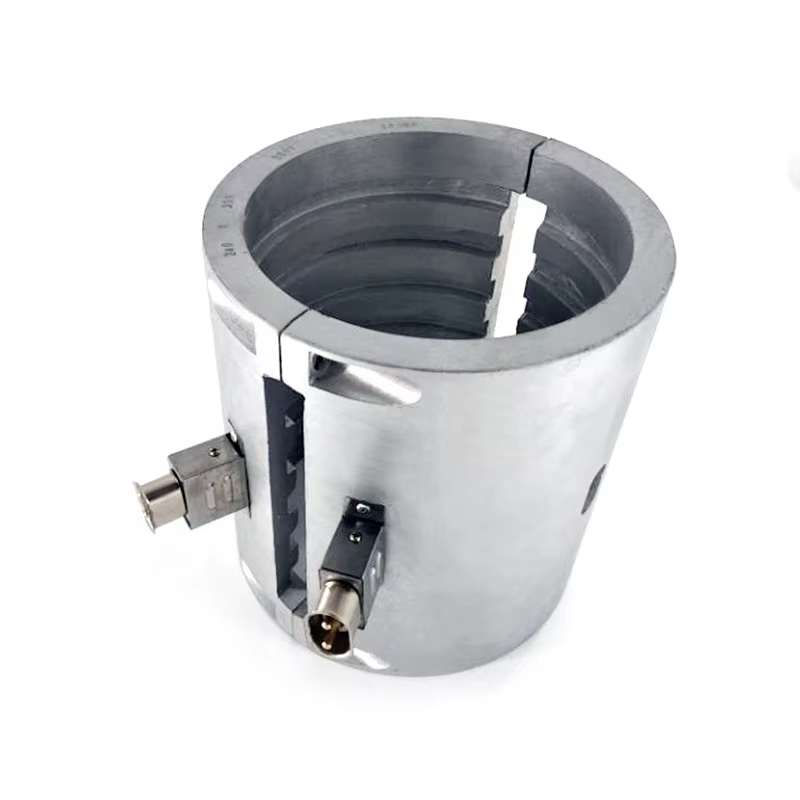
1. Thermal Expansion Dynamics & Rigid Bolt Loosening Mechanics
During initial heat-up and continuous thermal cycling, evaluating clamping and mounting systems for cast-in heaters requires analyzing how metals expand at significantly different rates based on their Coefficients of Thermal Expansion (CTE):
- Cast Aluminum Alloy (A356): CTE ≈ 21.0 × 10⁻⁶ /°C to 23.0 × 10⁻⁶ /°C
- Cast Bronze Alloy (CuSn10): CTE ≈ 17.5 × 10⁻⁶ /°C to 18.5 ×10⁻⁶ /°C
- Alloy Steel Processing Barrel (4140 / Nitrided): CTE ≈ 11.5 × 10⁻⁶ /°C to 12.5 × 10⁻⁶ /°C
Mechanical Breakdown of Rigid Clamping Failures
When standard rigid cast in heater clamping bolts are tightened onto a cold barrel, the initial torque applies a fixed axial clamping force. As operating temperatures rise toward 300°C – 450°C, the cast aluminum heater shell expands outward faster than the underlying steel barrel.
- Compressive Yielding: Higher aluminum expansion exerts intense compressive force on rigid steel bolts, causing the bolt threads or the soft aluminum mounting flanges to undergo plastic micro-deformation.
- Cooling Cycle Loosening: When the system cools down during maintenance or shutdown, the aluminum contracts back to its baseline dimensions. Because the rigid bolts or mounting ears were plastically stretched during heating, the clamp relaxes completely.
- Air Gap & Thermal Resistance Formation: Once the clamping force drops below critical thresholds, microscopic air gaps form at the barrel boundary. Because air has negligible thermal conductivity (k ≈ 0.026 W/m·K), these gaps trap heat within the heater shell, accelerating internal core element burnout.
To maintain contact pressure across temperature changes, Hongtai Industry Heater incorporates dynamic Belleville spring washers and engineered clamping geometries into its heating assemblies, accommodating thermal expansion cycles without structural relaxation.
For a deeper understanding of how contact surface preparation impacts thermal conduction, review Cast in Heater Surface Machining: Minimizing Thermal Contact Resistance.
2. Spring-Loaded Bolts vs. Standard Rigid Bolt-On Designs
Selecting the proper hardware setup for clamping and mounting systems for cast-in heaters depends on the operating temperature range, barrel diameter, and frequency of thermal cycling in the processing facility.
Fclamp = k · Δx
Where:
- Fclamp = Net dynamic clamping force (N)
- k = Effective spring rate of Belleville washer stack (N/mm)
- Δx = Compression deflection accommodating thermal expansion movement (mm)
Spring-Loaded Clamping Mechanism
Integrating a high-temperature spring loaded heater clamp or Belleville spring washer stack onto cast in heater clamping bolts creates a dynamic tensioning system. As the aluminum heater expands outward, the Belleville washer deflects, storing mechanical energy without exceeding the yield strength of the steel bolt. When the assembly cools, the stored spring tension pushes back, maintaining a constant force (Fclamp) against the barrel wall at all times.
Hinge Clamping & Quick-Release Mounts
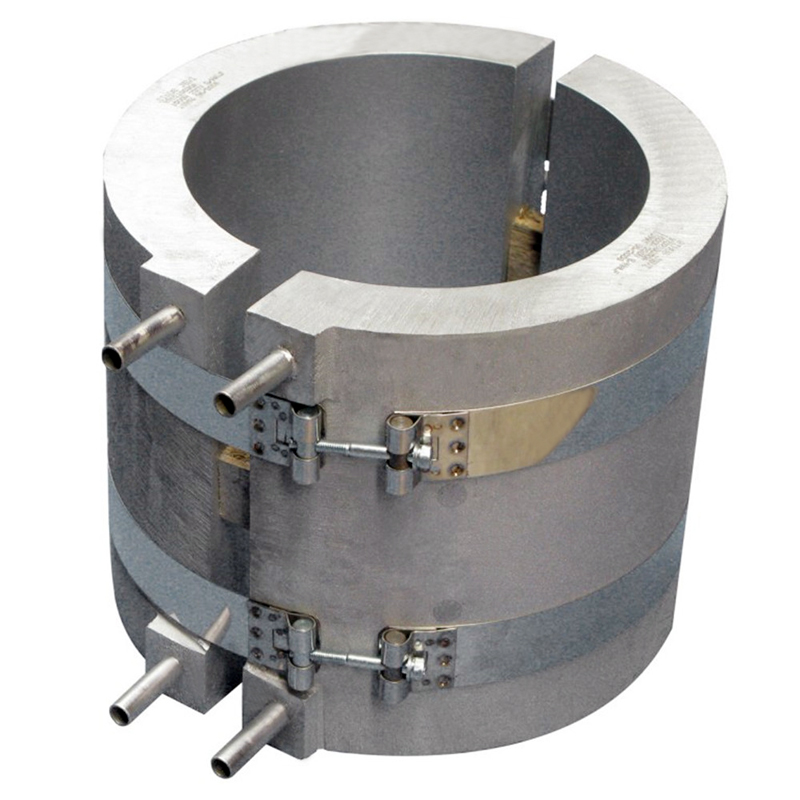
For large-diameter barrels or applications requiring frequent barrel maintenance, hinged two-piece cast-in heaters with high-strength tie-rod clamps provide fast installation and uniform 360° circumferential pressure distribution, reducing localized stress concentrations.
3. Clamping System Comparison & Performance Matrix
| Clamping Architecture | Primary Components | Thermal Expansion Compensation | Operational Temperature Range | Risk of Air Gap Formation | Hongtai Design Integration |
| Standard Rigid Bolt-On | Steel hex bolts & flat washers | None (Fixed mechanical position) | < 200°C (Low thermal movement) | High (Stretches under thermal cycling) | Used only for low-temperature, low-cycle applications. |
| Spring-Loaded Bolt Assembly | Cast in heater clamping bolts + Belleville springs | Dynamic (Spring deflection absorbs CTE movement) | Up to 450°C (High thermal fluctuation) | Negligible (Maintains continuous force) | Standard recommendation for extruder barrels. |
| Hinged Latch & Tie-Rod | Precision hinge pins + spring-loaded tie rods | High (Uniform 360° pressure) | Up to 500°C (Heavy-duty machinery) | Zero (Prevents uneven clamping drop) | Preferred for large-diameter barrels & quick changeovers. |
For technical mechanical property data on spring steel performance at elevated temperatures, consult MatWeb Material Property Data and machinery design standards from ISO Machinery Standards.
4. Field Installation SOP for Mounting Cast Aluminum Heaters
Executing correct installation procedures when mounting cast aluminum heater assemblies ensures uniform contact pressure and long-term operating stability:
- Surface Inspection & Preparation: Clean the barrel surface thoroughly using wire brushes and solvent to remove carbonized resin, rust, or debris before mounting cast aluminum heater units.
- Symmetrical Alignment & Torque Sequence: Position heater halves evenly around the barrel. Tighten cast in heater clamping bolts in an alternating crossover pattern (12-6-3-9 o’clock) using a calibrated torque wrench to achieve uniform initial compression.
- Thermal Retorque Audit: Bring the system up to operating temperature (e.g., 200°C) and allow it to soak for 30 minutes. Perform a warm torque check on rigid bolts, or inspect spring compression deflection on a spring loaded heater clamp system to ensure proper tension retention.
Every cast-in thermal assembly engineered by Hongtai Industry Heater is supplied with custom mounting hardware options, including Belleville spring-loaded bolt sets and hinged clamping geometries. By combining precision inner-bore machining with dynamic clamping solutions, Hongtai Industry Heater ensures maximum contact pressure, minimal thermal contact resistance, and long service life across all industrial heating applications.
Industrial Heating Solutions from Hongtai Industry Heater
The clamping and mounting systems for cast-in heaters detailed above address common mechanical loosening, thermal expansion, and surface contact issues encountered in plastics extrusion, blow molding, and industrial pressing operations. Hongtai Industry Heater’s technical engineering team works directly with equipment builders and plant maintenance managers to analyze mechanical mounting constraints, supply custom spring-loaded clamping hardware, and manufacture high-efficiency cast aluminum, bronze, and iron heating assemblies built for heavy-duty production lines.
If you require customized technical inspections, export compliance certification, or specialized cast-in heater designs for your processing equipment, contact Hongtai Industry Heater’s engineering department directly for a comprehensive technical review and custom thermal design solution.
B2B Related Technical Resources
- Quality Assurance & NDT Standards: Quality Control Standards for Cast-in Heaters: Hi-Pot, Insulation, and X-Ray Inspection
- Precision Machining & Surface Integrity: Cast in Heater Surface Machining: Minimizing Thermal Contact Resistance
- Internal Element Forming & Metallurgy: Internal Element Cast in Heater Design: Bending and Annealing Standards and Cast-in Heater Material Selection Guide: Aluminum vs. Bronze vs. Iron
- Custom Procurement & Diagnostics: Troubleshooting Cast-in Heater Failures: Internal Element Burnout and Warping and How to Specify Custom Cast-in Heaters for Industrial Machinery