
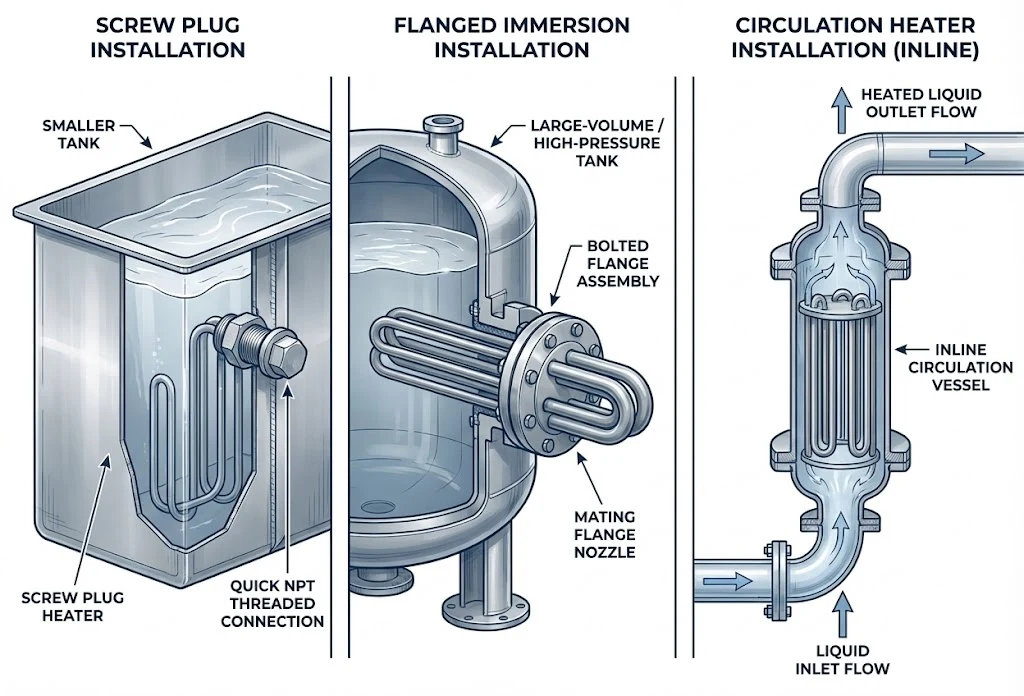
In the industrial manufacturing sector, thermal inefficiency is a silent profit killer. A heater failure doesn’t just cost the price of a replacement part; it costs hours of production downtime. For engineers and procurement managers, the challenge in 2026 isn’t just buying a heater—it’s specifying a thermal solution that matches the exact hydrodynamic and thermodynamic […]
Read More
Calculating Watt Density for Tubular Heaters: Formulas, Max Thresholds & Tolerance Correction
1. The Physics of Failure: Why Surface Load Matters In thermal system design, the total wattage defines the energy input, but the Watt Density (Surface Load) defines the heater’s lifespan. Watt Density, expressed in Watts per Square Inch (W/in^2) or Watts per Square Centimeter (W/cm^2), represents the rate at which thermal energy is transferred from […]
Read More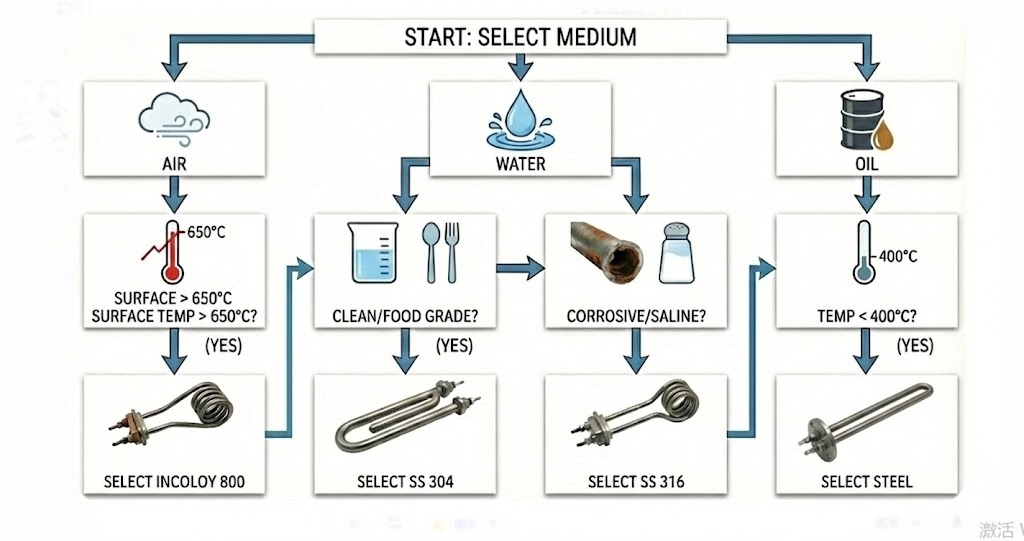
Incoloy 800 vs. 304 Stainless Steel: A Thermal & Corrosion Performance Comparison for Heating Sheaths
The Engineering Context: It’s Not the Wire, It’s the Sheath When selecting heating elements for industrial applications, the choice often comes down to Incoloy 800 vs 304 Stainless Steel. Understanding the differences in corrosion resistance, temperature limits, and cost is crucial for your project’s success. In industrial heating element failure analysis, a staggering 60% of […]
Read More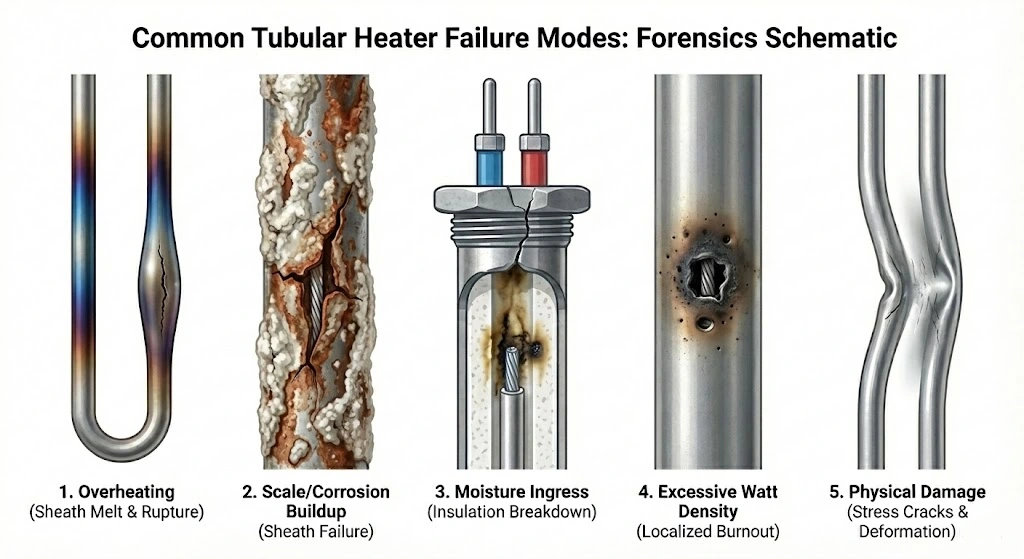
Forensic Analysis of Tubular Heater Failure: 5 Common Root Causes & Prevention Strategies
The Cost of Failure: Beyond the Component Price In industrial maintenance, the cost of a failed tubular heater is rarely the $50 replacement part. It is the $5,000 per hour in downtime, the wasted batch of raw materials, and the disruption to the production schedule. Most heater failures are dismissed as “wear and tear.” However, […]
Read More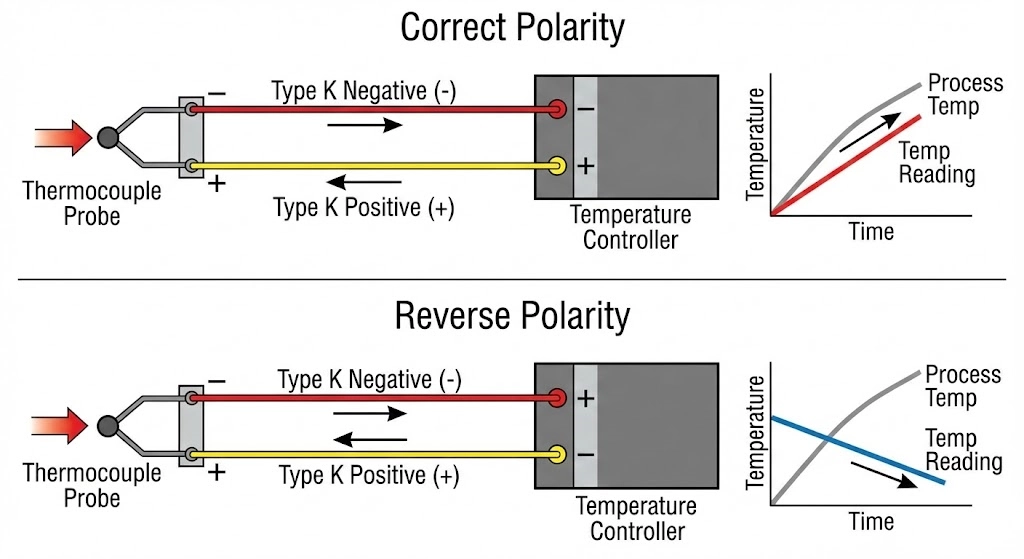
Mastering Thermocouple Color Codes: ANSI, IEC, and JIS Standards (2026 Guide)
Introduction: The “Red Wire” Trap In 99% of electrical engineering, Red means Positive (+). It is the universal language of DC power. In the world of American (ANSI) thermocouples, Red is Negative (-). This single counter-intuitive fact is responsible for thousands of hours of downtime and catastrophic equipment failures every year. The Scenario: A field […]
Read More
Class A vs. Class B vs. 1/10 DIN: Understanding Pt100 Accuracy Standards
Introduction: The “Accuracy” Mirage Customer Inquiry: “I need a high-accuracy Pt100 sensor for my chemical reactor.” Our Question: “Define high accuracy. Do you need Class A? 1/3 DIN? Or a sensor with specific Callendar-Van Dusen coefficients?” In the world of industrial metrology, “High Accuracy” is a meaningless marketing term. A sensor that is highly accurate […]
Read More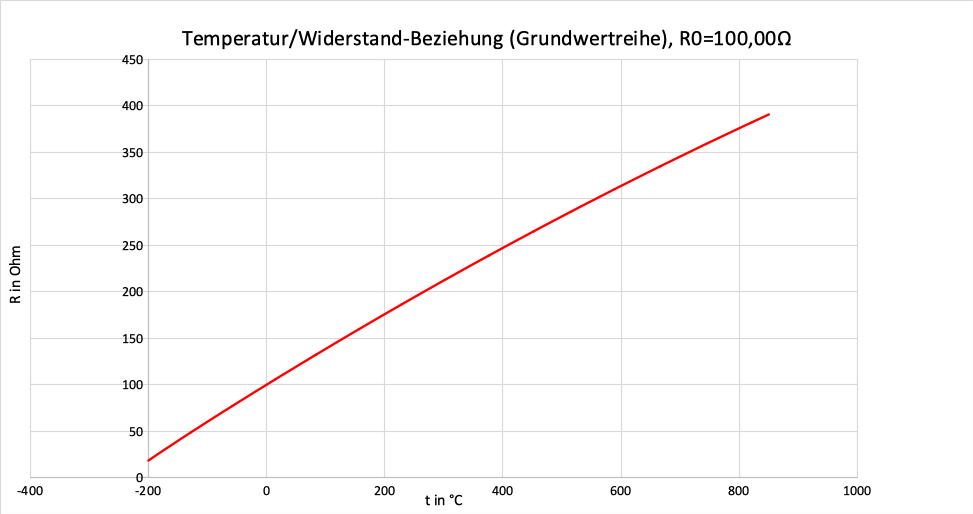
Pt100 vs. Pt1000 Sensors: Which Resistance Value is Right for You?
Introduction: The “10x” Difference The Scenario: You are designing a wireless, battery-powered temperature logger for a cold chain logistics crate. You default to specifying a Pt100 sensor because “that is what we used on the steam turbine project.” Two weeks into testing, you hit two walls: The Physics: Both Pt100 and Pt1000 sensors are made […]
Read More
2-Wire, 3-Wire, or 4-Wire? Mastering RTD Lead Compensation (2026 Guide)
Introduction: The “Hidden Resistor” The Scenario: You install a high-precision Class A Pt100 sensor. You run 50 meters of cable back to the control room. You power it up, and the controller reads 23°C, even though you know the tank is at 20°C. You replace the sensor, but the error remains. The Physics: The problem […]
Read More
Low Insulation Resistance? Don’t Scrap It! The “Bake Out” Guide to Reviving Wet Industrial Heaters
The “Monday Morning” Panic It’s a classic scenario. You took out a batch of heating tubes that had been in the warehouse for several months. Your quality control team pulls one out, hooks up a Megohmmeter (Megger), and sees a reading of 0.5 MΩ. The immediate reaction? “Defective product. Return it.” Stop. Put down the […]
Read More
Cartridge Heater Temperature Control: The Ultimate Guide to Thermocouples, PID & SSRs
Introduction A high-density cartridge heater without a control system is not a tool; it is a fuse waiting to blow. In high-watt density applications, the internal temperature of a heater can rise at a rate of 50°C per second. If you rely on a manual switch or a slow-reacting external sensor, the heater core will […]
Read More
2026 Cartridge Heater Ultimate Guide: From Selection Logic to Failure Analysis
Introduction In industrial thermal processing, a cartridge heater is often viewed as a simple commodity. However, for the maintenance manager facing a line shutdown or the R&D engineer designing a high-speed packaging die, these components are anything but simple. Premature burnout, uneven heating, and seized elements are rarely “bad luck”—they are usually the result of […]
Read More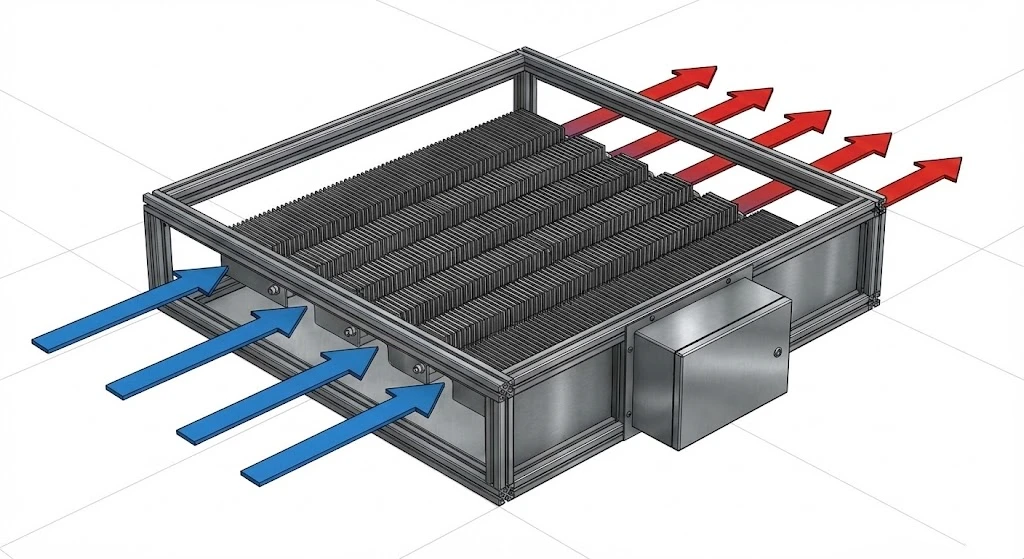
Designing Finned Tubular Heaters for Forced Air: Balancing Heat Transfer, Pressure Drop & Velocity
The Conductivity Challenge: Why Air is Difficult to Heat For thermal engineers, air is a notoriously difficult medium. Its thermal conductivity is approximately $0.026 W/m\cdot K$—roughly 20 times lower than stationary water. If you place a standard “bare” tubular heater in an air stream, the heat cannot escape the sheath fast enough. The result? The […]
Read More