Precision cast in heater surface machining is critical to achieving maximum energy efficiency, uniform heat distribution, and long operational lifespan on extrusion barrels and high-pressure processing machinery. While internal casting metallurgy provides structural strength, high-precision cast in heater surface machining determines the actual conductive heat flux across the physical boundary. Raw, unmachined casting surfaces leave microscopic air gaps that act as severe thermal insulators, driving up thermal contact resistance ($R_c$) and causing localized heat accumulation that leads to premature element burnout.
Whether retrofitting aging machinery or specifying custom components for high-speed extrusion lines, optimizing surface topography, inner-bore concentricity, and contact pressure is essential for seamless thermal transfer. Hongtai Industry Heater combines vacuum-assisted dense casting with advanced cast in heater surface machining, precision inner-diameter (ID) CNC boring, and specialized contact-face grinding designed to eliminate micro-voids, optimize thermal conductivity, and maximize equipment uptime.
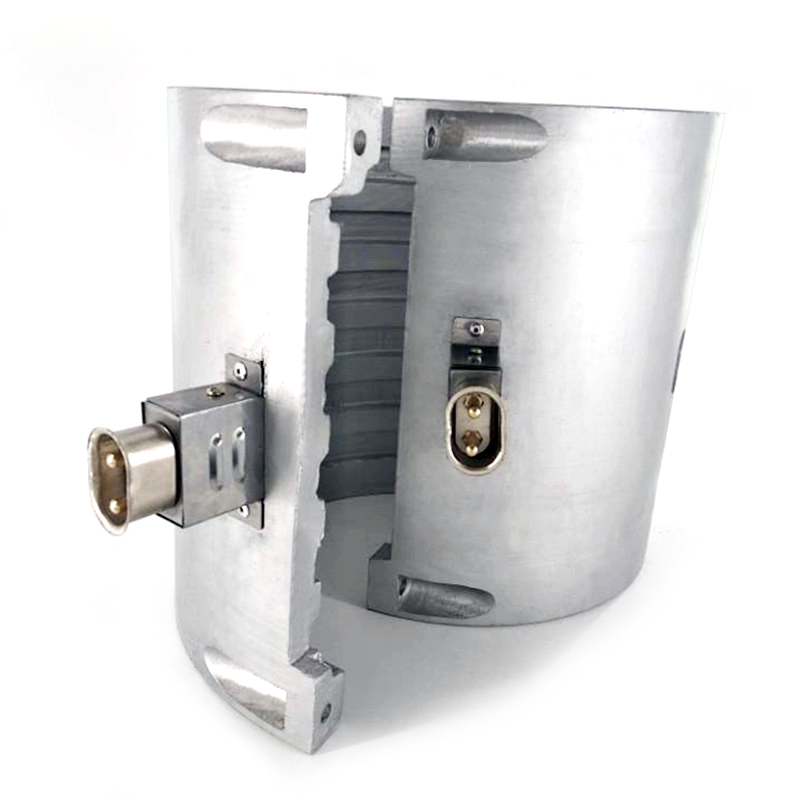
1. Fourier’s Law & Thermal Contact Resistance Physics
To evaluate how cast in heater surface machining impacts overall thermal transfer, process engineers analyze heat conduction across mating metal surfaces using Fourier’s Law:
q = −k · A · dT dx
Where:
- q = Heat transfer rate (W)
- k = Thermal conductivity of the matrix metal (W/m·K)
- A = Effective surface contact area (m²)
- dT/dx = Temperature gradient across the wall thickness (K/m)
Eliminating the Air Gap Thermal Barrier
As-cast permanent mold surfaces contain microscopic peaks and valleys (roughness asperities). When clamped onto a cylindrical processing barrel without precision cast in heater surface machining, these micro-peaks touch first, trapping stagnant air pockets in the intervening voids.
Because air exhibits negligible thermal conductivity (k ≈ 0.026 W/m·K) compared to cast aluminum (k ≈ 160 – 180 W/m·K) or cast bronze (k ≈ 100 – 120 W/m·K), these unmachined air gaps create high thermal contact resistance. Thermal energy generated by the encapsulated element cannot dissipate into the barrel, causing internal core temperatures to spike beyond 700°C while the outer processing face suffers severe thermal lag and cold spots.
2. Inner-Bore CNC Machining & Surface Roughness Standards
Eliminating thermal bottlenecks requires dedicated cast in heater surface machining protocols applied directly to the inner diameter of the cast assembly.
Surface Finishing Progression
- As-Cast Surface (Roughness Ra ≥ 12.5 µm): True contact area remains below 30%. Micro-air gaps cause localized thermal bottlenecks, internal heat buildup, and rapid resistance wire failure.
- Standard Lathe Turning (Roughness Ra 3.2 – 6.3 µm): Contact area reaches 60% – 70%. Acceptable for low-wattage applications, but subject to thermal lag during high-output production cycles.
- Precision CNC Boring & Surface Grinding (Roughness Ra ≤ 1.6 µm): True contact surface area exceeds 95%. Air gaps are virtually eliminated, enabling rapid conductive heat transfer and dead-level temperature uniformity across the barrel wall.
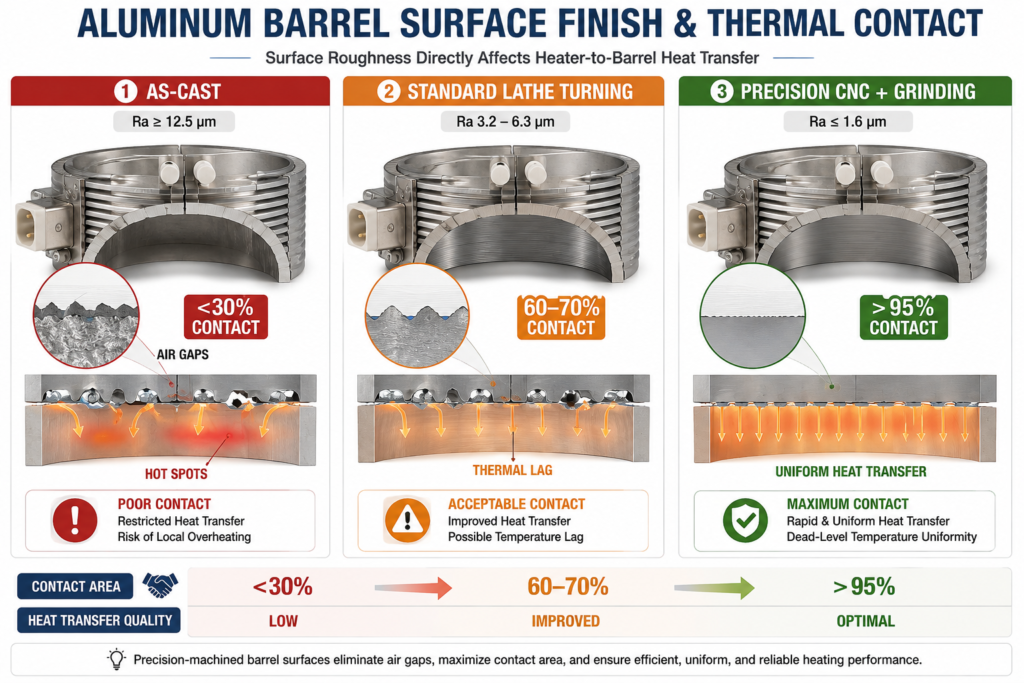
To solve the heat accumulation and air-gap issues typical of unmachined castings, Hongtai Industry Heater subjects every cast aluminum and bronze heater to rigorous cast in heater surface machining, utilizing multi-axis CNC inner-bore turning and precision grinding. By holding tight machining tolerances (within ±0.02 mm), Hongtai Industry Heater ensures maximum surface contact, minimizes thermal contact resistance, and prevents localized burnout on heavy-duty processing barrels.
To analyze how internal casting density and porosity impact heat dissipation, read How Porosity Affects Heat Transfer in Cast-in Heating Elements.
3. Machining Standards & Performance Matrix
| Surface Machining Standard | Roughness (Ra) | True Mating Contact Area | Thermal Contact Resistance (R_c) | Risk of Internal Wire Burnout | Hongtai Machining Standard |
| As-Cast (Unmachined) | > 12.5 µm | < 30% | Extremely High | Critical (Severe core heat buildup) | Excluded for processing heaters. |
| Standard Turning | 3.2 – 6.3 µm | 60% – 70% | Moderate | Moderate (Thermal lag present) | Baseline specification for low-wattage units. |
| Precision CNC Boring | 1.6 – 3.2 µm | 85% – 90% | Low | Minimal | Standard baseline across all extruder heaters. |
| Ground & Honed Finish | < 0.8 µm | > 95% | Negligible | Zero (Maximum heat transfer) | Premium standard for high-watt-density assemblies. |
For material data regarding aluminum and copper alloys under compressive contact stress, refer toMatWeb Material Property Data and international machinery standards from ISO Machinery Standards.
4. Preventative Installation and Quality Assurance
Executing proper cast in heater surface machining must be paired with disciplined field installation and quality verification to ensure low thermal contact resistance over thousands of operating hours:
- Surface Inspection & Torque Verification: Inspect barrel surfaces for carbonized resin or rust prior to mounting. Tighten clamping bolts in an even crossover sequence to maintain uniform circumferential pressure.
- Dielectric Audit (Hi-Pot & IR): Prior to startup, apply a 1,500V AC dielectric test (leakage current < 0.5 mA) and verify insulation resistance exceeds 500 MΩ using a 1,000V DC megohmmeter.
- Full-Face Thermal Imaging Audit: Perform infrared thermography during initial heat-up to confirm dead-level temperature profiles (±1°C) across active contact surfaces.
Every precision unit featuring custom cast in heater surface machining from Hongtai Industry Heater undergoes 100% X-ray fluoroscopy inspection, high-voltage dielectric testing, and infrared thermography auditing prior to shipment. By integrating void-free pressure casting with precision CNC cast in heater surface machining, Hongtai Industry Heater delivers thermal assemblies built to absorb mechanical shock, endure vibration, and maximize heat transfer efficiency.
Industrial Heating Solutions from Hongtai Industry Heater
The technical standards detailed above address the core thermal transfer bottlenecks encountered in plastics extrusion, blow molding, and heavy industrial processing equipment. Hongtai Industry Heater’s technical engineering team works directly with machinery builders and plant operations to diagnose heat dissipation issues, supply specialized cast in heater surface machining solutions, and manufacture custom cast aluminum, bronze, and iron heating assemblies tailored to high-stress processing environments.
If you are experiencing premature heater failure, surface hot spots, or thermal transfer issues on your processing line,contact Hongtai Industry Heater’s engineering department directly for a comprehensive technical review and custom thermal design solution..
B2B Related Technical Resources
- Extrusion & Blow Molding Thermal Solutions: Air Cooled Cast in Heater: Extruder Barrel Cooling Guide. and Extruder Barrel Cast in Heater: Blow Molding Thermal Guide.
- Failure Analysis & Troubleshooting: Troubleshooting Cast-in Heater Failures: Internal Element Burnout and Warping and Troubleshooting 101: 5 Common Causes of Band Heater Burn-Out
- Packaging Line Auxiliary Heating: Band Heater Installation Guide: Clamping SOP for Long Life, Band Heater Watt Density: Guide to Preventing Failure,and Brass Nozzle Heater: Eliminating Plastic Leakage Downtime.