An extruder barrel cast in heater must deliver continuous thermal stability under rigorous 24/7 production schedules without incurring heat transfer decay or excessive electrical energy waste. In plastic extrusion lines and high-speed blow molding machinery, thermal cycling causes metallic expansion that degrades contact pressure between the heater inner diameter (ID) and the cylinder wall. When a split half-band (Half-Band) casting loses intimate metal-to-metal contact, air gaps form, increasing thermal resistance and forcing internal heating elements to run hotter than necessary.
For plastics machinery manufacturers and factory equipment managers, eliminating these expansion gaps through precision machining and proper clamping is essential to maintaining melt homogeneity, reducing energy bills, and preventing unplanned line shutdowns.
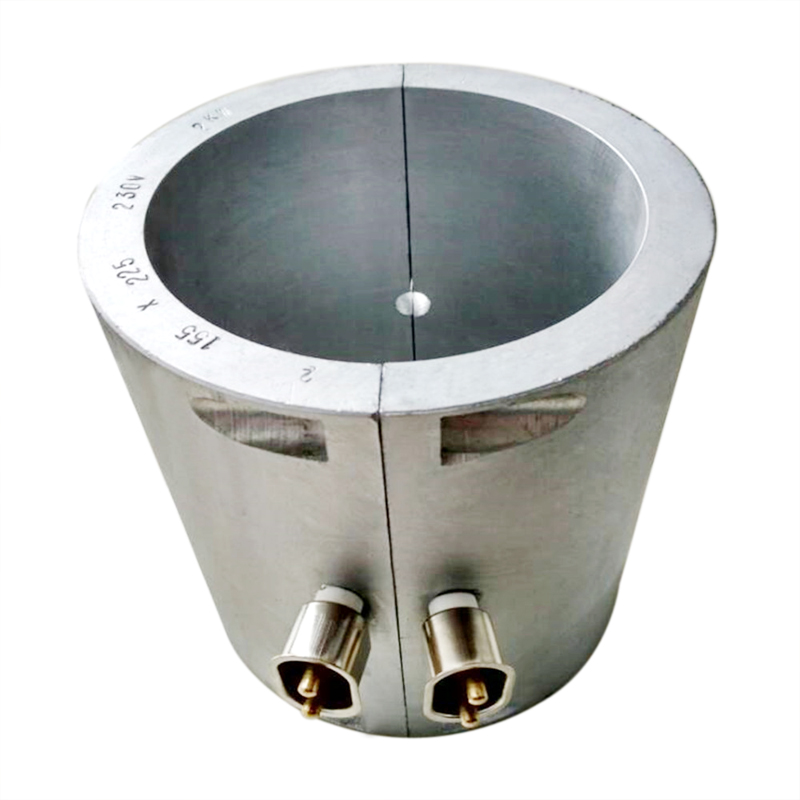
1. Thermodynamics of Split Half-Band Contact Fitment in 24/7 Operations
During continuous plasticizing operations, heat transfer from a plastic extrusion heater band or cast aluminum band to the steel cylinder relies on conductive interface dynamics.
Contact thermal resistance (Rc) across the interface is governed by Fourier’s Law of Conduction:
Where:
When an extruder barrel cast in heater expands at a higher rate (αAl ≈ 23 × 10-6 / K) than the underlying alloy steel barrel (αsteel ≈ 12 × 10-6 / K), a microscopic thermal expansion gap (Δx) develops.
Because air thermal conductivity (kair ≈ 0.026 W/(m·K)) is nearly 600 times lower than aluminum (kAl ≈ 160 W/(m·K)), even a 0.1 mm air gap acts as an insulating barrier. This causes severe thermal lag, forces the PID controller to boost power consumption, and increases internal wire temperatures—leading to premature burnout.
2. Structural Design Strategies for Split Half-Band Assemblies
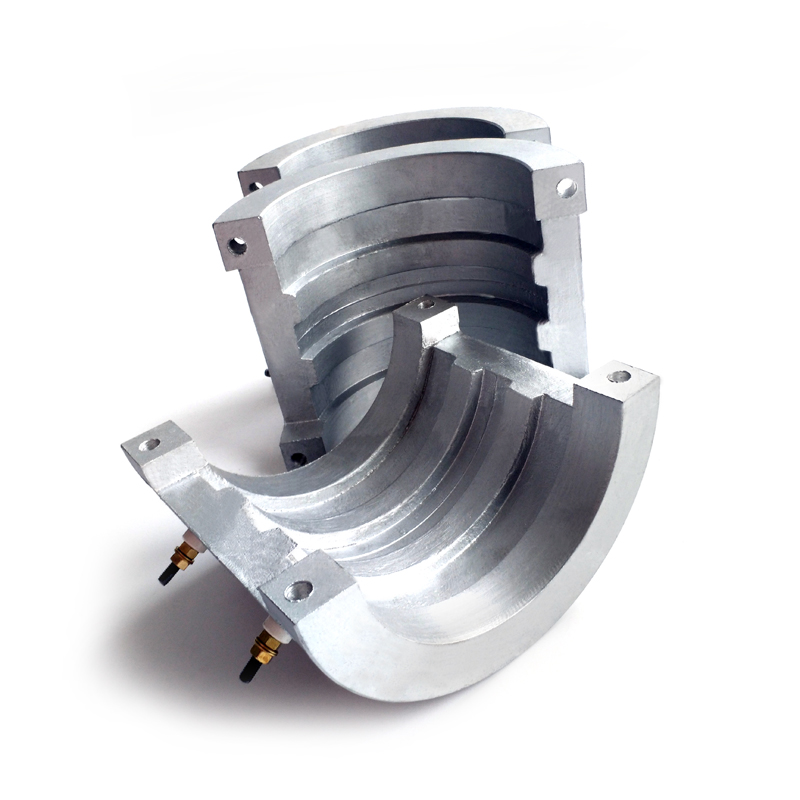
To maintain uniform surface contact across long processing runs, thermal engineers incorporate specific structural features into each blow molding heating element and extrusion band assembly:
- Precision CNC Inner Bore Machining: Machining the inside diameter to an ISO H7 fit after casting guarantees full 360° surface engagement with minimal surface roughness (Ra ≤ 1.6 μm).
- Heavy-Duty Expansion Lug Clamping: Reinforced clamping lugs equipped with high-tensile alloy socket-head cap screws prevent casting distortion during hot expansion cycles.
- Integrated Spring-Loaded Washers: High-temperature Belleville spring washers maintain constant axial clamping force against the barrel during rapid heat-up and cool-down phases.
To verify alloy purity and prevent internal air pockets in half-band castings, manufacturers enforce strict quality checks as detailed in How Porosity Affects Heat Transfer in Cast-in Heating Elements.
3. Technical Comparison: Extrusion vs. Blow Molding Thermal Requirements
While both applications demand continuous reliability, an extruder barrel cast in heater and a blow molding heating element face distinct mechanical and operational demands:
| Application Parameter | Plastic Extrusion Lines | Blow Molding Machinery |
| Primary Thermal Load | Continuous melt holding & shear heat cooling | Frequent thermal cycling & high mechanical shock |
| Vibration Environment | Moderate steady vibration | High impact vibration (Parison accumulator movement) |
| Heater Configuration | Finned extruder barrel cast in heater halves | Compact, high-watt-density cast band elements |
| Cooling Integration | Forced air fins or embedded water tubes | Direct conduction cooling or localized air shrouds |
| Key Failure Mode | Thermal resistance decay & barrel hot spots | Terminal stud fatigue & vibration-induced short circuits |
4. Preventative Maintenance and System Integration
Optimizing performance for any extruder barrel cast in heater requires combining proper installation protocols with routine diagnostic checks:
- Execute Hot Re-Torque Protocols: Always re-torque clamping bolts after the machine reaches operating temperature for the first time. Follow standard procedures outlined in our Band Heater Installation SOP: Preventing Hot Spots and Early Burnouts
- Verify Safe Surface Watt Densities: Prevent core degradation by reviewing power threshold guidelines in Understanding Watt Density: The Key to Preventing Premature Band Heater Failure
- Evaluate Barrel Cooling Options: For high-shear extrusion processes requiring precise temperature reduction, compare air and liquid cooling designs in Air Cooled Cast in Heater: Extruder Barrel Cooling Guide.
- Standardize Custom Sourcing: Streamline drawing parameter submissions for new machine builds using How to Specify Custom Cast-in Heaters for Industrial Machinery and compare casting alloys in Cast-in Heater Material Selection Guide: Aluminum vs. Bronze vs. Iron.
To diagnose field failures, casting cracks, or element burnouts, consult Troubleshooting Cast-in Heater Failures: Internal Element Burnout and Warping or review standard band failure modes in Troubleshooting 101: 5 Common Causes of Band Heater Burn-Out. For liquid-tight die setups, see Brass Nozzle Heater: Eliminating Plastic Leakage Downtime.
For diagnostic protocols across Cast-in Band systems, consult How Porosity Affects Heat Transfer in Cast-in Heating Elements or explore our master engineering manual:Industrial Band Heaters: The Ultimate Engineering Guide to Selection, Efficiency & Troubleshooting (2026 Edition).
.