It is 3:00 AM, the injection molding machine goes down with a critical temperature alarm, and the maintenance technician discovers yet another blown band heater on the carriage. Replacing the component takes an hour of valuable production time, but if the maintenance team does not identify why it failed, they will inevitably be replacing that exact same heater again next week.
Industrial band heaters do not have a predetermined expiration date. When a heating element dies prematurely, it is rarely due to a manufacturing defect; it is usually “murdered” by its operating environment or improper installation physics.
This diagnostic guide breaks down the thermodynamic and electrical physics behind the five most common causes of band heater failure. By learning how to perform a forensic autopsy on a dead heater, engineers can eliminate the root cause of unplanned downtime.
The engineering reality is this: 90% of premature band heater failures fall into five preventable categories: plastic contamination, poor clamping (insulating air gaps), incorrect watt density specification, PID control errors, and mechanical wire fatigue. Identifying the physical symptoms allows facilities to stop replacing consumables and start upgrading to the correct specification.
For a comprehensive look at how to match specific heater architectures to different machine zones, refer to our [Ultimate Industrial Band Heaters Guide].
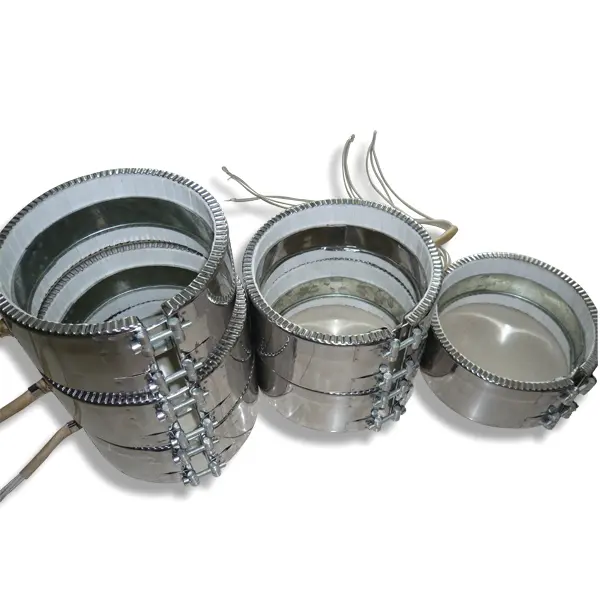
1. The Silent Killer: Contamination and Fluid Ingress
When investigating a failed heater, the most common culprit is not an electrical surge, but the physical intrusion of non-electrical substances.
The Chemistry of Dielectric Breakdown
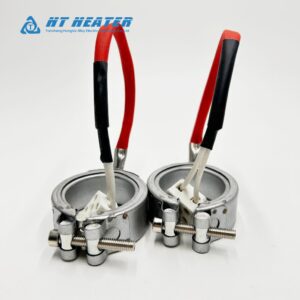
Standard mica band heaters are constructed with folded stainless steel seams. They are not hermetically sealed. In the harsh environment of a plastic extrusion or injection molding shop, molten polymers (like ABS, Polycarbonate, or Nylon), leaking hydraulic oil, and ambient moisture frequently coat the machine barrel.
Through capillary action, these fluids seep into the microscopic seams of the heater. At operating temperatures exceeding 250°C, the organic compounds in the plastic or oil boil off, leaving behind carbonized residue. From an electrical engineering standpoint, carbon is a highly efficient conductor.
This carbon buildup thoroughly penetrates the phlogopite mica insulation. It creates a direct, conductive bridge between the live Nickel-Chromium (NiCr) resistance wire and the grounded stainless steel sheath. The electrical current violently bypasses the heating circuit, arcing straight to ground. This dielectric breakdown results in a dead short, instantly tripping the machine’s breaker and blowing a hole through the heater casing.
The Fix: Encapsulation
If a specific machine zone—particularly the nozzle—is prone to leakage or “blowback,” replacing a standard mica heater with another standard mica heater is an exercise in futility. The only permanent engineering fix is to upgrade the zone to [Brass Sealed Nozzle Heaters]. These heaters utilize a folded-end, high-pressure encapsulation process that provides a 100% waterproof and plastic-proof barrier, physically isolating the dielectric core from external contamination.
2. Air Gaps and The “Hot Spot” Phenomenon
The most pervasive misconception on the shop floor is that tightening a band heater “until it feels snug” is sufficient. In thermal dynamics, a snug fit is often a destructive fit.
Heat Transfer Physics
Standard band heaters transfer energy to the machine barrel via thermal conduction. Conduction requires flush, metal-to-metal contact.
If a heater is installed over a barrel that has not been thoroughly cleaned of old plastic residue, or if the clamping screws are not torqued evenly, microscopic air gaps form between the heater sheath and the cylinder. Because air has an extraordinarily low thermal conductivity ($~0.026 \text{ W/m·K}$), these gaps act as powerful thermal insulators.
The heater continues to generate wattage, but the thermal energy is physically blocked from entering the barrel. The heat becomes trapped inside the heater casing. The internal temperature of the NiCr wire rapidly escalates beyond its melting point (typically $>1200°C$), causing the wire to oxidize, become brittle, and snap.
Symptoms of Poor Clamping
Maintenance technicians can easily “read” this failure. If the removed heater exhibits dark, warped patches on the inside diameter, or if the exterior stainless steel sheath shows a severe blue, purple, or rainbow-colored annealing discoloration in one specific area, the heater was not clamped properly.
The Corrective Action: Always scrape the barrel down to bare metal. Utilize a rubber mallet to ensure flush seating during installation, and most importantly, perform a “hot re-torque” (re-tightening the clamping screws immediately after the machine reaches operating temperature to counteract thermal expansion).
3. Engineering Mismatch: Over-Wattage for the Application
In an attempt to reduce machine startup times, process engineers sometimes specify replacement heaters with a higher total wattage than the original equipment manufacturer (OEM) designed for that specific zone. This logic directly violates material physics.
Breaking the Material Threshold
The limiting factor of any heating element is its Watt Density (the amount of power generated per square centimeter of heated area).
Standard mica band heaters rely on organic binders that begin to degrade structurally when surface loads exceed 3 W/cm² (20 W/in²). If an engineer forces a 1000W heater into a physical footprint that was originally designed for a 500W load, the watt density doubles. This guarantees that the internal temperature of the heater will exceed the dielectric limits of the mica insulation long before the massive steel machine barrel ever reaches its PID setpoint. The heater simply burns itself out trying to push too much heat through too small of a surface area.
Cycle Time vs. Heater Life
If the manufacturing process absolutely requires aggressive heat-up rates, you cannot safely achieve this by blindly increasing the watt density of a standard component. The thermal system must be engineered for the load.
- Solution A: Upgrade the insulation class. Switch from a Mica band to a Ceramic band heater, which utilizes steatite knuckles capable of safely sustaining loads up to 6 W/cm² (39 W/in²).
- Solution B: Increase the physical surface area. Specify a wider band heater to distribute the higher wattage over a larger footprint, maintaining a safe watt density while delivering the required total power.
4. Control System Failures: PID Overshoot and Sensor Placement
Occasionally, forensic analysis reveals a perfectly manufactured heater that was installed flawlessly, yet still burned out rapidly. In these scenarios, the heater is not the culprit; the machine’s control system is working the element to death.
Thermocouple Placement (Thermal Lag)
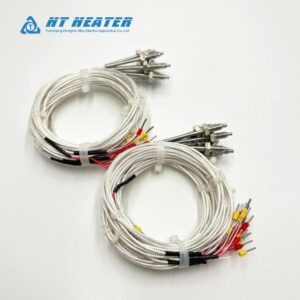
The PID (Proportional-Integral-Derivative) controller relies entirely on feedback from the zone’s thermocouple. If the J-type or K-type thermocouple is placed too deep within the heavy steel mold, or positioned too far away from the band heater, it creates a severe “thermal lag.”
The heater may be operating at 400°C, but the distant thermocouple is only registering 150°C. Because the controller believes the zone is still cold, it commands the Solid-State Relay (SSR) to fire at a 100% duty cycle continuously. The heater is never allowed to cycle off or modulate, causing it to overheat and fail prematurely. Ensure thermocouples are seated properly and positioned to read the active heat zone.
The “Runaway” Relay
Solid-State Relays are prone to failing in the “closed” (shorted) position. When an SSR fails closed, it continuously supplies line voltage to the band heater, even when the PID controller has achieved the temperature setpoint and is commanding a 0% output. This runaway condition will rapidly destroy the heater and severely degrade the plastic resin inside the barrel. If a zone is chronically overheating, test the SSR for a short circuit.
5. Mechanical Abuse and Wiring Fatigue
The most fragile component of a heavy-duty industrial heater is the electrical termination point. Many “electrical” failures are actually the result of mechanical abuse.
The “Handle” Mistake
A common, yet catastrophic, habit on the shop floor is carrying or pulling a band heater by its flexible lead wires.
Inside the heater, the flexible nickel lead wire is crimped or spot-welded to a rigid internal cold pin, which connects to the delicate NiCr resistance coil. Pulling on the leads acts as a lever, fracturing this internal connection. Once the connection is cracked, it creates high electrical resistance, localized arcing, and an eventual open circuit. Heaters must be handled strictly by their metal casings.
Vibration and Fraying
Injection molding carriages and extruders generate high-frequency vibrations. If standard fiberglass-insulated lead wires are routed loosely against sharp metal machine covers or safety guards, the vibration will rapidly chafe the insulation away. Once the bare nickel wire touches the grounded machine frame, it causes a dead short.
The Solution: For high-vibration applications, specify heaters with stainless steel braided armor or flexible metal conduit over the lead wires. This provides robust mechanical protection against abrasion and accidental compression from maintenance tools.
6. The Post-Mortem: How to “Read” a Dead Heater
Do not throw away failed components. Use this diagnostic matrix to identify the root cause of the failure and specify the correct preventive action.
| Visual Symptom | Probable Cause | Corrective Action |
|---|---|---|
| Rainbow/Blue discoloration on sheath | Overheating due to Air Gap (Poor Clamping) | Clean barrel to bare metal. Use rubber mallet during install. Re-torque screws when hot. |
| Black carbon buildup inside/outside seams | Dielectric Breakdown from Polymer/Fluid Contamination | Fix machine leak. Upgrade zone to a hermetically encapsulated Brass Sealed Heater. |
| Heater blown open / melted hole in casing | Severe Short Circuit (Arcing to ground) | Check for fluid ingress, exposed wiring, or verify the Watt Density does not exceed material limits. |
| Broken wire right at the exit point/post | Mechanical pulling, improper wrenching, or vibration fatigue | Use the two-wrench method on posts. Add stainless steel wire braid for high-vibration zones. |
7. Stop Replacing, Start Engineering
The TCO of Reliable Heating
Treating industrial band heaters as cheap, disposable consumables is a massive drain on operational expenditure. The true cost of a $30 heater is the $2,000 of machine downtime required to replace it.
Every thermal failure is an opportunity to re-evaluate the engineering of that specific zone. If a heater fails in under six months, do not blindly replace it with the exact same model. Read the symptoms, calculate the watt density, evaluate the environment, and engineer a better thermal solution.
Frequently Asked Questions
Why did my band heater turn blue and purple on the outside?
Discoloration (often looking like a rainbow or dark blue) is a metallurgical reaction indicating extreme overheating. This usually happens when the heater is not clamped tightly to the barrel. The air gap traps heat inside the casing, baking the metal instead of efficiently heating your process.
How can I tell if a band heater is blown?
You can test it safely with a digital multimeter. Disconnect the heater from all power and measure the resistance (Ohms) across the two lead wires. If the multimeter reads “OL” (Open Loop) or infinite resistance, the internal heating wire has melted and snapped, breaking the circuit.
Can plastic leakage really destroy a heater?
Yes. Most standard band heaters (like mica) have folded seams. When molten polymer drips onto the heater, it seeps inside, burns, and turns into conductive carbon. This carbon creates a bridge for the electricity to bypass the heating circuit, resulting in a violent short circuit to the grounded barrel.
How often should industrial band heaters be replaced?
Band heaters do not have a set expiration date. In a well-designed system with correct watt density, zero fluid contamination, and perfect mechanical clamping, a high-quality ceramic or mica band heater can last for 3 to 5 years of continuous operation. Frequent failures indicate a systemic engineering or installation issue, not a normal lifespan.