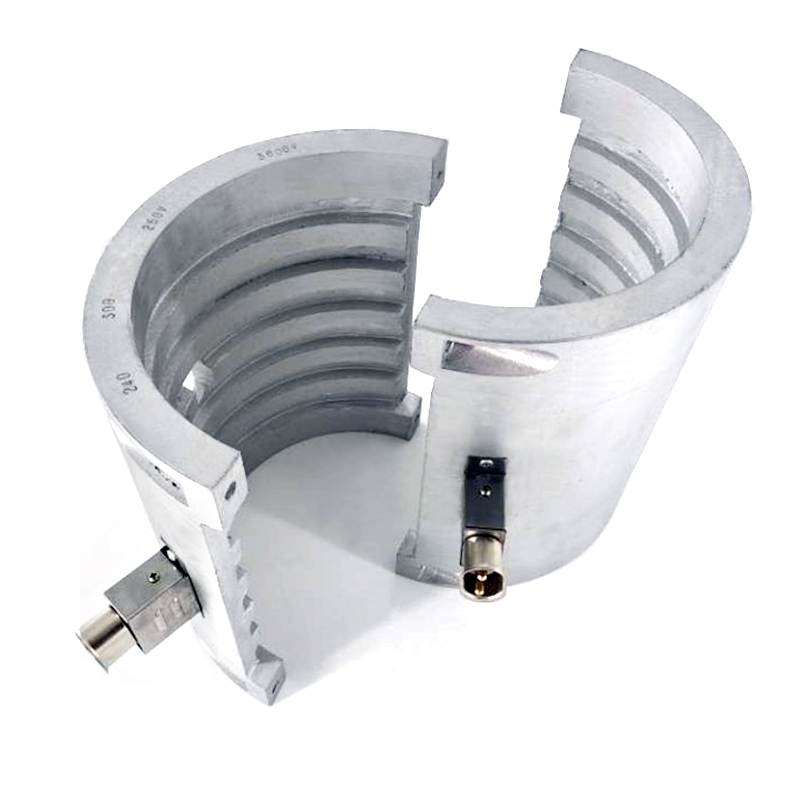
Streamlining a Request for Quotation (RFQ) for a custom cast in heater is vital for procurement specialists, B2B importers, and OEM equipment engineers seeking to prevent costly drawing revisions, sample delays, and dimensional mismatches during manufacturing. Cast heating elements provide structural durability and uniform thermal distribution for heavy extrusion barrels, die blocks, and packaging machinery. However, submitting incomplete engineering specifications often leads to extended sampling cycles and unexpected field failures.
By standardizing your drawing submission and technical parameter sheet, your engineering team can accelerate supplier response times, ensure precise physical fitment, and lock in consistent long-term heating performance.
1. Critical Technical Parameters for a Custom Cast in Heater RFQ
To accurately evaluate a custom cast in heater proposal, thermal manufacturers require complete electrical, dimensional, and thermodynamic boundaries.
Calculating target surface watt density allows engineers to verify that the specified power rating aligns with the thermal conductivity of the chosen alloy:
Where:
- Wd = Surface watt density (W/cm²)
- P = Total electrical power rating (Watts)
- Aactive = Effective contact surface area (cm²)
When submitting an RFQ to specify cast aluminum heater units, procurement managers should provide these essential operational metrics:
- Operating Voltage & Wattage: Define target line voltage (e.g., 220V, 380V, 480V, 3-Phase) and total wattage per zone.
- Maximum Operating Temperature: Specify continuous working temperatures (e.g., 300°C for aluminum vs. 650°C for bronze).
- Dimensional & Machining Tolerances: Indicate precise inner diameter (ID), outer diameter (OD), width, and bolt hole locations (e.g., ISO H7 bore fit for tight barrel contact).
- Electrical Termination Style: Select junction boxes, threaded post studs, ceramic blocks, or flexible armored lead cables.
2. Engineering Drawing Checklist for Custom Cast in Heater Sourcing
Providing a comprehensive 2D CAD drawing and 3D step file drastically reduces lead times when managing a cast in heater manufacturer rfq. Use this specification checklist prior to submission:
| Drawing Parameter Category | Procurement Specification Requirement | Common Engineering Oversights |
| Geometry & Bore Fit | Inside Diameter (ID) tolerance, split-half gap allowance | Omitting barrel expansion gap allowances |
| Thermocouple Ports | Thread size (1/8 NPT, M10x1.0), depth, and angular position | Placing sensor wells too close to heating elements |
| Cooling Integration | Finned air-cooling design OR embedded stainless water tube OD | Unspecified fluid inlet/outlet connection fittings |
| Terminal Protection | NEMA 4 moisture-resistant OR explosion-proof terminal enclosure | Inadequate clearance space for machine guards |
| Surface Finish | Precision CNC machined inner bore surface (Ra 1.6 μm) | Rough cast finish resulting in high thermal contact resistance |
3. Alloy Selection and Quality Verification for Your Custom Cast in Heater
Selecting the proper casting alloy impacts both heat transfer speed and component lifespan. To ensure structural integrity, procurement managers should match application temperatures to alloy properties:
- Cast Aluminum (Alloy 319 / 356): Ideal for standard extrusion up to 350°C; offers high thermal conductivity and lower weight.
- Cast Bronze / Brass: Recommended for heavy die plates up to 650°C requiring high mechanical shock resistance and elevated pressure limits.
- Cast Iron: Suited for extreme high-temperature dies up to 700°C with high compressive load requirements.
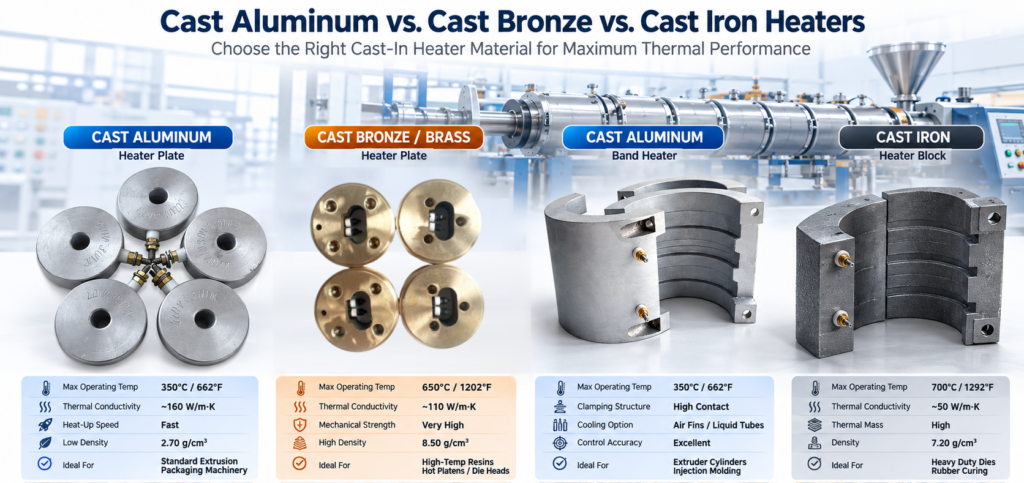
For a comprehensive breakdown of thermal conductivity and yield strength across casting metals, consult our technical guide on Cast-in Heater Material Selection Guide: Aluminum vs. Bronze vs. Iron. Furthermore, internal air voids severely compromise thermal transfer. To verify foundry quality standards during supplier audits, review How Porosity Affects Heat Transfer in Cast-in Heating Elements.
4. How to Streamline a Custom Cast in Heater Manufacturer RFQ Workflow
When preparing a technical inquiry for a custom cast in heater, follow this step-by-step procurement workflow:
- Define Barrel Cooling Method: Determine if the application requires forced air fins or internal liquid cooling loops as analyzed in Air Cooled Cast in Heater: Extruder Barrel Cooling Guide.
- Verify Watt Density Limits: Prevent premature sheath overload by checking safe watt density thresholds using our Understanding Watt Density: The Key to Preventing Premature Band Heater Failure
- Specify Installation Requirements: Ensure mounting straps and bolt torque specs align with our Band Heater Installation Guide: Clamping SOP for Long Life.
- Establish Quality Control Testing: Require suppliers to perform 100% dielectric high-pot tests, insulation resistance checks (Megger > 100 MΩ), and CMM dimensional inspection before dispatch.
For diagnosing field failure modes or troubleshooting short circuits across processing equipment, refer to Troubleshooting 101: 5 Common Causes of Band Heater Burn-Out. For smaller fluid-tight nozzle requirements, see Brass Nozzle Heater: Eliminating Plastic Leakage Downtime.
To review diagnostic guidelines across ceramic radiant heating systems, consult How Porosity Affects Heat Transfer in Cast-in Heating Elements.or explore our primary reference manual: Industrial Band Heaters: The Ultimate Engineering Guide to Selection, Efficiency & Troubleshooting (2026 Edition).