Accurately sizing a thermal system requires rigorous thermodynamic evaluation, making the cast in heater kw calculation critical for process engineers and project chiefs. Ensuring heavy machinery reaches operational temperatures within the designated ramp-up time without overloading electrical circuits requires precise engineering. Whether you are performing cast aluminum heater sizing for a plastics extrusion barrel or engineering a high-mass bronze platen, understanding the relationship between thermal mass, specific heat capacity, and power input is strictly required.
Hongtai Industry Heater relies on advanced thermodynamic formulas to execute every cast in heater kw calculation, ensuring optimal energy efficiency, rapid ramp-up times, and precise temperature control for custom industrial heating assemblies.
1. Material Specific Heat Capacity (Cp) & Thermal Mass
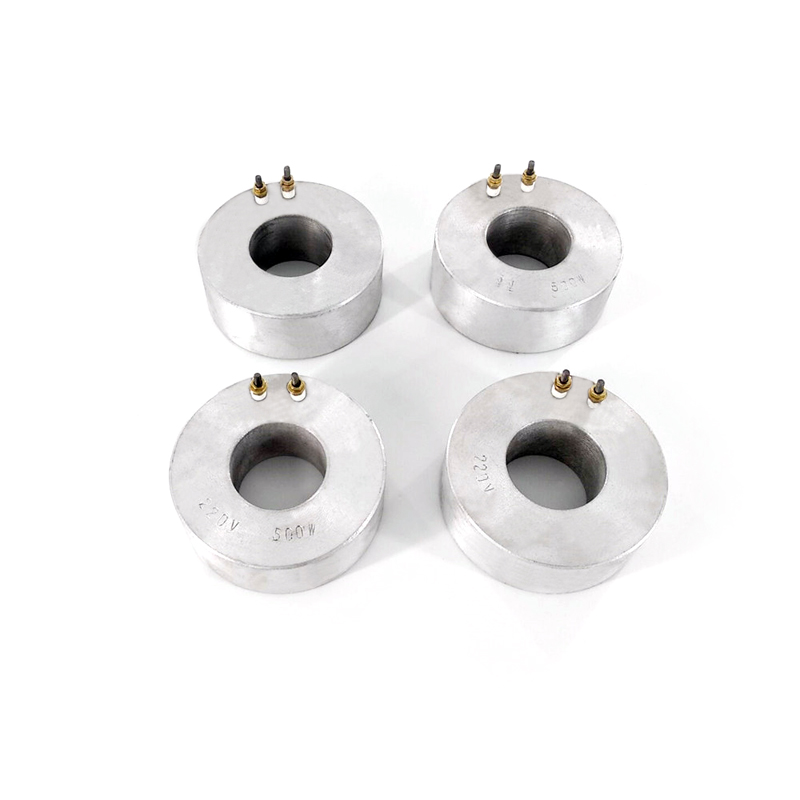
Before executing a cast in heater kw calculation, engineers must define the mass and material properties of both the heater itself and the load it intends to heat (e.g., the steel processing barrel). Every material requires a distinct amount of energy to raise its temperature by one degree, defined as its specific heat capacity (Cp).
- Cast Aluminum (A356): Cp ≈ 0.963 kJ/(kg·°C)
- Cast Bronze (CuSn10): Cp ≈ 0.380 kJ/(kg·°C)
- Carbon Steel (Processing Barrel): Cp ≈ 0.460 kJ/(kg·°C)
Because aluminum has a much higher specific heat capacity than bronze or steel, it requires more energy (kW) per kilogram to reach the same temperature. However, aluminum’s superior thermal conductivity ensures that this energy is transferred rapidly and uniformly to the processing equipment.
2. The Thermal Mass Heating Time Formula
To determine the exact power required to bring a system up to temperature within a specific timeframe, engineers use the foundational thermal mass heating time formula. This equation calculates the total sensible heat required and divides it by the allowable ramp-up time, factoring in system efficiency.
The baseline energy equation for a single material is
E = m · Cp · ΔT
To convert this energy requirement into electrical power (Kilowatts) over a specific time period, the full cast in heater kw calculation is expressed as
kW = (mheater · Cp(heater) + mload · Cp(load)) · ΔT 3600 · t · η
Where:
- kW = Total required power in Kilowatts
- m = Mass of the material (kg)
- Cp = Specific heat capacity of the material (kJ/kg·°C)
- ΔT = Required temperature rise (°C)
- 3600 = Conversion factor (seconds in an hour)
- t = Desired ramp-up time (Hours)
- η = System efficiency factor (Dimensionless)
3. Factoring in Efficiency (η) and Heat Loss
No industrial heating system is 100% efficient. During the ramp-up phase, a significant portion of the generated heat is lost to the ambient environment through natural convection and thermal radiation.
When finalizing your cast in heater kw calculation, the efficiency factor (η) acts as a critical safety margin:
- Well-Insulated Systems (e.g., heavily shrouded barrels): η = 0.80 to 0.85
- Uninsulated / Open-Air Systems: η = 0.50 to 0.60
- Standard Extrusion Lines: η ≈ 0.70
Failing to apply the correct efficiency factor will result in an undersized heater that may never reach the target setpoint, or take twice as long to achieve the necessary preheat state.
4. Engineering Calculation Example & Matrix
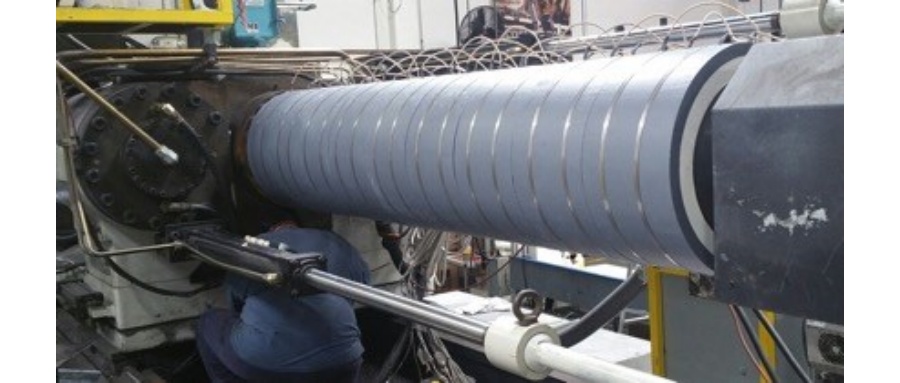
To illustrate a real-world cast in heater kw calculation, consider a standard scenario where a 25 kg cast aluminum heater is clamped to a 50 kg steel extruder barrel. The goal is to raise the system temperature from 20°C to 220°C (ΔT = 200°C) in exactly 1 hour, assuming a 70% efficiency rate (η = 0.7).
| Component | Mass (m) | Specific Heat (Cp) | Energy Required (E = m · Cp · ΔT) |
| Aluminum Heater | 25 kg | 0.963 kJ/(kg·°C) | 4,815 kJ |
| Steel Barrel | 50 kg | 0.460 kJ/(kg·°C) | 4,600 kJ |
| Total System Energy | N/A | N/A | 9,415 kJ |
Applying the formula:
kW = 9415 3600 · 1 · 0.7 = 9415 2520 ≈ 3.73 kW
For this specific zone, Hongtai Industry Heater engineers would recommend installing a 4.0 kW cast-in heater to comfortably meet the ramp-up requirements while providing a slight buffer for voltage fluctuations.
For complete thermodynamic property databases on industrial alloys, consult MatWeb Material Property Data and ISO Machinery Standards.
Industrial Heating Solutions from Hongtai Industry Heater
The thermal mass formulas and energy calculations detailed above are essential for designing reliable, high-performance processing equipment. Hongtai Industry Heater partners with OEM machinery builders and plant project engineers to perform exact cast in heater kw calculation audits, ensuring that every cast aluminum, bronze, or iron thermal unit is perfectly matched to your machinery’s mass and operational timeframe.
If you need engineering assistance with cast aluminum heater sizing, wattage distribution, or complete thermal system design,contact Hongtai Industry Heater’s engineering department directly for a comprehensive technical review and custom thermal design solution.
B2B Related Technical Resources
- Surface Optimization: Cast in Heater Surface Machining: Minimizing Thermal Contact Resistance
- Inspection & Verification: Quality Control Standards for Cast-in Heaters: Hi-Pot, Insulation, and X-Ray Inspection
- Mechanical Sizing & Fit:Clamping and Mounting Systems for Cast-in Heaters: Spring Loading vs. Bolt-On Design
- Maintenance Protocols: Cast-in Heater Maintenance Guide: Surface Cleaning and Thermal Compound Application
- High-Precision Applications: Precision Cast Heating Platen: Achieving ± 1 °C Uniformity for Semiconductor and Medical Equipment