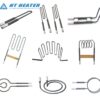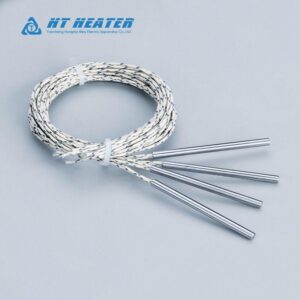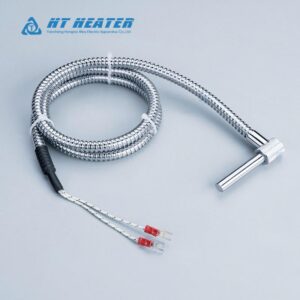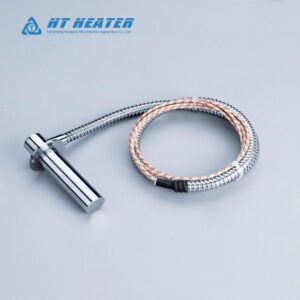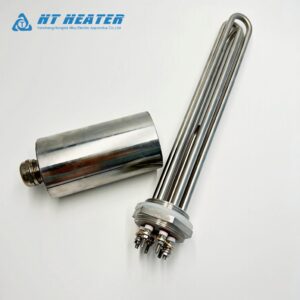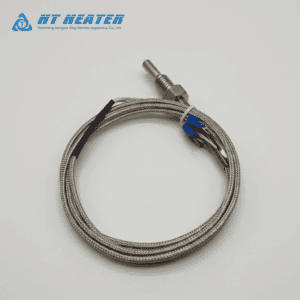
When running high-speed hot runner systems, there is zero room for temperature lag or cold spots. Integrating a precision sensor directly inside a Hongtai Coil Heater with Built-in Thermocouple eliminates messy external probe drilling while giving your PID controller instant, closed-loop feedback. Built with heavy-duty Incoloy sheathing and high-density compacted MgO, Hongtai heaters deliver bulletproof thermal contact and extended service life under continuous, high-cycle injection molding conditions.
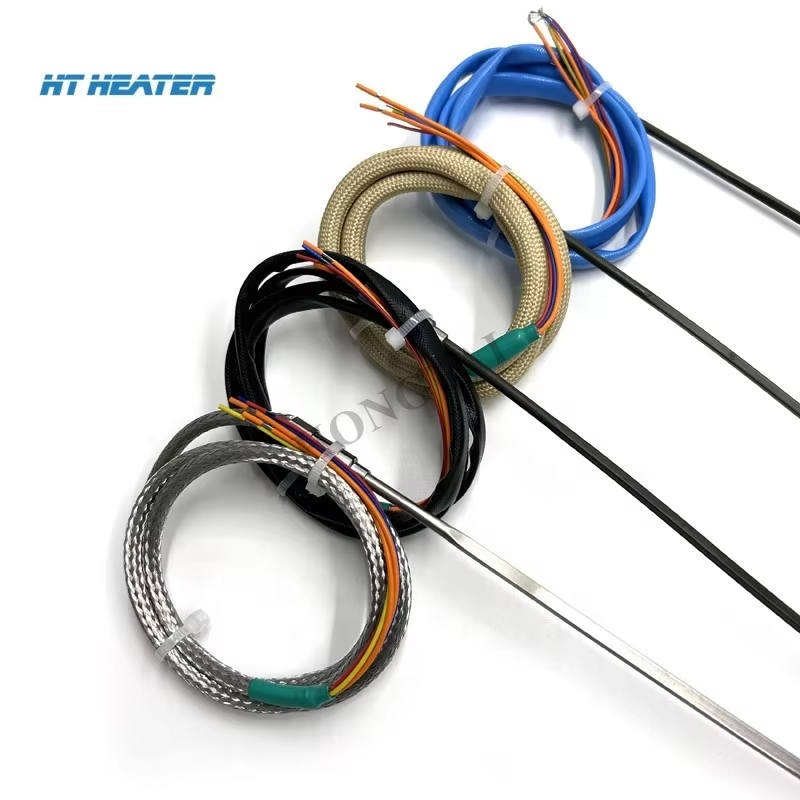
1.Type J vs. Type K: Which Thermocouple Calibration Fits Your Mold Setup?
Choosing between a hot runner type J thermocouple and a Type K sensor boils down to your processing temperature window and resin type. Hongtai precision-tunes both options so your controllers lock onto setpoints fast without temperature overshoot.
Type K (Chromel-Alumel): Purpose-built for high-heat engineering plastics such as PEEK, PEI, and PPS. Hongtai pairs Type K thermocouples with oxidation-resistant alloy sheaths to continuously withstand severe operating temps up to 1260°C (2300°F) without sensor drift.inuous heating up to 1260°C (2300°F). Essential for processing PEEK, PEI, and PPS resins.
Type J (Iron-Constantan): The go-to industry standard for commodity resins like PP, PE, PS, and ABS. A hot runner type J thermocouple embedded in a Hongtai coil provides ultra-responsive signal feedback up to 370°C (700°F)—delivering maximum sensitivity where standard molding temperatures live.
2.Axial vs. Radial Lead Exits: Eliminating Wire Fatigue in Tight Mold Cavities
Choosing the right coil heater wire exit (axial/radial) configuration during ordering is your best defense against wire pinching, flexural stress, and premature failure inside crowded mold plates.
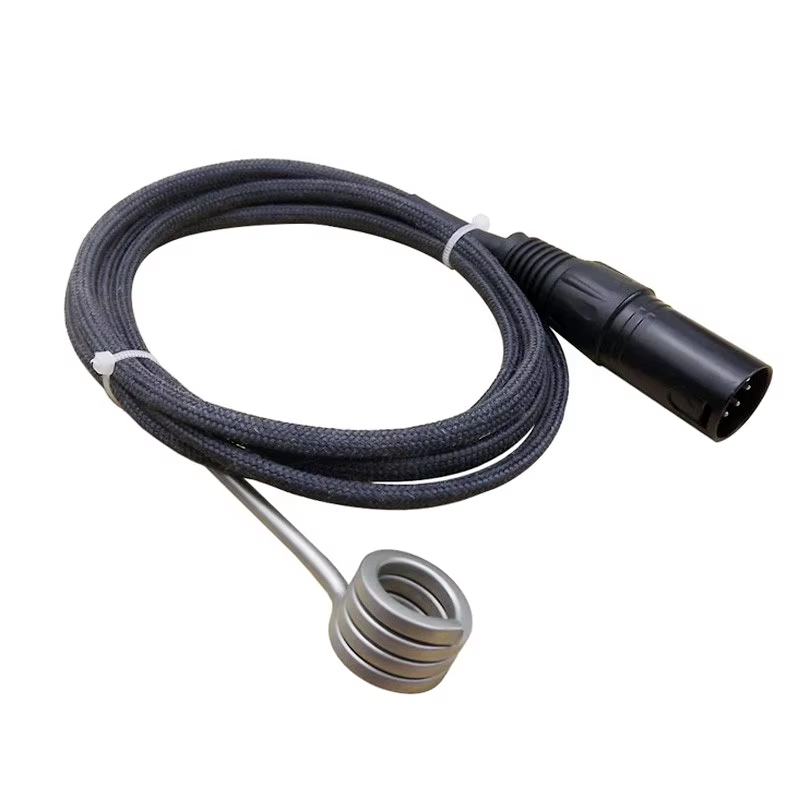
Axial Back Exit (180°): Power and sensor leads run straight out the back, parallel to the nozzle body. This coil heater wire exit (axial/radial) design keeps the radial footprint extremely compact—making it the ideal drop-in fit for deep mold pockets and close nozzle-to-nozzle centerlines. Reinforced with Hongtai’s 304 Stainless Steel flexible armor to handle thermal movement.
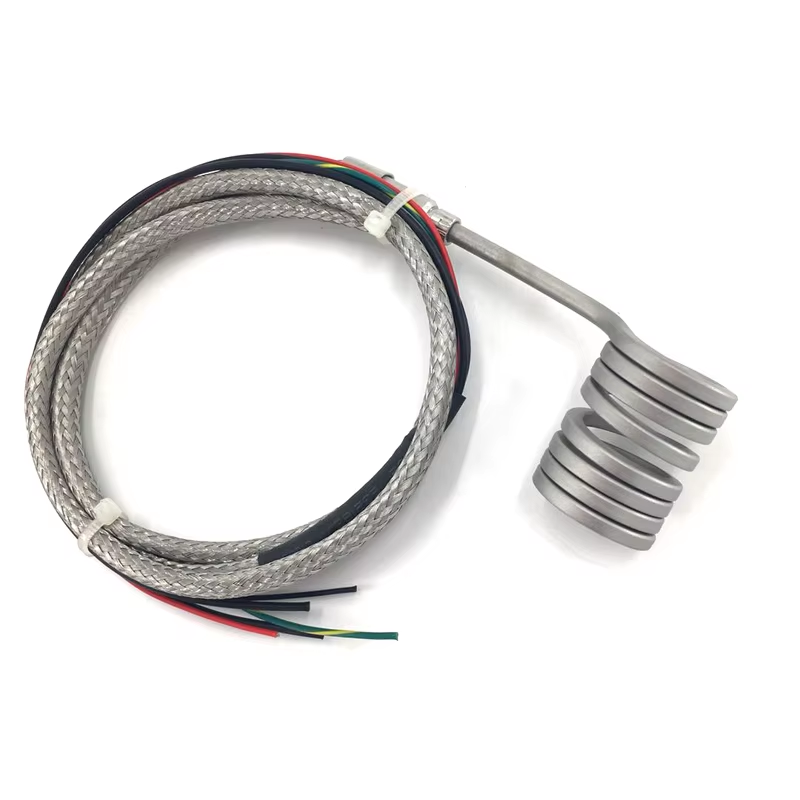
Radial Side Exit (90°): Leads exit at a right angle to the coil body. Perfect for molds with tight overhead clearance where top plates sit right above the nozzle head. Hongtai fits these exits with anti-kink strain relief springs and high-temp fiberglass sleeving to stop sharp wire bends.
Hongtai Heavy-Duty Transit Junction: The critical transition point between the rigid heater sheath and flexible leads is sealed with high-temperature potting compounds, standing strong against ambient mold pocket heat up to 260°C.
3.Grounded vs. Ungrounded Junctions: Speed vs. Electrical Noise Immunity
Hongtai Grounded Junction: The thermocouple tip is welded directly to the inner stainless/Incoloy sheath wall. This setup gives you lightning-fast response times (< 0.2 seconds)—perfect for high-speed gating where every fraction of a second counts.
Hongtai Ungrounded Junction: The sensing junction is completely isolated from the outer metal sheath inside compacted MgO powder. While response time is slightly slower (~ 0.5 seconds), it completely shields your PID controller from stray ground loops and electrical noise in complex multi-cavity manifolds.
4. Why Hongtai Integrated Coils Beat External Probes Hands Down
Upgrading to a Hongtai Coil Heater with Built-in Thermocouple eliminates extra mold machining, cuts wiring hassle in half, and guarantees exact heat placement at the nozzle tip.
| Feature / Performance Metric | External Probe + Separate Coil | Standard Commercial Coils | Hongtai HT Coil Heater with Built-in Thermocouple |
| Tooling Space Needed | High (Requires dedicated probe hole) | Standard Footprint | Ultra-Compact (Single integrated component) |
| Thermal Response Time | Slow (> 2.0s response lag) | Moderate (~ 0.8s) | Instant (< 0.2s Grounded / ~ 0.5s Ungrounded) |
| Built-In Sensor Options | None | Basic J-Type | Hongtai Calibrated Hot Runner Type J Thermocouple / Type K |
| Wire Exit Flexibility | Rigid / Fixed Routing | Standard Radial Only | Tailored Coil Heater Wire Exit (Axial/Radial) options |
| Sheath Metallurgy | Standard Stainless Steel | Commercial Grade | Heavy-Duty Incoloy 800 + High-Density MgO |
| Cable Protection | Exposed Wires | Basic Sleeving | Stainless Steel Armor Conduit + Strain Relief Springs |
5. What Wiring Standards and Thermocouple Color Codes Must Be Followed?
Reversing sensor polarity turns your heater setup upside down, causing your PID controller to misread temperature rises as drops. Always align leads with ANSI/IEC color standards before powering up.
| Calibration Type | Positive Conductor (+) | Negative Conductor (-) | Outer Jacket Color (ANSI / IEC) |
|---|---|---|---|
| Type J (Fe-CuNi) | Iron (Fe) — White | Constantan (CuNi) — Red | Black (ANSI) / Black (IEC) |
| Type K (NiCr-NiAl) | Chromel (NiCr) — Yellow | Alumel (NiAl) — Red | Yellow (ANSI) / Green (IEC) |
Note: Under ANSI standards, RED is ALWAYS negative. Hooking red to the positive terminal will cause temperature readings to plunge as the nozzle heats up.
6.How Do You Safely Wire and Test an HT Series Coil Heater with Built-In Sensor?
Follow Hongtai’s quick 6-step checklist during mold startup to prevent accidental sensor burnout and guarantee zero-downtime operation.
- Check Polarity & Location: Confirm sensor location (Tip, Center, or Rear) and verify wire colors for your hot runner type J thermocouple or Type K unit.
- Check Cold Resistance: Measure heater lead resistance with a digital multimeter to verify correct wattage rating against your power supply voltage.
- Run Megohmmeter Test: Test insulation resistance between heater power leads and ground using a 500V DC megohmmeter (must read higher than 5 MΩ).
- Verify Sensor Loop: Run a quick low-voltage continuity check across thermocouple leads to ensure no open circuits or loose crimps.
- Route Lead Wire Armor: Lay stainless armored conduits along mold wiring channels according to your chosen coil heater wire exit (axial/radial) orientation. Keep bend radii smooth (at least 5x armor diameter).
- Perform Controller Soft-Start: Run a 10-15 minute soft-start cycle at 50% power to drive out any ambient moisture from the element before cranking up to full operating temperature.
7. What Are the Frequently Asked Questions (FAQ) About Integrated Thermocouples?
Proper calibration selection and junction grounding eliminate PID error codes and ensure stable temperature profiles.
- Why choose Hongtai HT Coil Heaters for demanding hot runner tools?
- Hongtai combines precision CNC coil winding with high-density compacted MgO insulation and Incoloy alloys. This ensures tight zero-gap thermal contact with the nozzle, eliminating hot spots and premature heater burnouts.
- Where is the thermocouple sensor tip located inside the coil?
- In a coil heater with built-in thermocouple, Hongtai typically positions the sensor junction right at the nozzle tip (Head) for pinpoint gate temperature control, with custom Middle or Tail placements available upon request.
- Why is my temperature controller displaying a negative reading on warm-up?
- Your thermocouple wires are wired in reverse polarity. Swapping the positive (White/Yellow) and negative (Red) lead connections at the terminal block immediately fixes the issue.
- Which coil heater wire exit (axial/radial) works best for compact mold plates?
- An axial exit (180° back exit) is the best choice for narrow mold pockets because the cable exits straight back parallel to the nozzle, keeping side clearance as slim as possible.
8. What Related B2B Technical Resources Are Available?
- Thermal Distribution Design: Distributed Wattage Coil Heater Design & Temperature Profiles
- Sheath Metallurgy Selection:Sheath Materials for Hot Runner Coil Heaters: Stainless Steel vs. Nickel
- Cross-Section Selection:Hot Runner Coil Heater Cross Section: Round vs. Square vs. Rectangular
Custom Sensor Integration from Hongtai
Selecting the proper sensor calibration and wire exit geometry eliminates false PID alarms, protects signal integrity, and prevents costly mold downtime. Hongtai manufactures heavy-duty HT Coil Heater with Built-in Thermocouple units, providing custom hot runner type J thermocouple integrations and tailored coil heater wire exit (axial/radial) options to match your exact injection molding tool specifications.