Choosing the right cast in heater material is a critical engineering decision for plastics extrusion, blow molding, injection molding, die heating, sealing equipment, and industrial hot platens. The casting alloy affects heat transfer, thermal response, mechanical strength, thermal expansion, cooling integration, machining stability, and ultimately the service life of the heating assembly.Operating a heating assembly beyond its alloy-specific thermal limit leads to structural creep, core element deformation, and catastrophic thermal contact resistance.
Understanding the trade-offs between cast aluminum, cast bronze (brass), and cast iron enables mechanical design engineers and R&D specialists to match furnace-cast heating elements to specific temperature and pressure regimes.
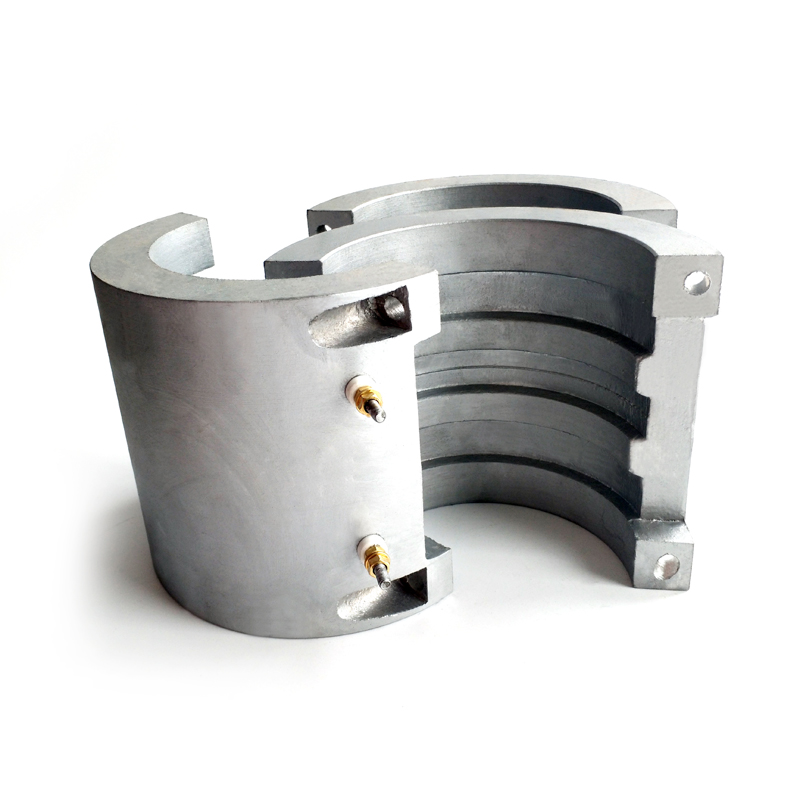
1. What Is a Cast-In Heater?
A cast-in heater integrates tubular resistance heating elements directly into a cast metal body.
Instead of relying only on mechanical contact between an external band heater and a barrel, the heating elements are embedded within a thermally conductive metal matrix.
The basic heat-transfer path is:
Electrical Power → Resistance Wire → Metal Sheath → Cast Metal Matrix → Machined Contact Surface → Barrel / Die / Platen → Process Material
The casting therefore performs two functions:
- Heat transfer
- Mechanical support
When properly designed and manufactured, the cast body distributes heat from the embedded elements over a larger surface area and helps reduce localized temperature gradients.
This is particularly valuable in applications where temperature uniformity is important, such as:
Custom heating jackets
Plastic extrusion barrels
Blow molding equipment
Injection molding machinery
Extrusion dies
Hot runner components
Heat sealing jaws
Hot platens
Rubber processing equipment
Industrial process heaters
2.Common Selection Categories of Cast in Heater Materials
Cast Aluminum vs. Bronze vs. Brass vs. Cast Iron
The following table provides a practical starting point for material selection.
| Property | Cast Aluminum | Cast Bronze | Cast Brass | Cast Iron |
|---|---|---|---|---|
| Typical Thermal Conductivity | High | Medium–High | Medium | Low–Medium |
| Typical Density | ~2.7 g/cm³ | ~8.5–9.0 g/cm³ | ~8.3–8.7 g/cm³ | ~7.0–7.5 g/cm³ |
| Thermal Response | Fast | Moderate | Moderate | Slow |
| Thermal Mass | Low | High | High | High |
| Mechanical Strength | Moderate | High | High | Very High |
| Resistance to Deformation | Moderate | High | High | Excellent |
| Thermal Expansion | Relatively High | Lower | Lower–Moderate | Low |
| Machinability | Excellent | Good | Excellent | Good |
| Typical Application | Standard plastics processing | High-temperature / high-load | Dies, platens, specialized tooling | Heavy-duty industrial service |
3. Thermal Conductivity and Limits in a Cast in Heater Assembly
The foundational function of a cast in heater is to encapsulate tubular heating elements inside a dense, precision-machined metal matrix, eliminating air gaps and hot spots:
3.1 Cast Aluminum (Max Operating Temp: ~350°C / 662°F):
Offers exceptional thermal conductivity (~160 W/m·K) and low mass density. It provides rapid heat-up and cool-down response, making it the industry standard for standard plastics processing (PE, PP, PS, ABS).
Typical aluminum alloys used for cast heating assemblies can provide thermal conductivity on the order of approximately 100–200 W/m·K, depending on alloy and processing condition.
However, exposing aluminum to temperatures above 380°C induces soft-annealing, structural sagging, and internal element shifting.
Cast aluminum is commonly considered for:
* PE extrusion
* PP extrusion
* PS processing
* ABS processing
* Packaging machinery
* Injection molding barrels
* Blow molding equipment
* Plastic processing dies
* Hot plates
* Machine platens
3.2 Cast Bronze (Max Operating Temp: ~650°C / 1202°F):
Cast bronze heaters are generally considered when mechanical strength and high-temperature dimensional stability are more important than low weight.
Delivers high mechanical strength and moderate thermal conductivity (~110 W/m·K). Cast bronze is engineered for high-temperature engineering thermoplastics (PEEK, PTFE, PEI) and high-vibration sealing jaws. It withstands intense clamping pressures without warping.
However,Bronze alloys typically have substantially higher density than aluminum, so a bronze heater contains considerably more thermal mass.
This can produce a slower thermal response, but the additional mass can also help resist rapid temperature fluctuations.
Cast bronze may be appropriate for:
High-temperature process equipment
* Engineering thermoplastics
* High-load dies
* Heavy-duty sealing equipment
* Specialized hot platens
* High-vibration machinery
* Applications requiring greater clamping integrity
3.2 Cast Brass (Max Operating Temp: ~650°C / 1202°F):
Cast brass is related to bronze but should not simply be treated as the same material.
Brass is primarily a copper-zinc alloy, while bronze generally refers to copper-based alloys containing tin and/or other alloying elements.
Cast brass offers good thermal conductivity, good machinability, good dimensional stability, high mechanical strength, good corrosion resistance for selected environments, and excellent suitability for precision-machined components.
For some heating applications, brass offers a useful compromise between aluminum and heavier high-strength casting materials.
Depending on the alloy and design, cast brass can be considered for:
* Hot platens
* Sealing jaws
* Specialized dies
* Injection molding tooling
* High-load thermal fixtures
* Compact industrial heaters
3.4 Cast Iron (Max Operating Temp: ~700°C / 1292°F):
Cast iron rovides high thermal mass and structural rigidity with lower thermal conductivity (~50 W/m·K).
Cast iron excels in severe heavy-duty industrial applications where extreme mechanical abrasion, structural loads, and high working temperatures render softer alloys impractical.
However, this lower conductivity is acceptable—and even advantageous—for severe industrial heating environments where high thermal mass, structural rigidity, and abrasion resistance are prioritized over a fast thermal response.
Typical Cast Iron Applications
Potential applications include:
* Heavy-duty dies
* Rubber processing
* Large industrial platens
* High-load tooling
* Industrial curing equipment
* Heavy machinery components
* High-abrasion environments
4. Cast Aluminum Heater vs Cast Bronze Heater Performance Analysis
When specifying an extruder cast in heater, balancing heating dynamics against thermal expansion stresses is critical. A cast aluminum heater vs cast bronze heater evaluation reveals distinct operational characteristics:
- Thermal Inertia & Control Response: Cast aluminum heats up to 45% faster than bronze due to higher thermal diffusivity. This allows closed-loop PID controllers to maintain tight barrel zone temperatures within ±1°C during continuous resin output.
- Compressive Strength & Clamping Integrity: Under continuous thermal cycling, aluminum exhibits greater thermal expansion. If mounting bolts loosen, an air gap forms between the barrel and the casting, raising thermal contact resistance. Cast bronze maintains structural integrity under heavy spring-loaded clamping torque, making it ideal for high-pressure die heads.
- Liquid & Air Cooling Integration: Aluminum castings easily incorporate cast-in stainless steel cooling tubes (for water/glycol loops) or external cooling fins (for forced-air shrouds) to counteract shear heating during high-speed extrusion.
Engineers evaluating surface thermal power limits across heavy-duty barrel heaters should review Understanding Watt Density: The Key to Preventing Premature Heater Failure for comparative heat flux methodologies.
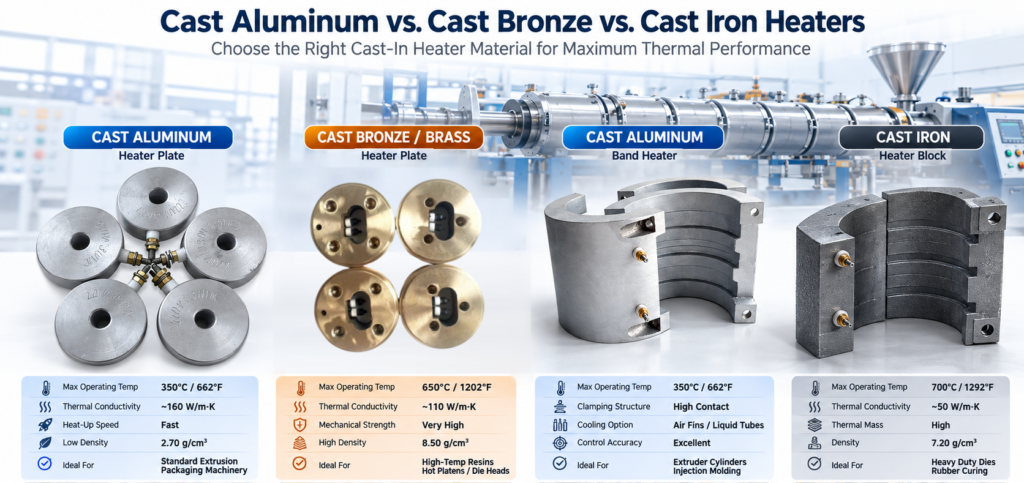
5. Technical Selection Matrix for an Extruder Cast in Heater
To streamline alloy selection for custom production lines, refer to the engineering comparison matrix below when configuring a cast in heater:
| Alloy Specification Parameter | Cast Aluminum | Cast Bronze / Brass | Cast Iron |
| Max Continuous Surface Temp | 350°C (662°F) | 650°C (1202°F) | 700°C (1292°F) |
| Thermal Conductivity (W/m·K) | ~160 | ~110 | ~50 |
| Density (g/cm³) | ~2.70 | ~8.50 | ~7.20 |
| Resistance to Structural Warping | Moderate | Very High | Excellent |
| Cooling Option Integration | Air Fins / Liquid Tubes | Liquid Tubes Only | Heavy Machined Channels |
| Primary Industrial Applications | Standard Extruders, Packaging | High-Temp Resins, Hot Platens | Heavy Duty Dies, Rubber Curing |
6. Practical Cast-In Heater Material Selection Guide
Selecting the ideal cast in heater material during initial machine design requires balancing thermal demand, mechanical stress, and heat dissipation dynamics. Follow this 5-step engineering sequence to determine the optimal alloy and heater configuration:
1. Establish the True Operating Thermal Profile
Never rely solely on the target resin or process temperature. Accurately map the full thermal envelope across all operating states:
- Operating Deltas: Account for the temperature gradient between the internal heating core, the casting body, and the working barrel surface.
- Transient Conditions: Factor in start-up ramp rates, continuous operating setpoints, and thermal overshoot during emergency shutdowns.
2. Assess Mechanical Loads and Physical Stress
Evaluate the structural demands placed on the casting during continuous operation:
- Clamping Torque & Expansion: Determine whether bolt-down forces will induce structural creep or thermal warping over repeated heating cycles.
- Vibration & Impact: High-vibration applications (such as die heads and sealing jaws) demand higher structural strength, making bronze or brass preferable to softer alloys.
- Dimensional Rigidity: Verify if the heater body functions as a load-bearing interface requiring strict dimensional stability.
3. Define Thermal Response and Control Dynamics
Match the material’s thermal mass to your control priorities:
- Fast Response (Cast Aluminum): High thermal conductivity (~160 W/m·K) and low density enable rapid heat-up times and agile closed-loop PID adjustments.
- High Thermal Mass (Bronze, Brass, Cast Iron): Greater density dampens temperature fluctuations, providing thermal stability for high-temperature or heavy-duty environments.
4. Integrate Cooling Requirements
Determine how heat will be extracted during exothermic or high-shear processing:
- Air Cooling: External fins or forced-air shrouds provide simple, reliable heat removal for standard extrusion zones.
- Liquid Cooling: Stainless steel cooling tubes cast directly alongside the element core deliver high-capacity, rapid thermal drawdown.
5. Verify Safe Watt Density and Heat Dissipation
Calculate total power density (W/in2 orW/cm2) based on the effective surface contact area. Ensure that the selected alloy, element layout, and cooling system can safely conduct heat away from the core elements without causing localized overheating or premature element burnout.
7. Hongtai Engineering Standards & Precision Manufacturing
To ensure maximum service life and eliminate premature failures, Hongtai applies rigorous manufacturing controls across all custom cast-in heater assemblies:
- Precision CNC Surface Machining: Ensure the inner contact radius is CNC-bored to match barrel outer diameter tolerances (within ±0.05 mm) to eliminate insulating air pockets.
- Spring-Loaded Clamping Bolts: Utilize heavy-duty spring washers on clamping studs to automatically compensate for thermal expansion and contraction during ramp-up cycles.
- X-Ray Porosity Inspection: Verify that custom castings undergo non-destructive X-ray inspection to confirm zero internal voids or air pockets around the internal tubular elements.
For additional guidance on selecting heavy-duty heating elements and troubleshooting premature thermal failure, consult Troubleshooting 101: 5 Common Causes of Band Heater Burn-Out or explore our primary technical reference: Industrial Band Heaters: The Ultimate Engineering Guide to Selection, Efficiency & Troubleshooting (2026 Edition).
8. Common Cast-In Heater Design Mistakes
- Selecting Alloy Only by Maximum Temperature:A material’s temperature capability is not the only selection criterion.Evaluate:Temperature + Strength + Expansion + Conductivity + Thermal Cycling**
- Using Excessive Watt Density:Higher power density does not automatically mean faster overall processing.Poorly distributed power can create hot spots and shorten element life.
- Ignoring Thermal Expansion:A rigid mounting system may become overloaded as the heater heats.Allow for thermal movement and maintain appropriate contact pressure.
- Poor Barrel-to-Heater Contact:An improperly machined contact surface can introduce air gaps and increase thermal resistance.
- Ignoring Casting Defects:Internal porosity near tubular heating elements can create localized thermal and mechanical problems.Critical castings should be inspected using an appropriate NDT method.
- Selecting the Alloy Without Considering Cooling:A high-output heater may require integrated cooling to maintain the desired process temperature.
- Treating Bronze and Brass as Identical:They are different alloy families.The exact alloy grade should be specified for engineering-critical applications.
Partner with Hongtai for Custom B2B Heating Solutions
Whether you require replacement extruder band heaters, liquid-cooled cooling jackets, or high-temperature custom die heaters, Hongtai delivers engineered thermal components manufactured to precise OEM specifications.
- Explore our full product line and technical specifications at the Hongtai B2B Thermal Components Catalog.
- Have a custom CAD drawing or engineering inquiry? Contact Hongtai Application Engineers today for a technical review and factory-direct quotation.