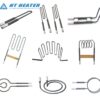
Troubleshooting hot runner coil heaters requires a structured diagnostic approach to identify whether heating failures stem from element burnout, insulation degradation, or severe current leakage. Unexpected heating failures on injection molding lines cost processing plants thousands of dollars per hour in unscheduled downtime and ruined melt batches. Simply replacing burnt-out heaters without isolating the root cause often leads to repeated failures on the same mold nozzle.
At Hongtai Industry Heater, our engineering team analyzes field-returned hot runner heaters to isolate why elements fail under continuous 24/7 operating stress. This guide provides maintenance managers and field engineers with a systematic troubleshooting decision tree and corrective actions to permanently resolve insulation failure on production floors.
1. What is a Hot Runner Coil Heater
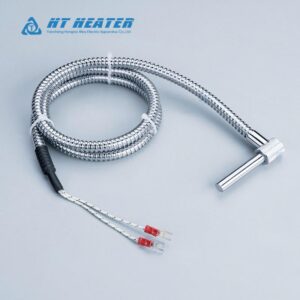
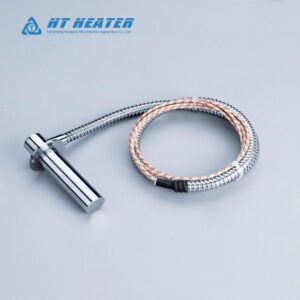
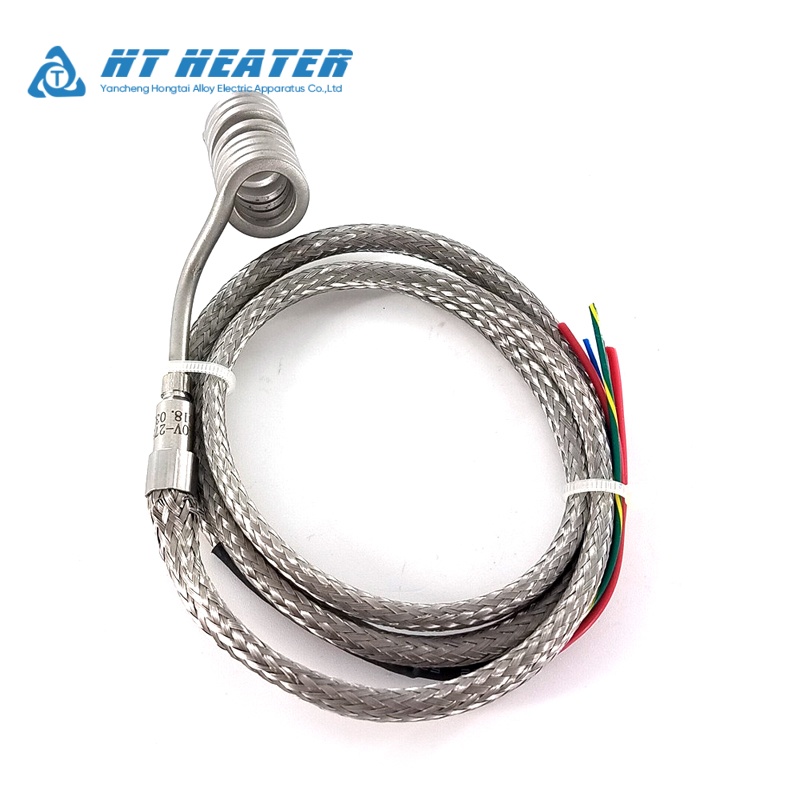
A hot runner coil heater (also known as a cable heater) is a compact, high-watt-density heating element designed to wrap tightly around injection molding nozzles or manifold plates. Constructed with an internal nickel-chromium (80/20 NiCr) resistance coil surrounded by compacted Magnesium Oxide (MgO) insulation inside a stainless steel or Incoloy sheath, it delivers precise thermal transfer to maintain polymer melt temperatures during production.
2. Primary Failure Root Causes: Dry Burning, Contamination, and Lead Fatigue
Physical inspection of failed heaters reveals three dominant failure modes responsible for more than 85% of field breakdowns:
Dry Burning and Air Gap Thermal Resistance
An improper fit between the nozzle body and the heater inner diameter (ID) leaves micro-air gaps. Air acts as an insulator (k ≈ 0.026 W/(m·K)), blocking conduction into the tool steel. The internal 80/20 NiCr resistance wire rapidly overheats past 1200°C, leading to localized element melt-off. High-watt-density applications require precision ID tolerance or encapsulated pressed-in brass coil heaters to guarantee 360° thermal contact.
Resin Blowback and Plastic Contamination
Failed nozzle tip seals allow molten resin (such as PA66, PBT, or PC) to flood the runner cavity. High operating temperatures carbonize the polymer into conductive carbon tracks across unsealed transition headers. This carbon bridge creates an immediate ground fault path, causing heater current leakage and dielectric breakdown.
Lead Root Transition Short Circuits
Repeated mechanical flexing during mold assembly or continuous mold clamping shocks strains the joint where cold nickel leads connect to the internal resistance coil. Bending coil heater lead wires directly at the transition ceramic collar damages the internal weld, leading to arcing and open-circuit failure.
3. Systematic Troubleshooting Tree for Maintenance Engineers
Follow this diagnostic decision matrix when troubleshooting hot runner coil heaters displaying erratic temperature readings or tripped electrical breakers:
| Diagnostic Step | Tool / Instrument | Target Benchmark | Measured Result | Root Cause & Corrective Action |
|---|---|---|---|---|
| Step 1: Cold Resistance Test | Digital Multimeter across lead terminals | R = V² / P (±5% to 10%) | ∞ Ω (Open) | Broken internal nickel wire or sheared lead joint. Replace heater unit (Model: Hongtai HT-CL-Series). |
| 0 Ω (Short) | Internal coil shorted across turns. Check for physical sheath deformation. | |||
| Step 2: Cold Megohm Insulation Test | Megohmmeter (500V DC) from lead to outer sheath | > 500 MΩ (Cold) | < 0.5 MΩ | Severe moisture ingress or carbonized plastic track. Perform soft-start bakeout. |
| 0 MΩ (Dead Ground) | Dielectric puncture through Magnesium Oxide (MgO) wall. Permanent sheath damage; replace heater. | |||
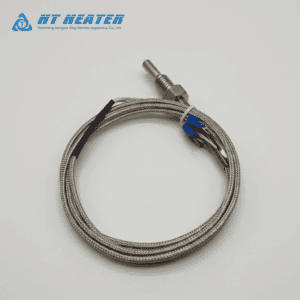
| Step 3: Thermocouple Continuity | Multimeter across TC leads (+ / -) | Type J: ≈ 1.0–2.5 Ω Type K: ≈ 2.0–4.5 Ω |
Reverse Polarity | PID hunting / runaway. Swap TC lead terminals. Verify against Type J or Type K thermocouple compensation wires specs. |
4 Dielectric Insulation Recovery & Soft-Start Protocol
Magnesium Oxide (MgO) powder inside the sheath provides high thermal conductivity and dielectric strength. However, unsealed MgO is hygroscopic and absorbs atmospheric moisture during storage or shipping. Absorbed water drops insulation resistance below safe thresholds, triggering GFCI breakers upon full power application.
Soft-Start Preheat Bakeout Procedure
If a Megohmmeter reading registers between 1 MΩ and 5 MΩ, do not apply full operating voltage. Execute this recovery protocol on your PID controller:
- Set controller output limit to 20%–30% duty cycle (or 80V–100V AC output).
- Maintain a bakeout temperature of 100°C to 120°C for 20 to 30 minutes.
- Allow trapped water vapor to vent out through the lead exit.
- Re-test insulation resistance at 500V DC. Once resistance exceeds 100 MΩ, increase to full operational setpoint.
5. Preventive Maintenance Protocol for Tooling Engineers
Implementing proper handling guidelines during mold setup prevents catastrophic insulation failure and extends component operating life:
- Enforce Correct Fit Tolerances: Ensure nozzle outer diameter and heater inner diameter match specified tolerances. Never force-hammer a tight heater onto a nozzle sheath; use anti-seize thermal paste sparingly.
- Specify Robust Sheath Metallurgy: Select Incoloy 800 and Stainless Steel sheath materials engineered to resist high-temperature oxidation up to 800°C.
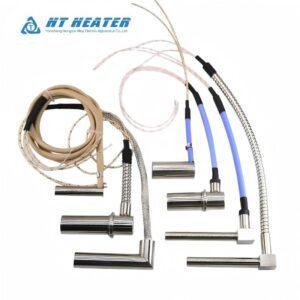
- Protect Lead Exits from Plastic Leakage: Upgrade to flexible stainless steel armor cable (
Hongtai HT-CLW-ARM) or potted ceramic seals when running high-pressure engineering resins susceptible to flashing. - Torque Control on Terminals: Tighten wiring terminal screws to manufacturer specifications. Loose connection
Contact Hongtai for Technical Support & Heavy-Duty Replacement Heaters
Tired of frequent heater burnouts interrupting your production cycles?Hongtai Industry Heater supplies premium-grade hot runner coil heaters with moisture-sealed headers, custom watt distributions, and high-density compaction for global injection molders.
Contact Our Engineering Team
Ready to upgrade your mold harness layout or need factory-direct replacement heaters?
Contact Hongtai for Coil heater lead wires selection guide.
What Related B2B Technical Resources Are Available?
- Sensor Integration: HT Coil Heater with Built-in Thermocouple: Type J vs. K & Lead Exit Selection Guide
- Thermal Distribution Design: Distributed Wattage Coil Heater Design & Temperature Profiles
- Sheath Metallurgy Selection:Sheath Materials for Hot Runner Coil Heaters: Stainless Steel vs. Nickel
- Cross-Section Selection:Hot Runner Coil Heater Cross Section: Round vs. Square vs. Rectangular