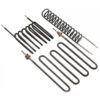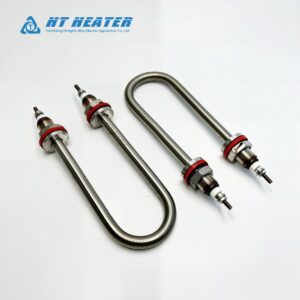
At Hongtai Heater Factory, we frequently remind equipment maintenance managers and after-sales service engineers that simply replacing a failed heating element without determining the root cause guarantees that the replacement will fail the exact same way. Effective failure analysis requires a systematic approach: correlating physical symptoms with electrical diagnostic tests and operational history.
Below is an engineering-level guide for troubleshooting tubular heaters, detailing how initial process anomalies cascade into catastrophic element failures.
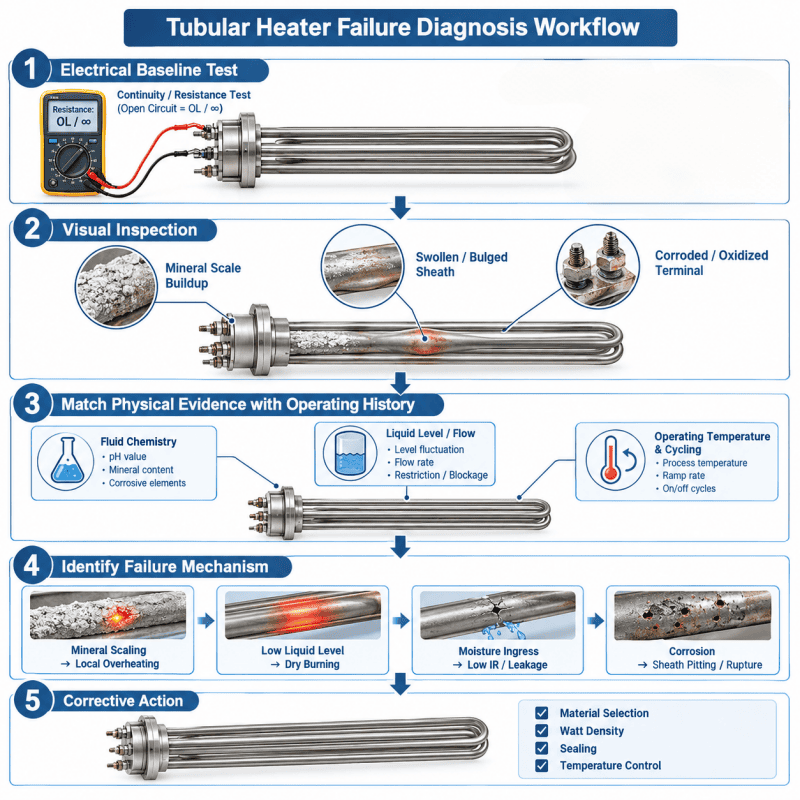
1.Diagnostic Testing: The First Steps of Failure Analysis
Before removing the heater from the vessel, establish a baseline using standard diagnostic tools:
- Continuity / Resistance Test: An “OL” (Open Loop) or infinite reading indicates a broken internal resistance wire (Open Circuit).
- Insulation Resistance (Megger) Test: Tests the integrity of the MgO dielectric insulation between the internal wire and the outer sheath.
- Visual Inspection: Look for localized discoloration, pitting, terminal oxidation, or physical swelling.
2.Mineral Scaling vs. Dry Firing (Localized Overheating)
A common misconception in fluid heating is confusing mineral scaling with a dry firing failure. While both cause severe overheating, the mechanisms are distinct.
Dry Firing occurs when the active heated section is exposed to air or insufficient fluid cooling due to low liquid levels.
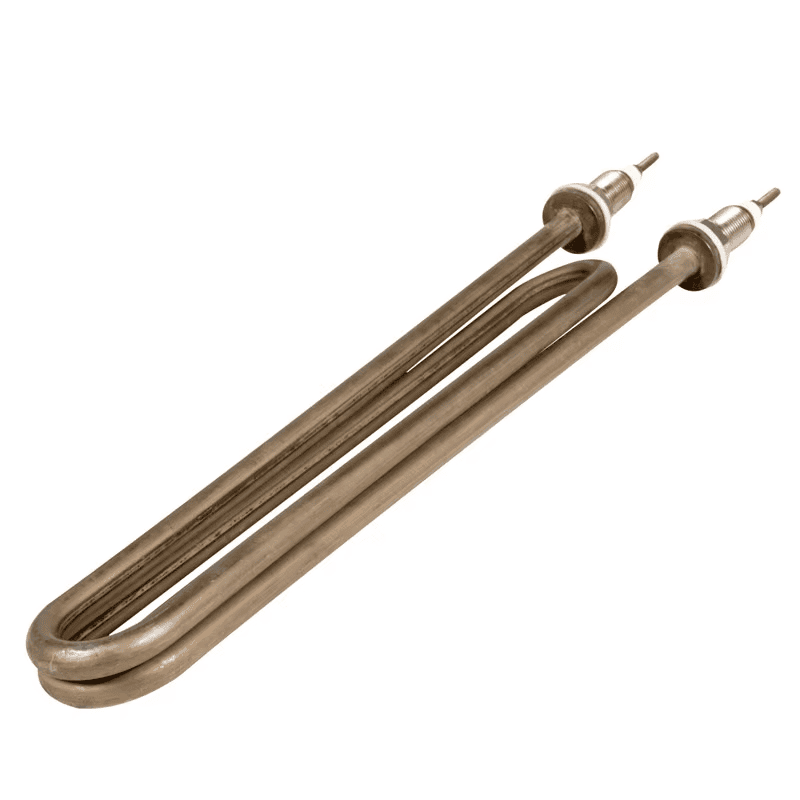
Mineral scale accumulation, however, occurs while the heater is fully submerged. When heating hard water or chemical solutions, dissolved minerals precipitate and form a hard crust on the sheath.
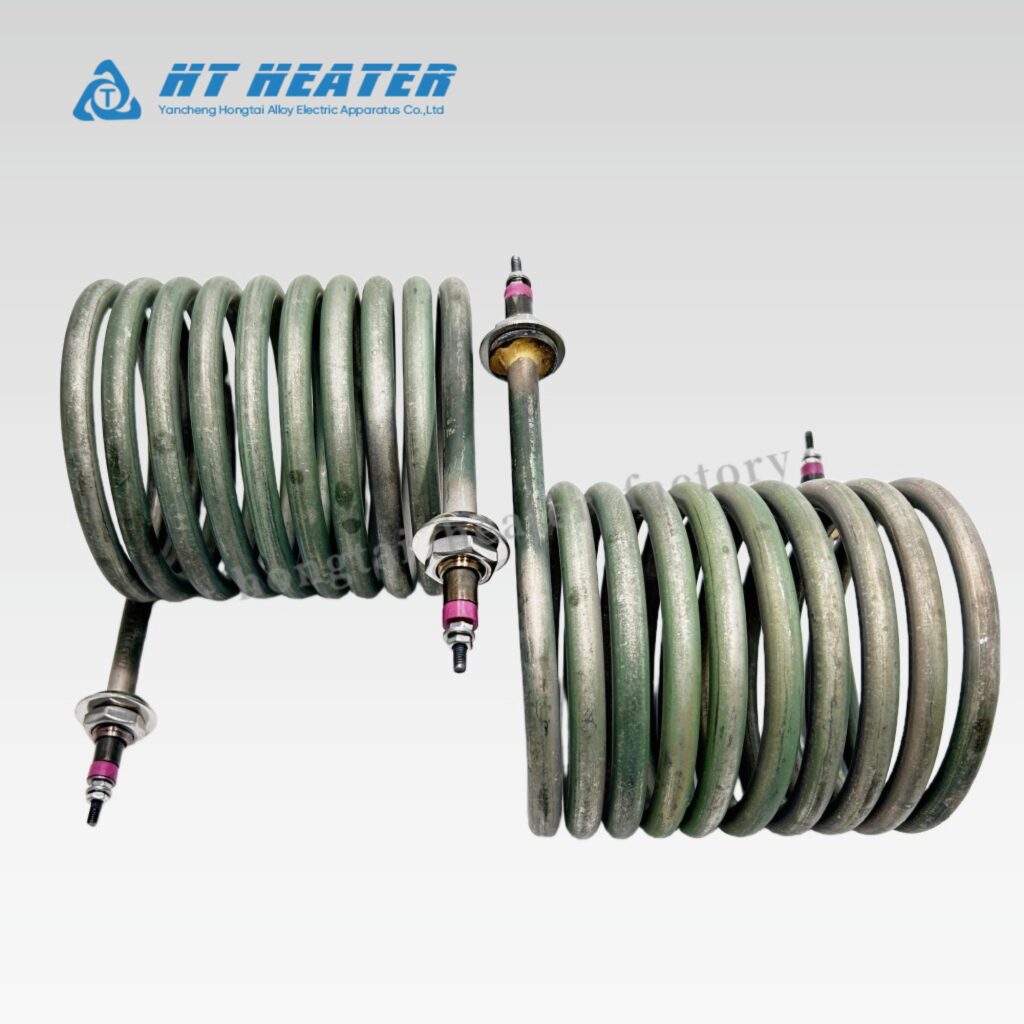
- Process Temp ≠ Sheath Temp: Scale acts as a dense thermal barrier. Even if the process fluid is only 80°C, the scale traps the generated heat, causing the localized sheath temperature to spike hundreds of degrees beyond its design limit.
- The Watt Density Factor: Lowering the element’s watt density helps reduce the initial sheath temperature, which slows down mineral precipitation. However, it does not cure an underlying fluid contamination issue. To properly size surface loads, refer to our watt density selection guidelines.
3.Sheath Rupture and Corrosion
A tubular heater sheath rupture (where the tube bulges or splits) is rarely a singular event; it is usually a late-stage symptom of prolonged operational stress.
When a sheath splits, it exposes the internal Magnesium Oxide (MgO) insulation to the process fluid, causing an immediate ground fault. A clean, swollen longitudinal split often points to extreme internal pressure and overheating (typically resulting from severe scaling or dry firing). Conversely, microscopic pinholes or a porous, discolored surface indicate chemical attack.
Corrective Action: Do not rely on visual inspection alone. Correlate the rupture with fluid chemistry and verify if the sheath material and internal construction were properly specified by Hongtai Heater Factory for your corrosive environment.
4.Low Insulation Resistance and Current Leakage
If a system’s Ground Fault Circuit Interrupter (GFCI), RCD, or insulation monitoring device repeatedly trips, the heater is likely suffering from current leakage.
MgO insulation is highly hygroscopic. If exposed to high humidity or washdown environments, moisture migrates past the terminal seals, lowering the insulation resistance (IR). This allows leakage current to pass from the resistance circuit to the grounded metal sheath, eventually leading to a catastrophic dielectric breakdown or electrical arc.
- The 1 Megohm Guideline: While a reading below 1 MΩ at 500 VDC is commonly treated as a warning threshold, acceptable IR varies by temperature and manufacturer specification.
- Bake-Out Procedures: If low IR is strictly due to moisture absorption at the terminal root and the heater remains mechanically intact, a controlled bake-out in an industrial oven can sometimes drive out the moisture. However, if the sheath is breached or carbon tracking has occurred, the element must be replaced. Prevent moisture ingress by utilizing appropriate tubular heater terminal seals.
5.Open Circuit (Broken Resistance Wire)
If the heater draws zero current but the breaker hasn’t tripped, the internal Nichrome resistance wire has severed. This open circuit is typically caused by:
- Extreme localized overheating melting the wire (often due to scaling).
- High-frequency machine vibration causing mechanical fatigue.
- Thermal cycling stress fracturing the wire over time.
6.Terminal Overheating and Connection Failure
Not all failures occur inside the vessel. Discolored, melted, or oxidized terminal hardware indicates high contact resistance. This happens when mechanical nuts are insufficiently torqued, standard copper ring terminals oxidize in high-ambient zones, or the heater’s unheated “cold zone” is incorrectly sized. To ensure secure connections, follow standard practices for tubular heater terminations .
Tubular Heater Failure Evidence Matrix
Use the matrix below to correlate physical evidence with potential root causes during your field diagnosis.
| Observed Symptom / Evidence | Potential Root Cause | Recommended Diagnostic Check |
| Heavy Chalky/Rocky Crust | Mineral scale accumulation | Visual inspection; verify fluid chemistry and watt density. |
| Bulged or Swollen Sheath | Severe localized overheating | Check for scale buildup, low liquid level, or restricted flow. |
| Longitudinal Split / Rupture | Tubular heater sheath rupture | Cross-reference operating temps; test for dead ground fault. |
| Pinholes or Pitting | Chemical corrosion / Material incompatibility | Analyze fluid pH and verify sheath metallurgy. |
| Low Megger Reading (Low IR) | Moisture ingress / Dielectric degradation | Perform Cold IR test; check terminal seals for environmental exposure. |
| “OL” Resistance (Zero Amps) | Broken internal wire (Open Circuit) | Verify supply voltage; check for vibration or thermal fatigue. |
Need Expert Failure Analysis?
Stop treating symptoms and start engineering solutions. If your facility is experiencing repeated element burnouts, ground faults, or premature sheath ruptures, Hongtai Heater Factory provides comprehensive failure analysis. We re-engineer custom tubular heaters with upgraded alloys, optimized watt densities, and specialized terminal seals to withstand your exact process environment.
- Consult our Engineers: Send your wiring schematics to the Hongtai Heater Factory technical team for a free design review.
- Visit Us:: www.hongtai-heater.com