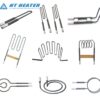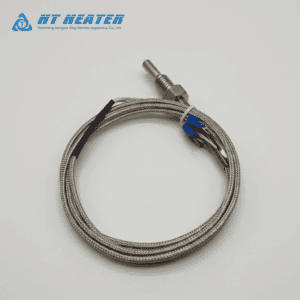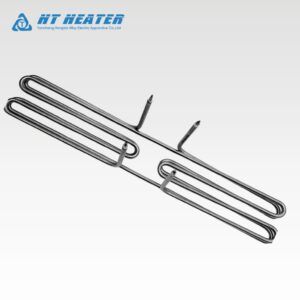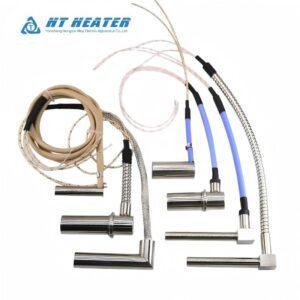
When performing hot runner coil heater troubleshooting, achieving consistent plasticization and leak-free performance requires viewing the heating element as part of a complete thermal system. A premature heater burnout is rarely caused by an isolated component defect; it is typically the result of interconnected interactions between internal wire metallurgy, nozzle fit tolerances, thermal expansion differentials, thermocouple feedback placement, and lead protection.
At Hongtai Industry Heater, we engineer high-performance heating solutions that bridge the gap between basic product specs and real-world mold reliability. This comprehensive B2B engineering guide provides a complete decision framework for selecting, calculating, installing, testing, and troubleshooting industrial hot runner coil heaters.
1. What Is a Hot Runner Coil Heater?
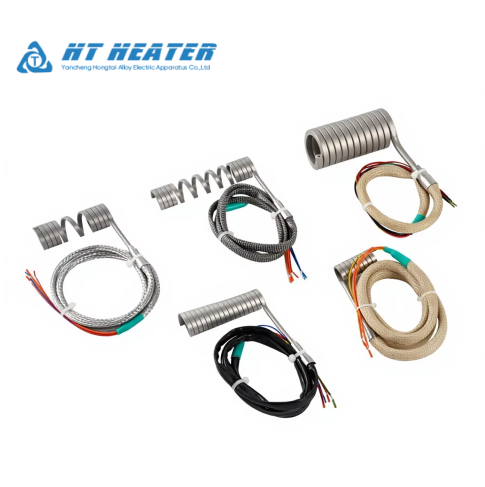
A hot runner coil heater is a compact, high-watt-density electrical resistance heater designed to slip over injection molding nozzles or press into manifold blocks. Its primary function is maintaining molten polymer at an exact processing temperature from the machine barrel nozzle to the mold cavity gate.
Unlike standard cartridge or band heaters, coil heaters are constructed with high flexibility to allow coiling around cylindrical nozzles while providing uniform heat flux in restricted spatial envelopes within the mold base.
2. Coil Heater Internal Construction
Understanding the internal construction of a coil heater explains why improper handling or electrical spikes lead to rapid failure:
- Resistance Core Wire: High-grade 80/20 Nickel-Chromium (NiCr) wire provides consistent electrical resistance and oxidation stability up to 1200°C.
- Dielectric Insulation: Highly compacted, pure Magnesium Oxide (MgO) powder surrounds the resistance wire, transferring thermal energy away from the core wire to the outer sheath while maintaining electrical resistance.
- Outer Sheath Metal: Stainless steel (304/321) or Incoloy 800/840 shields internal layers from mechanical damage and corrosive plastic outgassing.
3. Standard Coil vs. Pressed-In Brass vs. Cast-In Heaters
Choosing the right heater architecture from Hongtai Industry Heater depends on injection pressure, operating temperature, and plastic leakage risks:
| Heater Technology | Thermal Transfer Efficiency | Plastic Leakage Defense | Mechanical Durability | Replacement Ease |
| Standard Open Coil | Moderate (Line contact) | Low (Resin fouls open coils) | Moderate | Fast & Easy |
| Pressed-In Brass | High (360° Conduction) | High (Solid brass barrier) | High | Moderate |
| Cast-In Brass/Bronze | Maximum (100% Metal Seal) | Absolute (Seamless body) | Maximum | Requires full sleeve swap |
4. Dimensional Sizing & Watt Density Calculation
To size a replacement or custom heater, accurately measure four core parameters:
- Inner Diameter (ID): Must match nozzle Outer Diameter (OD) plus specific cold clearance allowances.
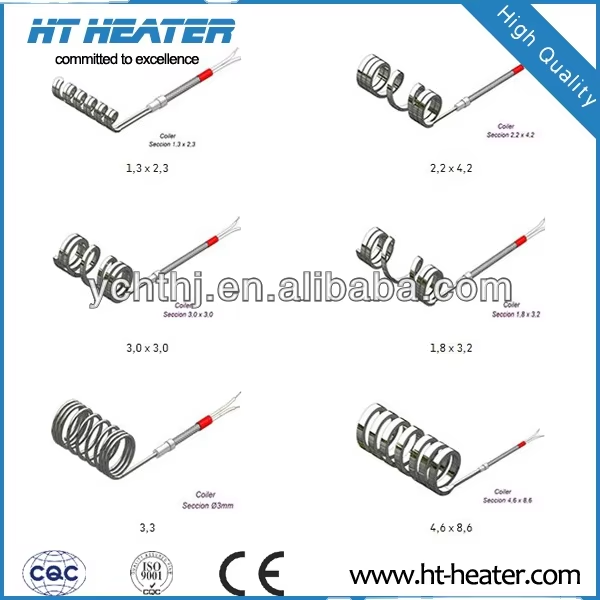
- Outer Diameter (OD) / Profile Cross-Section: Round (Ø 3.0mm, Ø 4.0mm), Square (3.0 × 3.0mm, 3.2 × 3.2mm), or Rectangular (2.2 × 4.2mm). Square and rectangular profiles increase contact surface area by up to 70%.
- Heated Length (Lh): The active axial length of the nozzle requiring heat coverage.
- Wattage (P) & Voltage (V): Matched to nozzle mass, target processing temperature, and cycle time ramping.
Watt density (Wd) dictates how hard the internal resistance wire is driven. Exceeding recommended watt density limits causes rapid internal dielectric breakdown.
Calculate watt density using the uncoiled heated length (Luncoiled) and sheath surface area:
Wd = P π · dsheath · Luncoiled
Where:
- P = Total Heater Wattage (W)
- dsheath = Diameter or cross-sectional width of the heater profile (cm)
- Luncoiled = Straight uncoiled length of the active heating wire (cm)
Safety Threshold: For standard hot runner applications, maintain watt density below 8.0 W/cm² (51.6 W/in²) to prevent localized overheat spots.
5. Designing a Distributed Wattage Heat Profile
Injection nozzles lose significant thermal energy at their extremities—the rear nozzle head transfers heat into the cold manifold block, while the front tip loses heat to the water-cooled mold cavity plate. A uniform-pitch heater causes a saddle-shaped temperature drop at both ends.
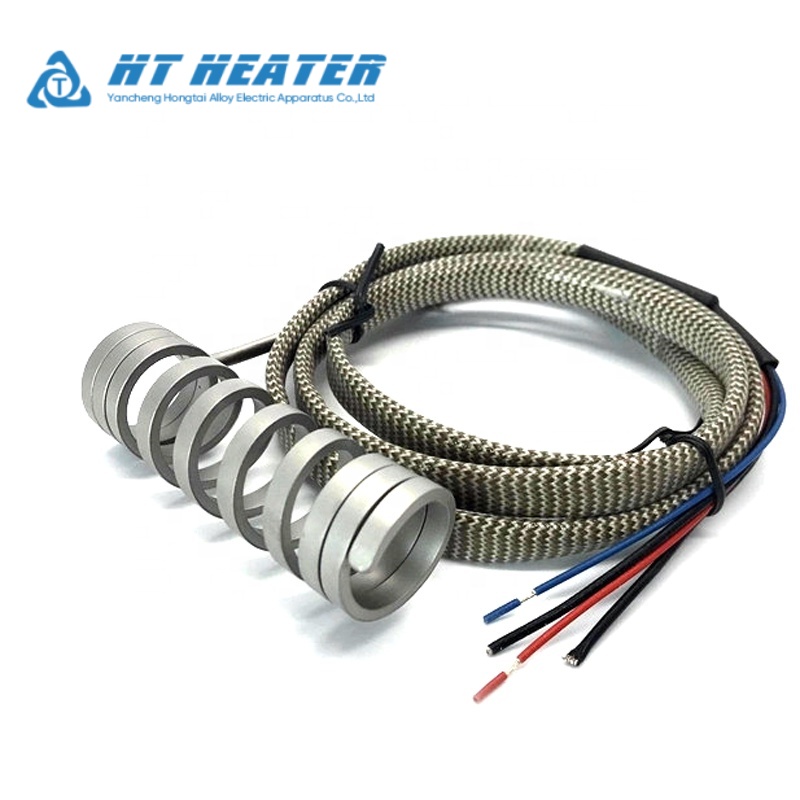
By engineering a distributed wattage profile—tightening the coil winding pitch at the head and tip while spacing it wider in the middle—Hongtai Industry Heater compensates directly for localized heat sinks, achieving an isothermal melt profile (±1.5°C).
6. Thermocouple Calibration & Junction Placement
Closed-loop temperature accuracy depends on thermocouple calibration and physical contact positioning within the heater structure:
- Type J (Fe-CuNi): Standard for commodity resins (< 370°C). Offers strong signal voltage output (~50 µV/°C).
- Type K (NiCr-NiAl): Required for high-temperature engineering polymers (> 370°C, e.g., PEEK, PEI).
- Grounded Junction: Thermocouple tip welded directly to outer sheath; delivers rapid thermal response (< 0.2s) but requires isolated PID controller inputs.
- Ungrounded Junction: Sensing tip isolated within MgO powder; offers maximum immunity to electrical noise and ground loops.
7. Precision Fit Tolerances & Differential Expansion
The fit between the heater ID and nozzle OD determines thermal contact resistance:
- Cold Clearance: A cold clearance gap of +0.05mm to +0.10mm is required for manual installation without galling the nozzle.
- Thermal Clamping: During warm-up, the heater sheath expands and tightens against the nozzle steel (αIncoloy > αToolSteel), eliminating air gaps and maximizing conductive heat flux.
8. Sensor Calibration & Electrical Quality Control Testing
Closed-loop temperature control relies on precise thermocouple integration (Type J for commodity plastics <370°C, Type K for high-temp engineering resins >370°C). Prior to installation, Hongtai recommends performing two quality control tests:
Cold Resistance Test: Measure resistance across terminals using a multimeter. Verify against nominal Ohm law values: R = V² / P (acceptable tolerance: ±5% to 10%).
Insulation Resistance (Hi-Pot) Test: Measure megohms between leads and the outer metal sheath using a Megohmmeter at 500V DC. Cold insulation resistance must exceed 500 MΩ.
9. Primary Burnout Causes & Systemic Troubleshooting
When a hot runner heater fails on the production line, refer to the systemic troubleshooting matrix below to determine the root cause:
| Visual Failure Symptom | Physical Root Cause | Corrective Action |
| Sheath Swelling / Pitting | Excessive watt density or trapped moisture | Lower watt density; apply soft-start PID heating. |
| Melting at Lead Junction | Contamination from molten plastic blowback | Upgrade to Armor Cable or Brass Encapsulated body. |
| Sheath Cracking / Fracture | Over-tight cold fit forced during assembly | Adjust machining tolerances to +0.05mm cold clearance. |
| Core Wire Burnout at Tip | Air gap causing thermal insulation dry-burn | Ensure spring lock or clamp band enforces surface contact. |
Custom Harness Engineering from Hongtai Industry Heater
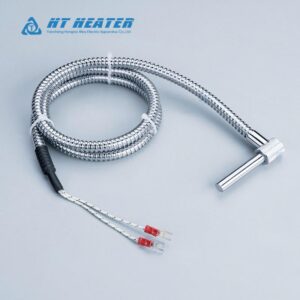
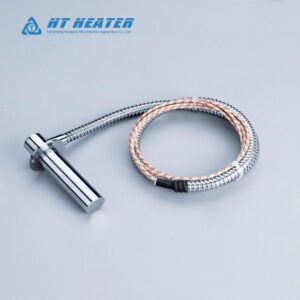
Selecting the right protection for coil heater lead wires reduces electrical maintenance downtime, prevents wiring short circuits, and extends heater service life. Hongtai Industry Heater manufactures custom hot runner coil heaters with tailored lead lengths, integrated armor cables, flexible SS braiding, and heavy-duty strain relief transitions built to your exact tooling requirements.
Ready to optimize your hot runner thermal profiles or need immediate troubleshooting assistance for a custom mold build?
Contact Hongtai Industry Heater today to submit your CAD drawings, request sample prototypes, or obtain fast factory-direct pricing for high-performance hot runner coil heaters.
What Related B2B Technical Resources Are Available?
- Sensor Integration: HT Coil Heater with Built-in Thermocouple: Type J vs. K & Lead Exit Selection Guide
- Thermal Distribution Design: Distributed Wattage Coil Heater Design & Temperature Profiles
- Sheath Metallurgy Selection:Sheath Materials for Hot Runner Coil Heaters: Stainless Steel vs. Nickel
- Cross-Section Selection:Hot Runner Coil Heater Cross Section: Round vs. Square vs. Rectangular
Frequently Asked Questions (FAQ)
Q1: Q: Are Hongtai coil heaters directly interchangeable with major European and American OEM brands (e.g., HASCO, DME, Yudo, Mold-Masters)?
Electrical & Sensor Integration: Fully compatible with standard 230V/240V molding systems and integrated with standard Type J or Type K thermocouples.
1:1 Drop-In Fit: Designed for exact physical and thermal replacement without requiring modifications to existing mold plates or controller pinouts.
Q2: What quality certifications, CE/RoHS compliance, and testing standards do your heaters meet for EU and US imports?
100% Quality Inspection: Every heater undergoes 100% factory testing for cold resistance tolerance ($\pm 5\%$), high-voltage dielectric insulation (Hi-Pot test @ 1500V AC), and grounding continuity.
Traceability: Batch numbers and core specs are laser-engraved on the sheath or lead junction for full quality traceability.
Q3: How do you prevent MgO moisture absorption during long-distance shipping and storage?
Protective Packaging: Vacuum-sealed anti-moisture packaging prevents ambient humidity ingress during extended warehouse storage in humid overseas regions.
Soft-Start Protocol: Includes standard guidelines for controller soft-start preheating ($100^\circ\text{C}$ bakeout cycle) to safely eliminate moisture prior to applying full operating voltage.
Q4: Can Hongtai supply distributed wattage (variable pitch) coil heaters for critical thin-wall or multi-cavity molds?
Flexible Lead Exit Options: Radial $90^\circ$ side exit, axial back exit, or custom angle configurations built to match specific mold raceways.
Encapsulation Options: Available as standard open coils, flexible stainless steel braided, heavy-duty armor cable, or precision pressed-in brass bodies.
Q5: What is your Minimum Order Quantity (MOQ) and standard lead time for US and European B2B buyers?
Rapid Prototyping: Standard custom samples manufactured and dispatched in 5–7 business days.
Production & Shipping: Bulk production orders completed within 10–14 days, with express air freight (DHL/FedEx/UPS, 3–5 days delivery to US/EU) or DDP door-to-door sea shipping options.