Selecting the right air cooled cast in heater or liquid-cooled alternative is a foundational decision for managing extruder barrel heating and cooling performance. In high-throughput polymer extrusion, processing heat-sensitive resins—such as PVC, XLPE, or engineering fluoropolymers—frequently causes extreme viscous shear heating (exothermic heat generation) inside the barrel. When mechanical shear generates more thermal energy than the polymer melt requires, the thermal system must immediately switch to cooling mode to protect resin integrity.
Mechanical designers and plastics processing engineers must evaluate thermal inertia, cooling response speeds, and maintenance overhead when integrating an air cooled cast in heater into modern processing machinery.
1. Thermodynamics of Extruder Barrel Heating and Cooling and Shear Heat
During high-speed screw rotation, plasticizing energy comes from two primary sources: external electrical heat provided by cast aluminum bands and internal friction generated by polymer shear stress.
When viscous shear heat drives barrel temperatures above setpoint, an air cooled cast in heater evacuates excess thermal energy according to Newton’s Law of Cooling:
Where q is heat transfer rate, h is the convective heat transfer coefficient, A is the heat transfer surface area, Ts is the cast aluminum surface temperature, and T∞ is the cooling fluid temperature.
Forced air convection across an air cooled cast in heater yields a moderate convective heat transfer coefficient (h ≈ 20 – 100 W/(m²·K)). This moderate transfer rate provides gradual heat removal, preventing sudden resin freezing along barrel walls.
2. Design Analysis: Air-Cooled Cast in Heater Mechanics
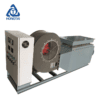
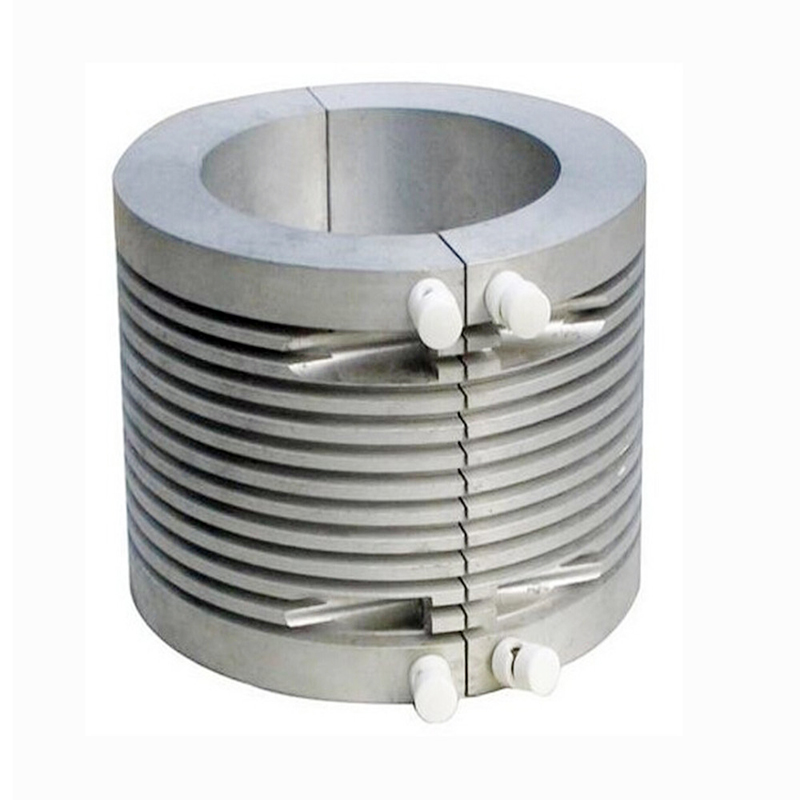
An air-cooled cast in heater features deeply grooved exterior aluminum fins that maximize the convection surface area (A). Blowers housed within external stainless steel shrouds force ambient air across the finned fins to evacuate excessive friction heat.
- Gentle Thermal Response: Forced air cooling provides smooth, gradual heat removal, making it ideal for processing heat-sensitive polymers where sudden temperature drops cause resin freezing along barrel walls.
- Zero Thermal Shock: The lower heat transfer coefficient of air prevents localized thermal stress cycles in the aluminum alloy matrix.
- Low Maintenance: Air systems eliminate water scaling, mineral clogging, and high-pressure steam leaks.
To prevent micro-air voids in cast aluminum fins from compromising convective efficiency, manufacturers must enforce strict void-elimination standards, as detailed in How Porosity Affects Heat Transfer in Cast-in Heating Elements.
3. Design Analysis: Liquid Cooled Cast Aluminum Heater Mechanics
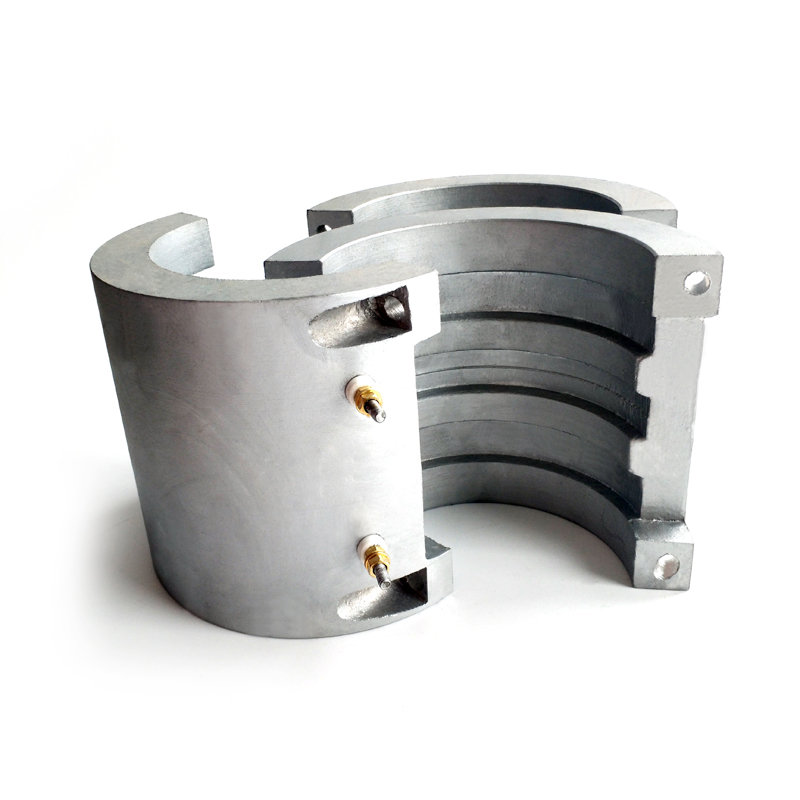
A liquid cooled cast aluminum heater features seamless stainless steel or Monel cooling tubes precisely bent and cast directly alongside tubular electrical heating elements.
- Rapid Heat Dissipation: Water circulation removes high BTU loads almost instantly, making it necessary for high-shear, high-speed twin-screw extruders.
- Tight Micro-Zone Thermal Control: Liquid cooling quickly arrests runaway exothermic reactions during aggressive masterbatch compounding.
- Closed-Loop Complexity: Requires external heat exchangers, solenoid valves, treated water lines, and automatic blow-back purging systems to avoid water flashing into steam inside hot cooling tubes.
For a comprehensive comparison of base metal alloys, thermal conductivity specs, and mechanical durability, refer to our primary guide: Cast-in Heater Material Selection Guide: Aluminum vs. Bronze vs. Iron.
4. Performance Comparison: Air-Cooled vs. Liquid-Cooled Heaters
Selecting the optimal extruder barrel heating and cooling system requires matching cooling dynamics to resin rheology and machine throughput goals:
| Engineering Parameter | Air-Cooled Cast in Heater | Liquid Cooled Cast Aluminum Heater |
| Cooling Medium | Forced Air via External Blowers | Water, Glycol, or Thermal Oil |
| Heat Removal Capacity | Low to Medium (Gentle) | Very High (Rapid / Aggressive) |
| Temperature Control Precision | ±1.5°C to ±3.0°C | ±0.5°C to ±1.0°C |
| Risk of Barrel Thermal Shock | None | Moderate (Requires pulsed PID control) |
| System Maintenance Level | Low (Blower filter cleaning only) | Medium to High (Water quality & scaling checks) |
| Target Polymer Processing | PVC, PE, PP, Film & Profile Extrusion | PET, Nylon, Engineering Resins, XLPE |
5. Maintenance and System Upgrades for Extruder Barrels
Proper installation and clamping torque are critical for both cooling options to prevent surface hot spots and contact resistance. Maintenance personnel should enforce standard clamping protocols as outlined in our Industrial Band Heaters: The Ultimate Engineering Guide to Selection, Efficiency & Troubleshooting (2026 Edition)
For diagnostic procedures regarding barrel heating failures or electrical short-circuits, consult our guide on Troubleshooting 101: 5 Common Causes of Band Heater Burn-Out. To evaluate alternative radiant heating systems across barrel zones, check Nano Band Heater: ROI & 30%+ Energy Savings Guide and nozzle-specific solutions in Brass Nozzle Heater: Eliminating Plastic Leakage Downtime.
To explore diagnostic strategies across ceramic systems, consult How Porosity Affects Heat Transfer in Cast-in Heating Elements. or review our main reference: Industrial Band Heaters: The Ultimate Engineering Guide to Selection, Efficiency & Troubleshooting (2026 Edition).