coil vs infrared heater efficiency comparisons demonstrate why plant managers and energy auditors are rapidly phasing out traditional open-coil and sheath heaters. In high-throughput industrial drying, thermoforming, and curing processes, resistive coil systems lose up to 50% of their input energy to parasitic air heating and oven wall conduction.
Upgrading to medium and long-wave ceramic infrared panels shifts your heating mechanism from slow convective heat transfer to direct radiative transfer. This guide delivers the thermodynamic equations, energy balance calculations, and payback period formulas required to justify a factory-wide retrofit to corporate procurement officers, offering a complete engineering breakdown of the coil vs infrared heater performance gap.
1. Thermodynamic Analysis: Coil vs Infrared Heater Efficiency
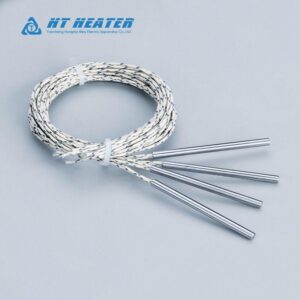
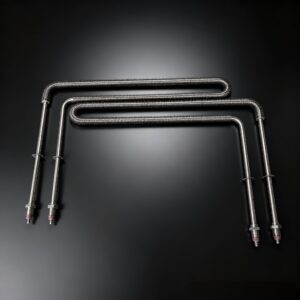
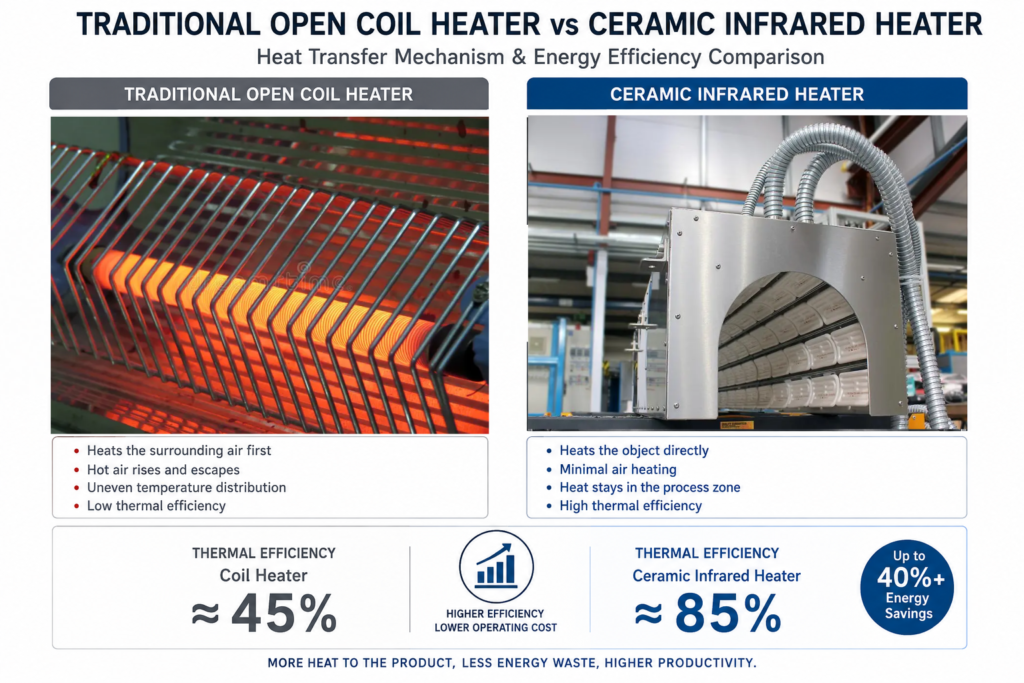
Traditional open-coil heaters rely on indirect heat transfer: electrical energy heats the resistance wire, which heats ambient air, which eventually transfers thermal energy to the target substrate via convection. Because air is a poor conductor of heat, warm-up times are long, and huge amounts of thermal energy are continuously lost through exhaust dampers and oven casings.
Conversely, ceramic infrared emitters transfer thermal energy directly via electromagnetic waves according to the Stefan-Boltzmann Law. Photons travel through air with minimal absorption, striking the target surface directly and vibrating its molecular structure. By eliminating the intermediate air medium, ceramic heater energy efficiency increases dramatically—delivering 80% to 90% usable thermal radiation directly to the product. Industrial energy efficiency frameworks published by the U.S. Department of Energy (DOE) confirm that direct electromagnetic radiation significantly minimizes factory background thermal loads compared to forced convective air loops.
To analyze how different ceramic refractory geometries maximize directional emissivity, engineers can review our detailed thermodynamic study onThrough vs. Solid Ceramic Heaters: Heat Transfer Efficiency Analysis.
2. Quantifying Energy Savings in Coil vs Infrared Heater Retrofits
To present a compelling budget request for equipment retrofit, energy auditors must quantify expected kilowatt-hour (kWh) reductions. According to ISO 13579 industrial furnace energy measurement standards, calculating total annual energy savings achievable by replacing open-coil banks with targeted IR panels is modeled by:
Where:
- Esavings = Annual energy savings (kWh)
- Pbase = Total installed power rating of legacy coil heaters (kW)
- h = Total annual operating hours (hours/year)
- ηcoil = Thermal system efficiency of open coils (~0.45)
- ηIR = Thermal system efficiency of ceramic IR emitters (~0.85)
Once annual energy savings are calculated in kilowatt-hours, multiply by your local industrial electricity tariff ($/kWh) to determine annual cost savings. The simple payback period for your CAPEX retrofit budget is calculated using:
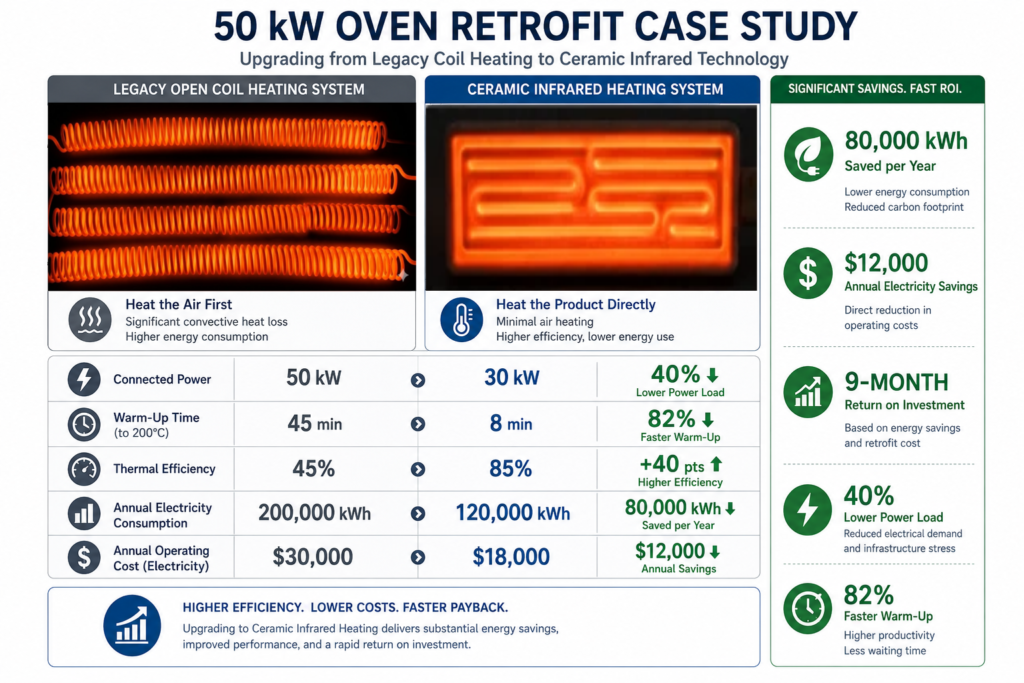
3. Real-World Financial Audit: 50 kW Oven Retrofit Case Study
Consider a thermoforming production line operating 16 hours per day, 250 days per year (4,000 operational hours/year), with an industrial electricity rate of $0.15 per kWh.
Below is a direct comparison between a traditional open-coil forced-air oven and an upgraded ceramic IR heating array:
| Performance Metric | Legacy Open-Coil Array | Upgraded Ceramic IR Array | Net Improvement |
| Connected Power Load | 50 kW | 30 kW | 40% Reduction |
| Warm-Up Time to 200°C | 45 minutes | 8 minutes | 82% Faster |
| Effective Thermal Efficiency | 45% | 85% | +40% Delta |
| Annual Electricity Draw | 200,000 kWh | 120,000 kWh | 80,000 kWh Saved |
| Annual Operating Cost | $30,000 | $18,000 | $12,000 Annual Savings |
In this real-world operational scenario, achieving a strong ir heating roi is straightforward. Assuming a total turnkey retrofit investment of $9,000 (including ceramic IR panels, reflector mounting hardware, and solid-state relays), the entire capital expenditure pays for itself in just 9 months.
To ensure your retrofit array does not exceed the structural thermal absorption limits of your product, calculate your surface wattages beforehand using How to Calculate Watt Density for Ceramic Infrared Heaters.
4. Secondary ROI Factors: Reduced HVAC & Lower Maintenance Costs
While electricity bill reductions provide the primary financial metric, upgrading from open coils to ceramic IR arrays unlocks three major secondary financial gains:
- Reduced Plant HVAC Loads: Convective coils dump heat into the surrounding factory floor, overloading facility air conditioning systems. Direct IR absorption keeps heat locked inside the process zone.
- Elimination of Thermal Shock Failures: Open coils are highly susceptible to airborne contaminants, oxidation, and mechanical vibration. High-density ceramic bodies enclose the resistance wire in refractory clay, preventing burnout. For maintenance teams troubleshooting legacy system downtime, see Troubleshooting Premature Failure in Ceramic Infrared Heating Elements: A Diagnostic Guide.
- Faster Startup Cycles: Reducing pre-heat times from 45 minutes to under 10 minutes adds over 100 hours of active production time back to your facility every year.
For plant engineers ready to build a comprehensive proposal for executive sign-off, reference our primary specification manual: Ceramic Infrared Heaters: The Complete Engineering & Selection Guide.