Introduction
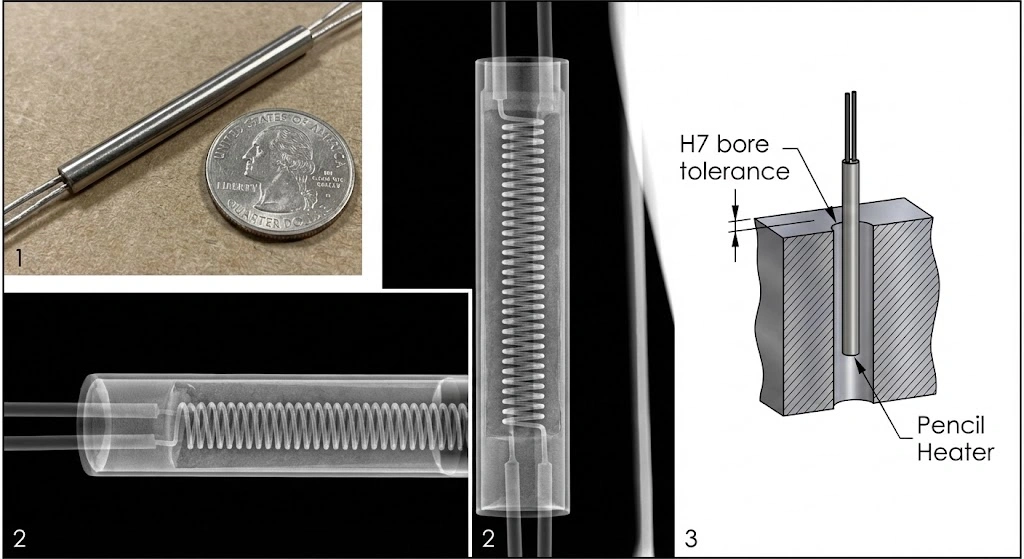
In industrial procurement, nomenclature can be confusing. You might see “Pencil Heater” on a legacy schematic from the 1980s or in a medical device specification. In modern engineering terms, a Pencil Heater is simply a colloquialism for a Micro Cartridge Heater (typically smaller than 3/8″ or 10mm in diameter).
However, while the name suggests simplicity, the engineering reality is anything but. When you scale a heating element down to the diameter of a matchstick (3mm), manufacturing difficulty increases exponentially. How do you maintain a dielectric safety barrier of 500V when the resistance wire is only 0.5mm away from the steel sheath?
This guide moves beyond the standard catalog. We will explore the thermodynamics of the “Pencil Heater,” analyzing its critical role in semiconductor wire bonding, medical micro-fluidics, and aerospace instrumentation. We will also provide the specific calculation adjustments required when working with high watt densities on microscopic surface areas.
1. Defining the “Pencil Heater”: Dimensions and Standards
In the context of 2026 global supply chains, “Pencil Heater” is not a distinct product category but a size classification.
The Dimensional Threshold
Generally, any swaged cartridge heater with a diameter of 3/8″ (9.5mm) or less falls into the “Pencil” or “Micro” category. At ht-heater.com, we define the micro-range as:
| Nominal Size | Metric Equivalent | Application Niche |
| 1/8″ | 3.17 mm | Micro-fluidics, Medical Probes |
| 4 mm | 4.00 mm | 3D Printer Hotends, plastic welding |
| 1/4″ | 6.35 mm | The most common “Pencil” size (General purpose) |
| 6 mm | 6.00 mm | European standard for small molds |
| 3/8″ | 9.53 mm | Upper limit of “Pencil” classification |
Regional Terminology
- North America: Often referred to as “Pencil Heaters” due to the visual similarity to a graphite pencil.
- Europe/Asia: Simply cataloged as “Small Diameter High-Density Cartridge Heaters.”Understanding these aliases is crucial for sourcing cross-reference parts for imported machinery.
2. The Micro-Engineering Challenge: Scaling Down
As dimensions shrink, physical margins for error vanish.
The Dielectric Limit (Creepage Distance)
In a standard 12mm heater, there is ample space between the NiCr resistance coil and the outer sheath. In a 3mm Pencil Heater, that insulation layer (MgO) might be less than 0.5mm thick.
- The Risk: High voltage (e.g., 240V) can easily arc through thin insulation if the MgO purity is not $\ge$ 99.4%.
- The Standard: We strictly test all micro-heaters to ensure Insulation Resistance (cold) remains $\ge$ 500 MΩ at 500V DC.
The Watt Density Trap
Smaller heaters have less surface area to dissipate heat.
- Calculation Example:
- Heater: 3mm Dia x 30mm Length (200W).
- Surface Area: $\pi \times 0.3cm \times 3.0cm \approx 2.8 cm^2$.
- Watt Density: $200W / 2.8cm^2 = \mathbf{71 W/cm^2}$ (approx 460 W/in²).
- Conclusion: This is an extreme density. Without a perfect H7 fit and a high-grade alloy sheath, this heater would melt instantly.
Lead Connection Fragility
Standard “internal swaging” of leads is physically impossible in diameters under 4mm. We utilize micro-welding techniques under magnification to attach leads externally or via a transition adapter, which requires careful handling during installation.
3. High-Tech Applications: Precision Where it Matters
Why go small? Because modern technology demands localized, rapid thermal response.
Medical & Lab Instrumentation
- PCR (Polymerase Chain Reaction) Cyclers: Require heaters that can ramp from 50°C to 95°C in seconds. The low thermal mass of a Pencil Heater makes this possible.
- Surgical Tools: Electrocautery and vessel sealing devices use micro-heaters embedded in the forceps tips (running on low voltage, e.g., 12V-24V).
Semiconductor Wire Bonding
In chip packaging, gold wire bonding requires the capillary (bonding tool) to be heated to precisely 200°C-250°C.
- The Requirement: A 1/8″ or 3mm heater inserted directly into the bonding head. It must maintain stability within ±1°C to ensure the gold wire fuses correctly without damaging the silicon die.
Aerospace & Drones
- Pitot Tubes: Preventing ice formation on airspeed sensors.
- Battery Warming: Keeping Li-Ion batteries within optimal operating temp in high-altitude UAVs.
- Key Feature: High vibration resistance and lightweight construction.
4. Selection & Customization: The “Micro” Spec Sheet
When ordering Pencil Heaters, standard rules often don’t apply.
Voltage Strategy: Go Low
Due to the “Creepage Distance” issue mentioned earlier, we strongly recommend using Low Voltage (12V, 24V, or 48V) for any heater under 6mm diameter.
- Safety: Reduces the risk of internal arcing.
- Compliance: Mandatory for many portable medical devices (IEC 60601).
Lead Protection
The lead wires on a 3mm heater are often 24-26 AWG (very thin).
- Teflon (PTFE) Sleeving: Provides strain relief and moisture protection.
- Micro-Braid: A miniature stainless steel mesh to prevent the wire from being severed by sharp edges in the machine housing.
Profiled Wattage (Variable Winding)
In a tiny metal block, the ends lose heat much faster than the center.
- The Solution: We can wind the resistance wire tighter at both ends and looser in the middle. This Distributed Wattage profile compensates for edge loss, ensuring the entire micro-block stays at a uniform temperature.
5. Zero-Click Checklist: Customizing Your Pencil Heater
Before submitting an RFQ for micro-heaters, verify these 5 points:
- [ ] Bore Tolerance: Is your hole reamed to an H7 tolerance? (Crucial for micro-sizes).
- [ ] Voltage Safety: Is the voltage appropriate for the diameter? (e.g., Avoid 240V in 3mm).
- [ ] Sensor Integration: Do you need a built-in Type J/K thermocouple?
- [ ] Lead Stress: Will the leads be moving? (Requires strain relief).
- [ ] Ramp Rate: How fast do you need to heat up? (Determines Watt Density).
6. Installation & Handling: Handle with Care
A 3mm heater has the structural integrity of a glass rod. It cannot withstand abuse.
Do Not Strike
Never use a hammer or impact tool to force a pencil heater into a hole. If it doesn’t slide in with a distinct “cushion of air” resistance, the hole is too small. Ream the hole; do not force the heater.
The Necessity of Precision Reaming
For a 1/2″ heater, a 0.1mm gap is bad. For a 1/8″ heater, a 0.1mm gap is catastrophic.
- Fit Standard: Target a clearance of -0.01mm to -0.03mm.
- Thermal Paste: Use a thin film of high-temp thermal transfer paste. Do not over-apply, as thick paste acts as an insulator.
7. The Future: Smart Micro-Heating
The next generation of Pencil Heaters is evolving. We are currently prototyping units with integrated RTD sensors on the chip level and ceramic-substrate cores for even higher watt densities.
At ht-heater.com, our manufacturing capabilities push the physical limit:
- Min Diameter: 2.5mm
- Max Temp: 750°C (Incoloy 800 Micro)
FAQ: Common Questions on Micro Heaters
Are Pencil Heaters interchangeable with standard Cartridge Heaters?
In principle, yes—they work the same way. However, “Pencil Heater” implies a specific size class (usually under 10mm). If your application requires a 20mm heater, it is simply a standard Cartridge Heater. The physics of watt density are identical, but the manufacturing tolerance is tighter for the Pencil class.
What is the maximum power for a 3mm heater?
Power is limited by surface area. A 3mm x 40mm heater can comfortably handle 50W to 80W. Pushing it to 150W is possible but requires perfect fitment and active temperature control to prevent immediate burnout.
What is the smallest diameter you can manufacture?
Our standard production limit is 3mm (1/8″). We can produce 2.5mm custom units for specialized aerospace and medical applications, though these carry a higher Minimum Order Quantity (MOQ).