When heating moves “off-grid”—whether inside a refrigerated truck, a portable medical device, or a 48V telecom cabinet—the engineering challenge shifts from thermal dynamics to electrical constraints.
Designers often underestimate the implications of Low Voltage (DC) heating. The challenge isn’t generating heat; it’s managing the massive current (Amperage) required to do so. A 12V heater demands 20x the current of a 240V heater to produce the same wattage.
This guide explores the design parameters for DC Silicone Heaters. We will navigate the limitations of Ohm’s Law, select the correct wire gauges (AWG) to prevent fire hazards, and optimize heating strategies for battery-powered systems.
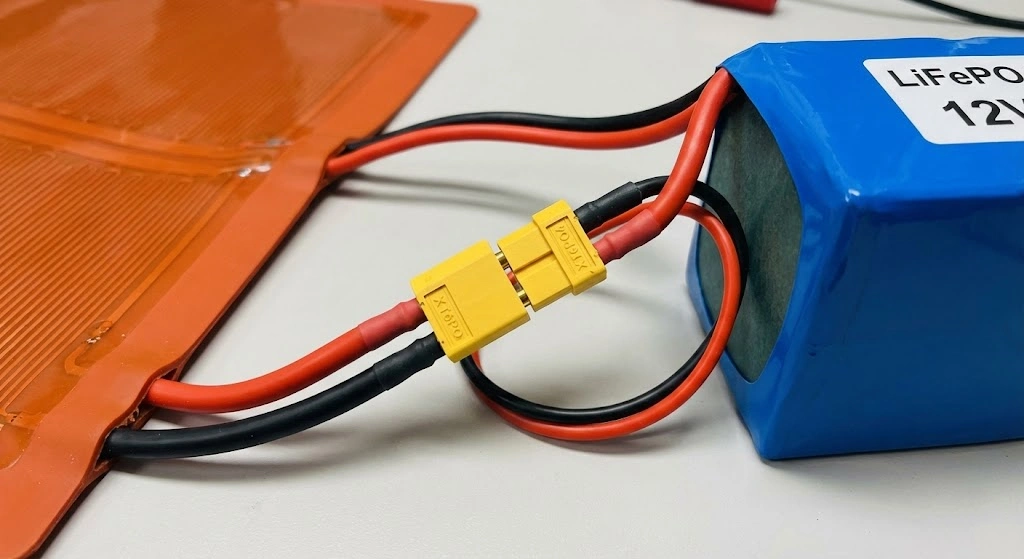
Low voltage heating requires robust connectors and heavy-gauge wiring to handle high current without voltage drop.
1. The Trap of Ohm’s Law: Low Voltage ≠ High Power
Many engineers ask: “Can you make a 1000W heater running on 12V?”
The theoretical answer is yes. The practical answer is absolutely not.
The Math: Why 12V is Limiting
Power (P) = Voltage (V) × Current (I).
Scenario A (220V AC): To get 500 Watts, you need ~2.3 Amps. This can be safely carried by a thin 22 AWG wire.
Scenario B (12V DC): To get 500 Watts, you need 41.7 Amps.
The Consequence: You would need a 6 AWG or 4 AWG cable (thick as a finger) just to power the heater. The connector would melt, and the silicone mat’s internal foil tracks would vaporize.
HT-Heater Recommended Limits
To ensure safety and manufacturability, we recommend the following maximum power caps per heater mat:
12V Systems: Max 150W (approx. 12.5A).
24V Systems: Max 300W (approx. 12.5A).
48V Systems: Max 600W (approx. 12.5A).
Note: If you need more power, use multiple smaller heaters wired in parallel rather than one giant mat.
2. Typical Applications: Breaking Free from the Cord
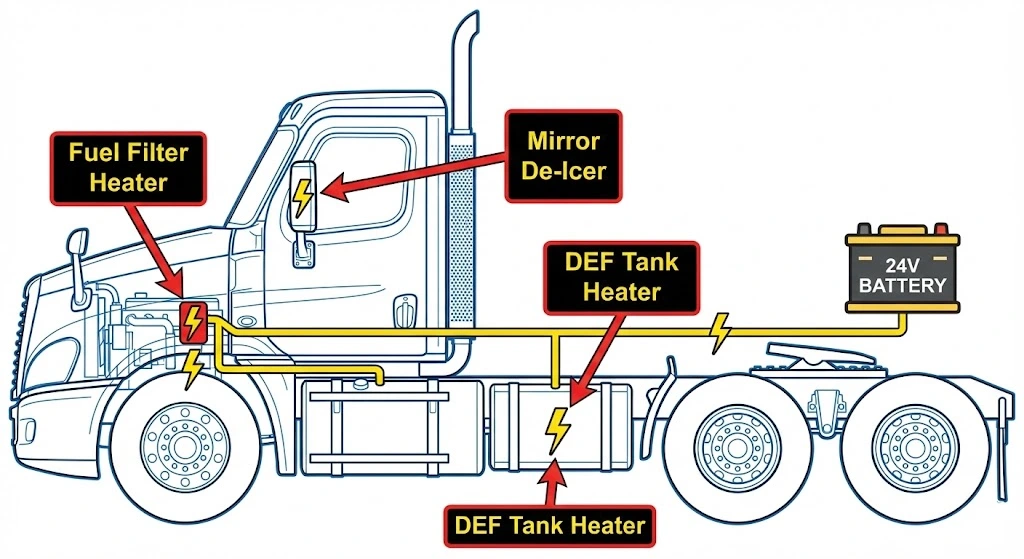
Heavy-duty transport relies on DC heaters to keep fluids flowing in freezing conditions.
A. Automotive & Trucking (12V / 24V)
Diesel exhaust fluid (DEF/AdBlue) freezes at -11°C. Fuel filters wax up in winter.
Solution: Ruggedized silicone heaters powered directly by the vehicle’s alternator/battery.
Benefit: Vibration resistant and oil-proof. We often integrate a simple “Click-disk” thermostat to turn on at 5°C and off at 15°C to save battery life.
B. Portable Medical & Beauty Devices (SELV)
For handheld physiotherapy pads or portable incubators, safety is paramount.
Solution:SELV (Safety Extra Low Voltage) heaters. Even if the silicone insulation is accidentally pierced, 12V or 24V DC will not cause a dangerous electric shock to the patient.
C. Outdoor Telecom & Security (48V)
Remote 5G base stations and security cameras often run on 48V DC backbones.
Application: Lens de-fogging and battery cabinet warming.
Efficiency: Running directly off the 48V bus eliminates the efficiency loss of an inverter (DC to AC).
3. Connectors & Integration Strategies
Selecting the right connector is critical. A standard barrel jack will melt above 5 Amps.
Connecting a DC heater isn’t as simple as stripping wires. High current demands low-resistance connections.
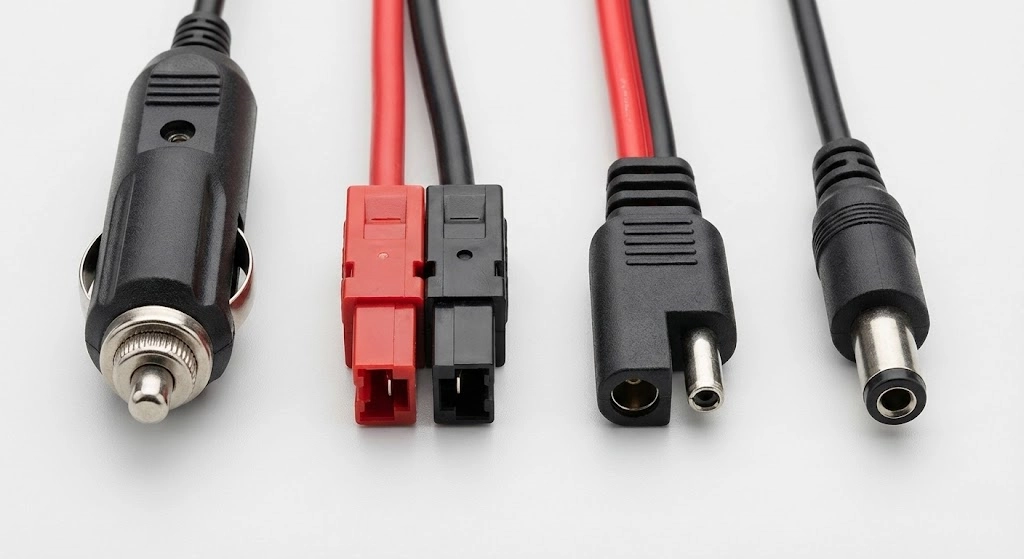
Connector Selection Guide
Cigarette Lighter Plug:
Limit: Max 100W-120W (approx. 8-10A).
Risk: Poor contact springs can overheat. Only for temporary use.
SAE / Anderson Powerpole:
Limit: 30A – 50A+.
Verdict: The industrial standard. Reliable, genderless, and vibration-proof.
DC 5521/5525 Barrel Jack:
Limit: Max 3A – 5A (approx. 36W-60W at 12V).
Verdict: Only for very low-power electronics heaters.
Battery Conservation Strategies
To prevent draining the user’s battery:
PWM Dimming: Use a Pulse Width Modulation controller to run the heater at 50% duty cycle once the target temp is reached.
Low Voltage Cutoff: Ensure your power source has a BMS that cuts power if the voltage drops below critical levels (e.g., 10.5V for a 12V lead-acid battery).
4. Safety: DC Arcing & Fusing
DC Arcing is dangerous. Unlike AC (Alternating Current), which crosses zero volts 100/120 times a second (extinguishing sparks), DC voltage is constant. If a wire is loose, the arc will sustain itself, generating intense heat and fire risk.
1. Robust Termination
HT-Heater uses hydraulic crimping for all DC terminals and strain-relieves the exit point with a molded silicone block to prevent wire fatigue.
2. Mandatory Fusing
Rule: Every DC heater circuit must be fused.
Install an inline fuse rated for 125% of the max current (e.g., for a 10A heater, use a 12.5A or 15A fuse) as close to the battery terminal as possible. This protects the wire from melting in a short circuit.
Design Reference Table: Voltage vs. Limits
Use this table to size your system correctly.
System Voltage
Max Recommended Power
Current Draw
Min Wire Gauge (Silicone)
Typical Use
USB (5V)
10W
2.0A
22 AWG
Hand warmers, USB coasters
12V DC
120W – 150W
10A – 12.5A
16 AWG
Cars, RVs, Portable Med-Tech
24V DC
240W – 300W
10A – 12.5A
16 AWG
Trucks, Industrial PLC Panels
48V DC
500W – 600W
10.4A – 12.5A
16 AWG
Telecom, Golf Carts, Forklifts
Frequently Asked Questions (FAQ)
How long can I run a 12V heater on my car battery?
Calculation: Time = (Battery Capacity in Ah) / (Heater Current in Amps). Example: A 60W heater draws 5 Amps (60W/12V). On a standard 60Ah car battery: $60Ah / 5A = 12 Hours$ (theoretical). Reality: You should never discharge a lead-acid battery below 50%. So, the safe run time is ~6 hours.
Do silicone heaters have polarity (+ / -)?
The heater element itself is purely resistive, so it is non-polarized (it works regardless of which wire is + or -). However, if your heater includes an integrated LED indicator, NTC sensor, or digital controller, you must observe the correct polarity, or you will damage the electronics.
Can I connect the heater directly to a solar panel?
We recommend connecting to a Solar Charge Controller and Battery first. Solar panels have a fluctuating “Open Circuit Voltage” (Voc) that can be significantly higher than 12V/24V, which creates unstable heating and may exceed the rated voltage of the heater.
Powering your innovation?
From 5V USB pads to 48V telecom heaters, let us calculate the amps so you don’t have to.