htwaimaokuaiche@gmail.com

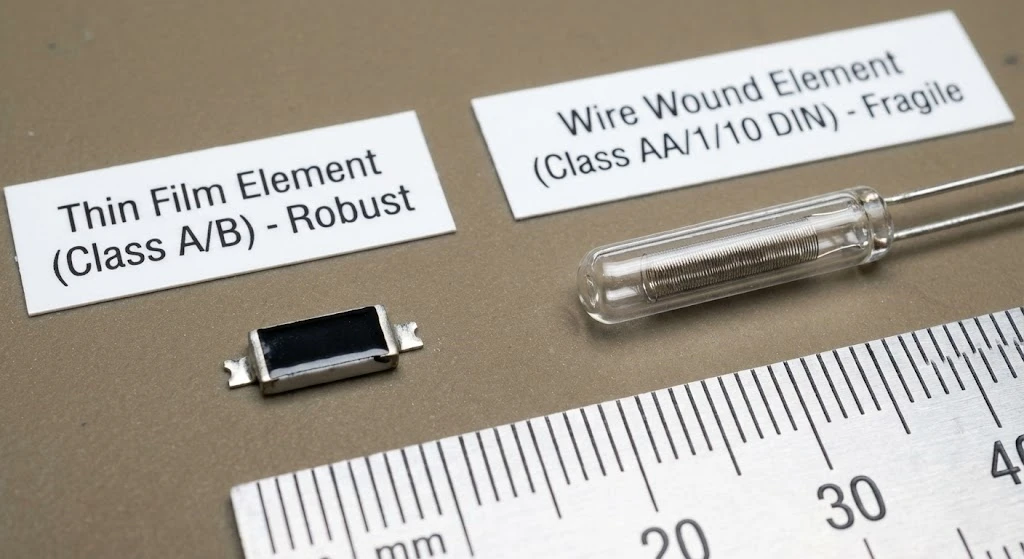
Difference between thin film and wire wound Pt100 elements.

Class A vs. Class B vs. 1/10 DIN: Understanding Pt100 Accuracy Standards

Introduction: The “Accuracy” Mirage Customer Inquiry: “I need a high-accuracy Pt100 sensor for my chemical reactor.” Our Question: “Define high accuracy. Do you need Class A? 1/3 DIN? Or a sensor with specific Callendar-Van Dusen coefficients?” In the world of industrial metrology, “High Accuracy” is a meaningless marketing term. A sensor that is highly accurate

Class A vs. Class B vs. 1/10 DIN: Understanding Pt100 Accuracy Standards Read More »
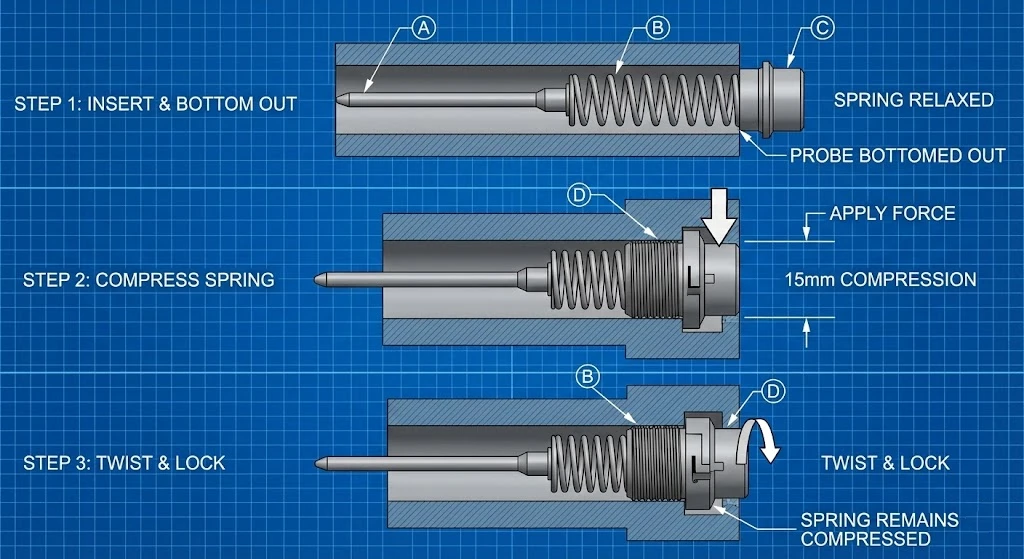
How to install bayonet thermocouple with spring tension preload.

Temperature Sensors for Plastics: Mastering Bayonet & Nozzle Thermocouples

Introduction: The “Air Gap” Enemy Your PID settings are tuned perfectly. Your heater bands are brand new. Yet, your injection molding machine is producing parts with “Black Specks” (carbonization) or “Short Shots” (incomplete filling). The root cause is rarely the controller—it is often a 0.5mm invisible gap between your sensor tip and the barrel wall.

Temperature Sensors for Plastics: Mastering Bayonet & Nozzle Thermocouples Read More »

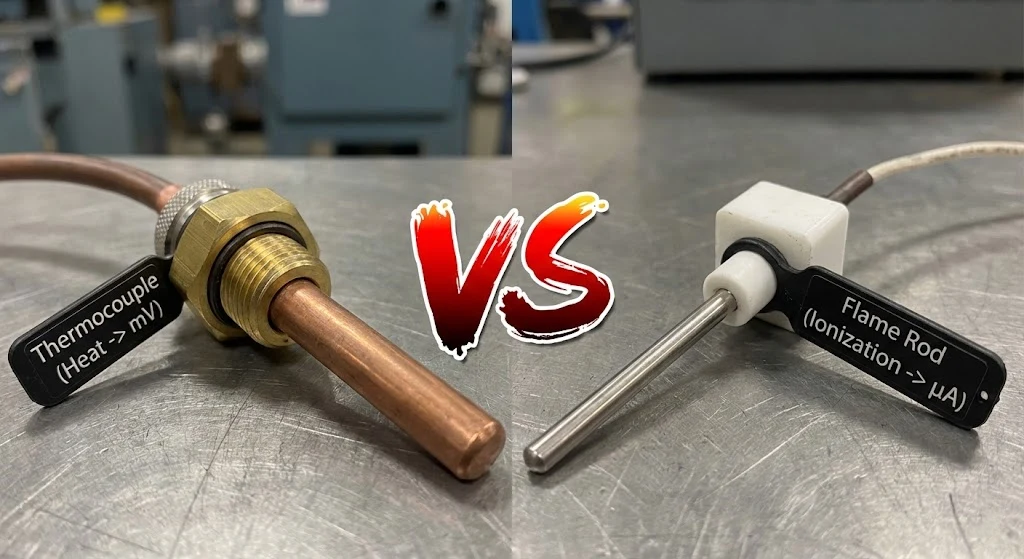
Difference between thermocouple and flame rectification sensor visual comparison.

Flame Sensors Explained: How Thermocouples Secure Gas Safety Loops

Introduction: The “30mV” Life Saver The Phenomenon: You press the control knob on a gas heater, and the pilot lights up instantly. You hold it for ten seconds, but the moment you release your thumb, the flame dies. The Physics: This is not a mechanical failure. It is a Thermoelectric Safety Loop functioning exactly as

Flame Sensors Explained: How Thermocouples Secure Gas Safety Loops Read More »

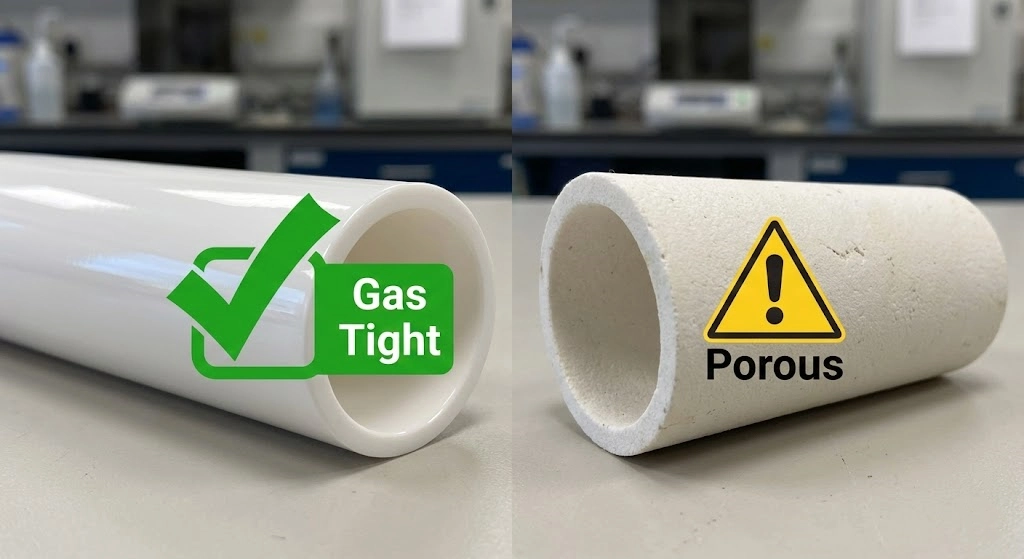
Difference between Alumina C799 and Mullite C610 ceramic protection tubes.

Thermocouple Sheath Materials: SS304 vs. SS316 vs. Incoloy 800 (Selection Guide)

Introduction: The “Melting Probe” Mystery Scenario: A maintenance manager installs a brand new Type K thermocouple into a carburizing furnace running at 950°C. Two days later, the signal goes dead. When he pulls the probe out, the metal sheath has vanished—dissolved into a twisted, blackened skeleton, leaving the bare wires exposed. The customer blames the

Thermocouple Sheath Materials: SS304 vs. SS316 vs. Incoloy 800 (Selection Guide) Read More »

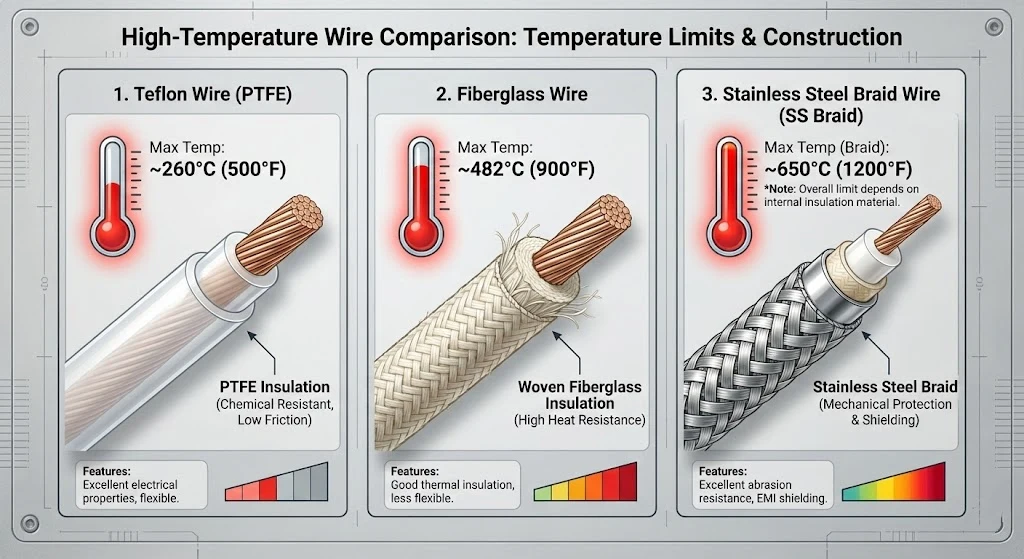
Stainless steel braided wire vs Teflon wire vs Fiberglass wire

How to Order a Thermocouple: The 7-Point Specification Checklist for Engineers

Introduction: The “Email Ping-Pong” Killer “I need a price for a Type K thermocouple.” This is the most common inquiry we receive, and ironically, the most inefficient. Our sales engineers are forced to reply: “How long? What diameter? What thread size? What kind of wire insulation?” This back-and-forth “email ping-pong” can delay your order by

How to Order a Thermocouple: The 7-Point Specification Checklist for Engineers Read More »

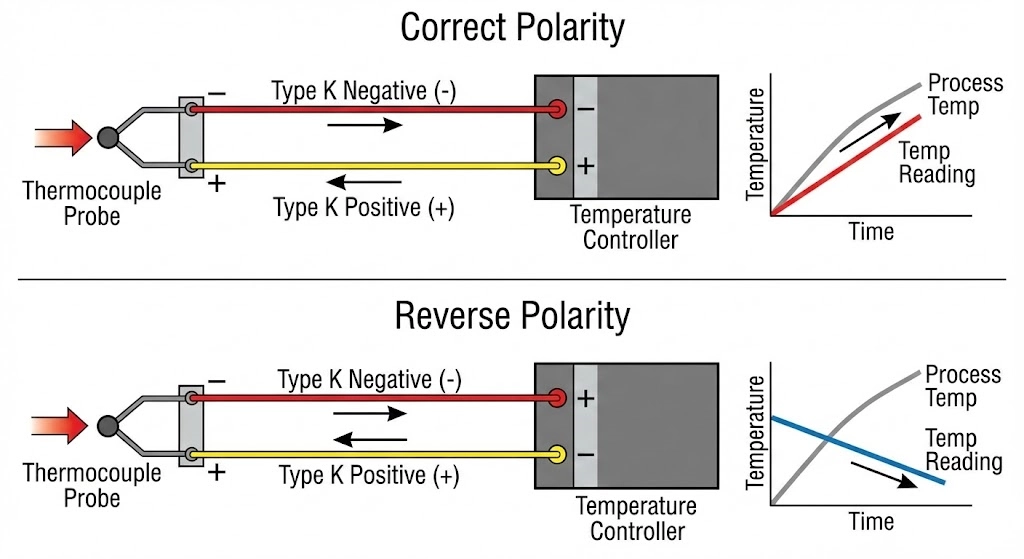
Thermocouple reverse polarity wiring diagram and temperature error graph.

Mastering Thermocouple Color Codes: ANSI, IEC, and JIS Standards (2026 Guide)

Introduction: The “Red Wire” Trap In 99% of electrical engineering, Red means Positive (+). It is the universal language of DC power. In the world of American (ANSI) thermocouples, Red is Negative (-). This single counter-intuitive fact is responsible for thousands of hours of downtime and catastrophic equipment failures every year. The Scenario: A field

Mastering Thermocouple Color Codes: ANSI, IEC, and JIS Standards (2026 Guide) Read More »

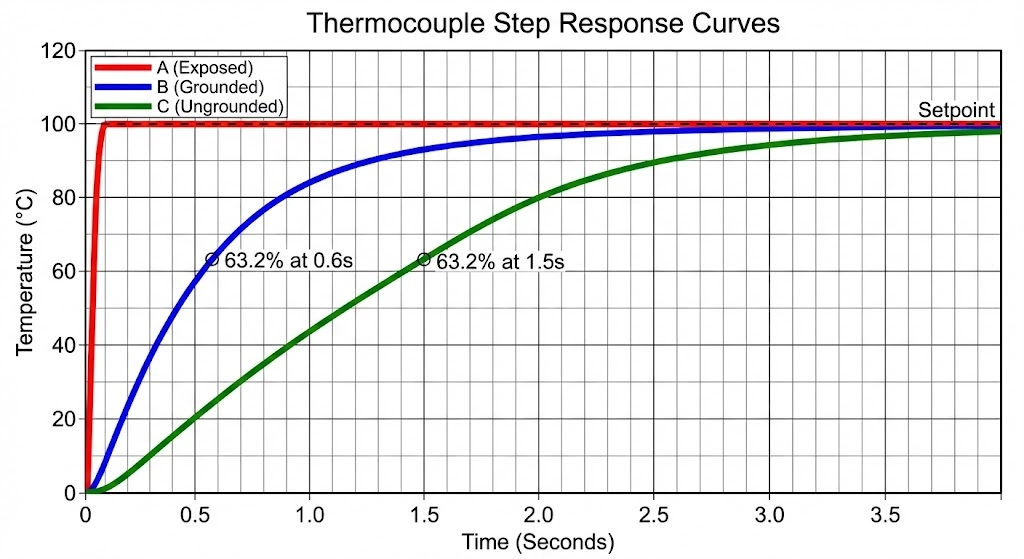
Thermocouple response time graph comparing grounded vs ungrounded vs exposed junctions.

Grounded vs. Ungrounded Junctions: The Speed vs. Noise Trade-off

Introduction: The “Nervous” Control Loop You have tuned your PID loop perfectly. Your integral and derivative terms are calculated to the decimal point. Yet, your process temperature is still oscillating like a heartbeat, and your heater contactors are chattering themselves to death. The problem likely isn’t your controller settings. It is a fundamental conflict in

Grounded vs. Ungrounded Junctions: The Speed vs. Noise Trade-off Read More »

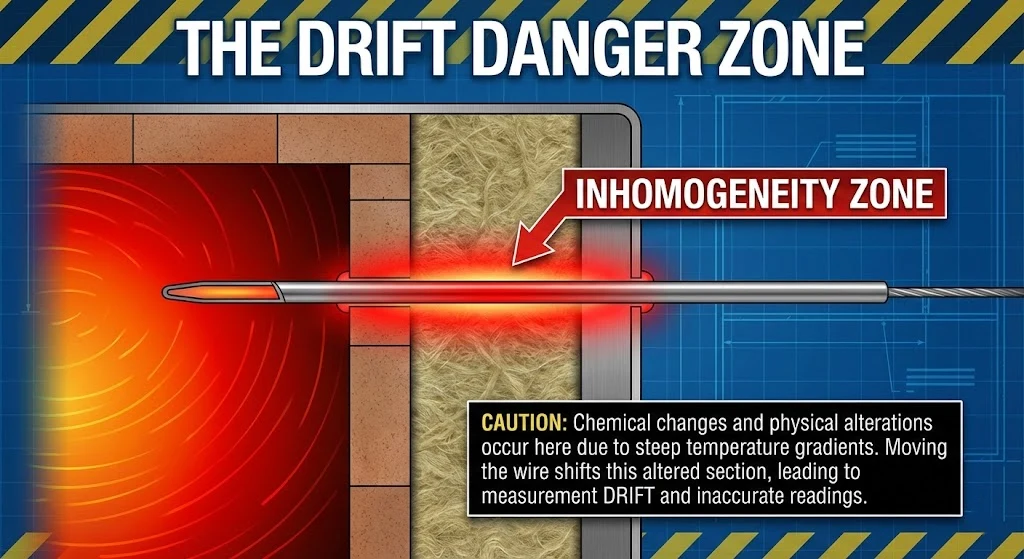
Thermocouple inhomogeneity and drift explanation diagram.

Troubleshooting Thermocouple Failures: Open Circuits, Drift, and Ground Loops (Field Guide)

Introduction: The Friday Afternoon Nightmare It is a scenario every maintenance engineer knows too well: It is 4:00 PM on a Friday. You are ready to clock out, but suddenly the main heat treatment furnace alarms out. The PID controller displays a flashing “OPEN”, or worse, the temperature reading starts jumping from 800°C to 1200°C

Troubleshooting Thermocouple Failures: Open Circuits, Drift, and Ground Loops (Field Guide) Read More »

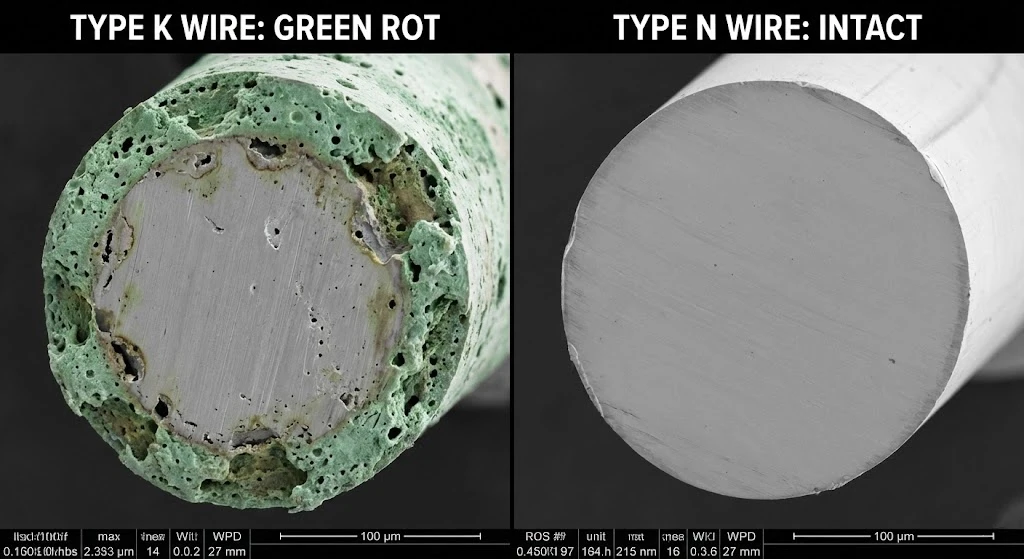
Microscopic analysis of Green Rot corrosion on Type K thermocouple vs intact Type N wire.

Why Upgrade from K-Type to N-Type? The Science of “Drift” and “Green Rot”

Introduction: The “Silent Killer” of Heat Treatment Your furnace controller reads 1100°C. Your chart recorder reads 1100°C. But your Rockwell hardness test just failed. Why? Because your process temperature was actually 1085°C. You are the victim of Thermocouple Drift. Unlike a catastrophic open-circuit failure where the system shuts down safely, drift is a silent killer.

Why Upgrade from K-Type to N-Type? The Science of “Drift” and “Green Rot” Read More »

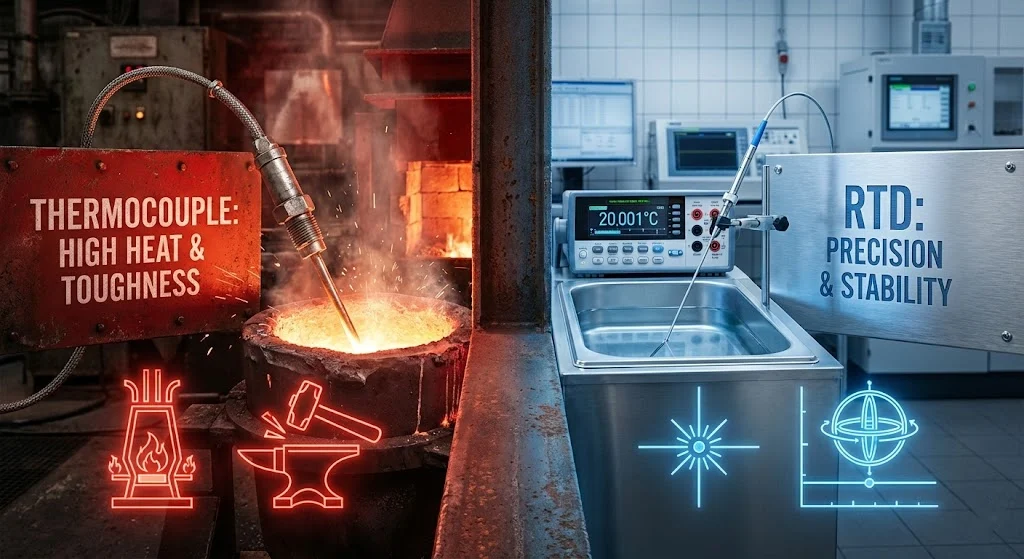
Thermocouple vs RTD comparison chart showing temperature range and accuracy differences.

Thermocouple vs. RTD (Pt100): The Engineer’s Decision Guide (2026)

Introduction: The “Over-Engineering” Trap In the world of process automation, the most expensive sensor is not the one with the highest price tag—it is the one that fails because it was the wrong tool for the job. We see the “Over-Engineering” trap constantly: A project engineer specifies a high-precision Pt100 RTD for a diesel exhaust

Thermocouple vs. RTD (Pt100): The Engineer’s Decision Guide (2026) Read More »

Scroll to Top