htwaimaokuaiche@gmail.com

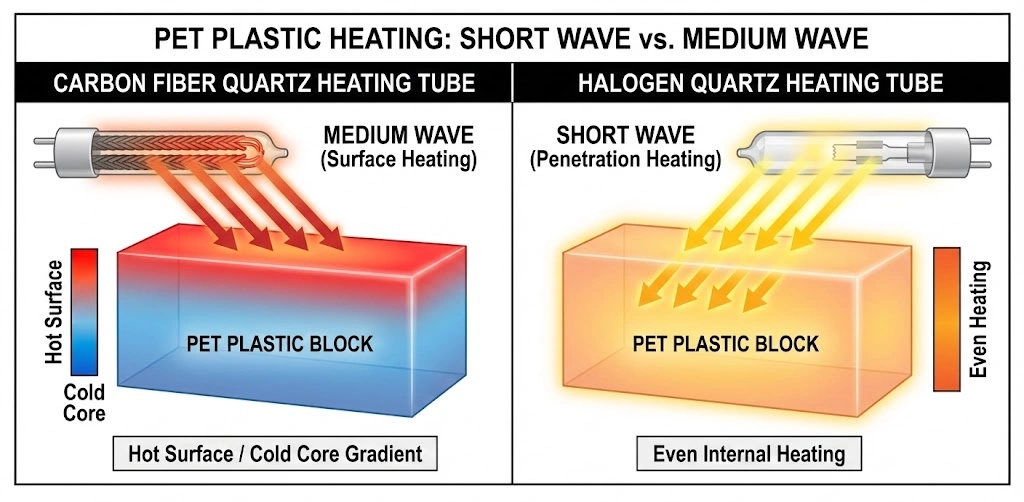
Short wave infrared penetration vs medium wave surface heating diagram for PET plastics.

Halogen Infrared Heating Tubes (Short-Wave): Engineering Fast-Response Thermal Dynamics

Introduction & Context In a PET blow molding line running at 30,000 bottles per hour, a heating delay of just 3 seconds doesn’t just mean a pause—it means hundreds of preforms are rejected. In high-stakes manufacturing, Time is Thermodynamics. When your production line moves faster than a ceramic heater can think, you need the Formula

Halogen Infrared Heating Tubes (Short-Wave): Engineering Fast-Response Thermal Dynamics Read More »
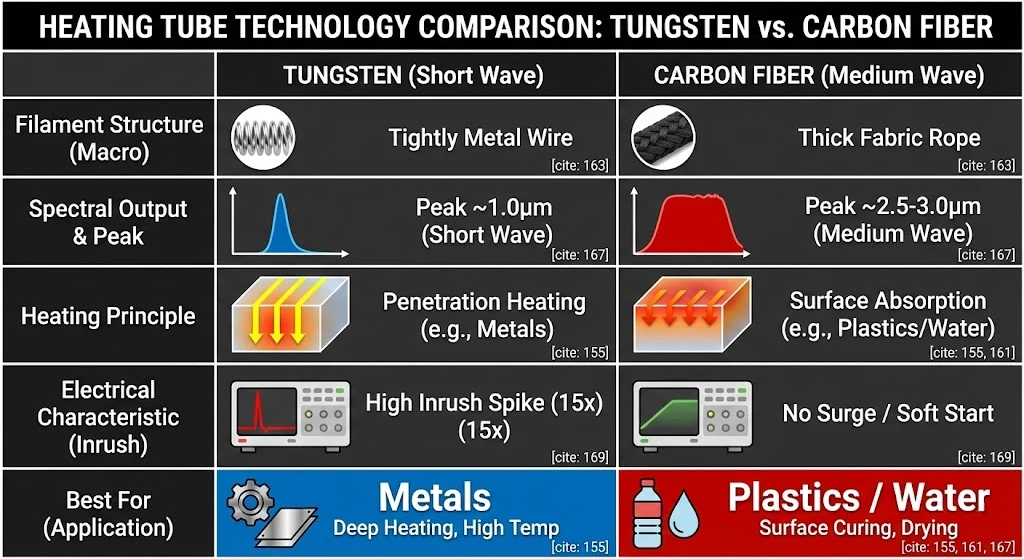
Comparison table of Tungsten Halogen vs Carbon Fiber infrared heaters specs.

Tungsten vs Carbon Fiber: The Ultimate Engineering Comparison for Infrared Heating

Introduction & The Dilemma Picture this: A process engineer installs high-power 2000W halogen lamps to dry a water-based coating on white plastic trays. The lamps fire up instantly, blindingly bright. Ten minutes later, the trays are warping and charring at the edges, yet the coating in the center is still tacky. The engineer blames the

Tungsten vs Carbon Fiber: The Ultimate Engineering Comparison for Infrared Heating Read More »

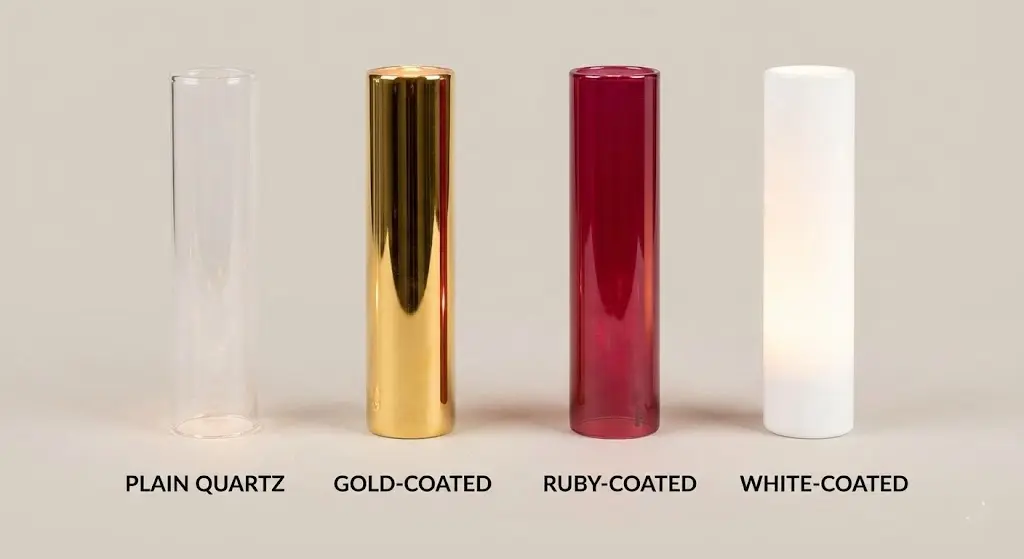
plain quartz golden-coated ruby-coated white coated heating tube

Industrial Quartz Heating Tubes: The 2026 Engineering Guide to Spectral Matching & Efficiency

Introduction The “Technical Insight” Hook: Did you know that a standard 2400K halogen heater wastes nearly 40% of its energy when curing clear plastics? It’s not a defect in the heater; it’s physics. Most clear polymers are transparent to short-wave radiation—meaning the heat passes right through the material instead of being absorbed by it. In

Industrial Quartz Heating Tubes: The 2026 Engineering Guide to Spectral Matching & Efficiency Read More »

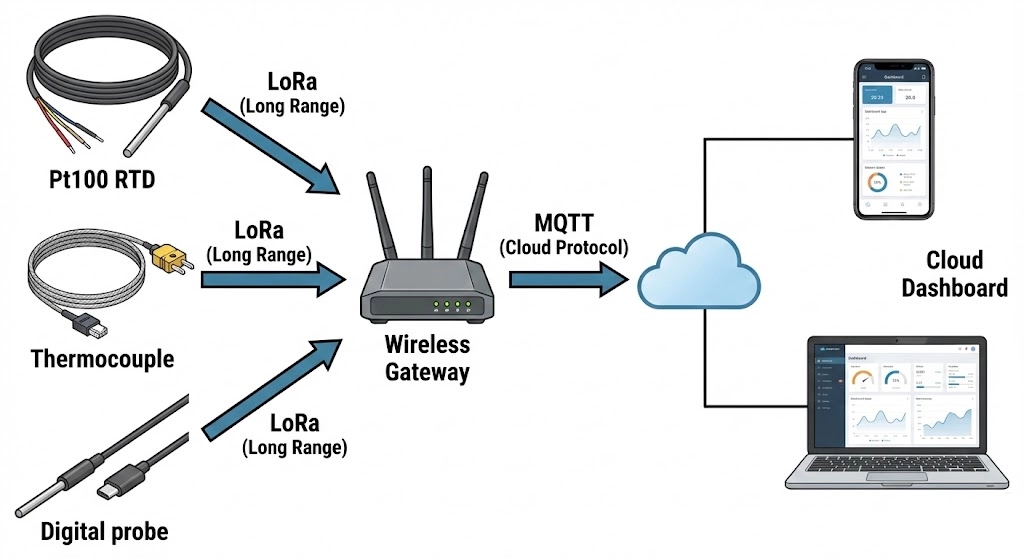
Industrial wireless IoT temperature monitoring system architecture diagram.

Cut the Cord: The Engineer’s Guide to Industrial Wireless & IoT Temperature Monitoring

Introduction: The “Spaghetti Wiring” Nightmare The Scenario: You manage a factory with 50 critical monitoring points spread across a 5,000 square meter floor. To install traditional wired sensors, you are looking at kilometers of cable trays, conduit, and labor costs exceeding $10,000. And if one cable breaks inside a wall? Good luck troubleshooting it. The

Cut the Cord: The Engineer’s Guide to Industrial Wireless & IoT Temperature Monitoring Read More »

Industrial handheld thermocouple thermometer with interchangeable probe kit.

Beyond the Kitchen Gadget: The Professional’s Guide to Industrial Digital Thermometers & Probes

Introduction: The Cost of “Slow” Readings The Scenario: You are a QA manager standing on a freezing loading dock, inspecting a pallet of frozen beef. Or you are a civil engineer watching a steamroller compact fresh asphalt. You stick your thermometer in, and the numbers crawl… 10°C… 12°C… 15°C… taking 30 seconds to stabilize. The

Beyond the Kitchen Gadget: The Professional’s Guide to Industrial Digital Thermometers & Probes Read More »

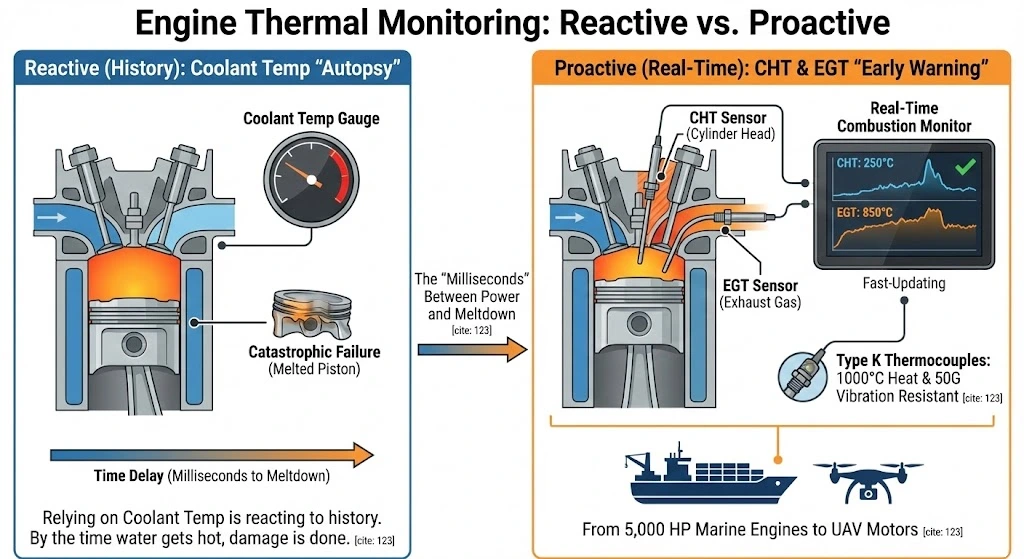
Cylinder Head (CHT) & Exhaust Gas Temperature (EGT) Sensors

Cylinder Head (CHT) & Exhaust Gas Temperature (EGT) Sensors: The Engineer’s Guide to Thermal Management

Introduction: The “Milliseconds” Between Power and Meltdown The Hook: In a high-performance diesel generator or a racing engine, the difference between “Peak Efficiency” and “Catastrophic Failure” is often just a few seconds of thermal runaway. If you are relying solely on your Coolant Temperature gauge, you are reacting to history. By the time the water

Cylinder Head (CHT) & Exhaust Gas Temperature (EGT) Sensors: The Engineer’s Guide to Thermal Management Read More »

DIN Standards & European Specs

Understanding “Thermoelements”: The Engineer’s Guide to DIN Standards & European Specs

Introduction: The “German Machine” Headache The Scenario: You are the maintenance lead for a bottling plant. Your $500,000 German-made Krones labeler has just stopped because a temperature sensor failed. You open the manual, and the part list simply says: “Thermoelement Type L.” You check your stockroom, grab a standard Type J thermocouple (since both are

Understanding “Thermoelements”: The Engineer’s Guide to DIN Standards & European Specs Read More »

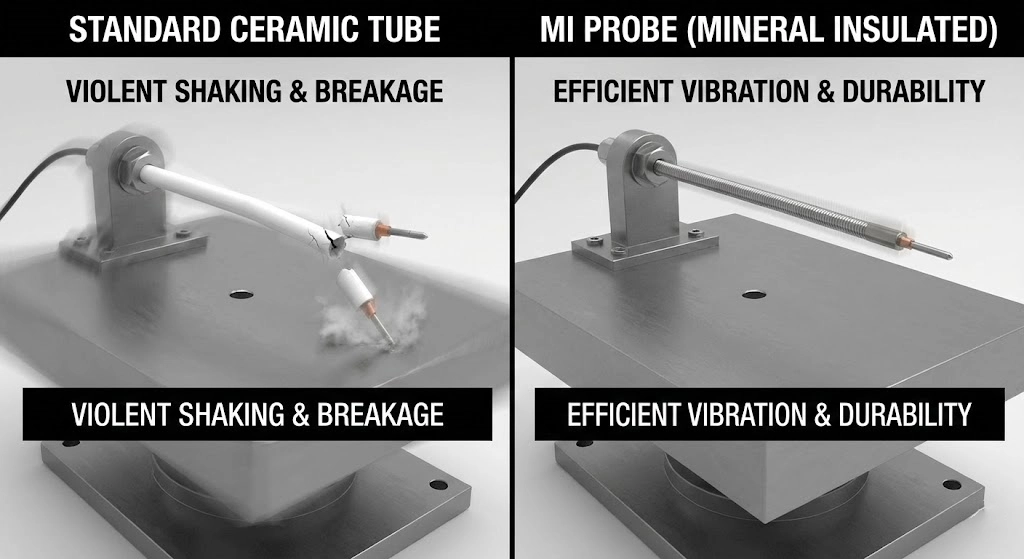
Vibration testing comparison between ceramic tube and mineral insulated thermocouple.

What is Mineral Insulated (MI) Cable? The “Unbreakable” Sensor Solution

Introduction: The “Rattle” of Death Scenario: You are running a 2,000 HP diesel generator set. The vibration is intense. You install a standard rigid thermocouple to monitor exhaust gas temperatures. Two weeks later, the reading goes “Open Circuit.” You pull the sensor out, and it sounds like a maraca. Inside the steel tube, the ceramic

What is Mineral Insulated (MI) Cable? The “Unbreakable” Sensor Solution Read More »

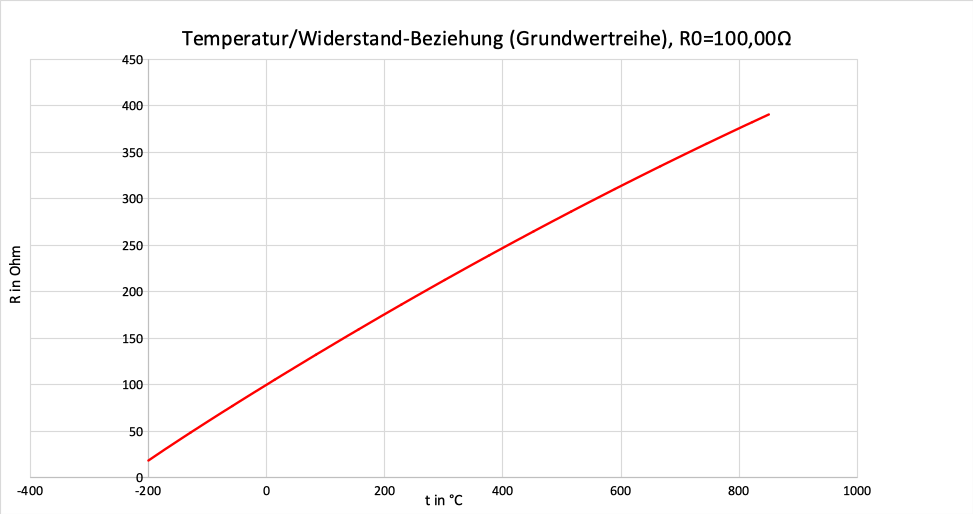
Pt100 vs Pt1000 resistance curve sensitivity graph.

Pt100 vs. Pt1000 Sensors: Which Resistance Value is Right for You?

Introduction: The “10x” Difference The Scenario: You are designing a wireless, battery-powered temperature logger for a cold chain logistics crate. You default to specifying a Pt100 sensor because “that is what we used on the steam turbine project.” Two weeks into testing, you hit two walls: The Physics: Both Pt100 and Pt1000 sensors are made

Pt100 vs. Pt1000 Sensors: Which Resistance Value is Right for You? Read More »

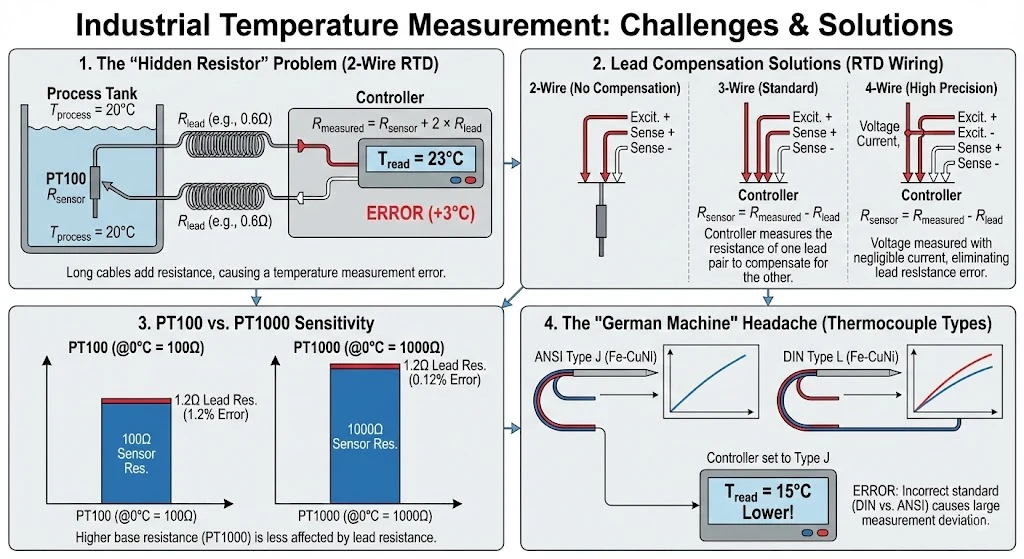
Mastering RTD Lead Compensation

2-Wire, 3-Wire, or 4-Wire? Mastering RTD Lead Compensation (2026 Guide)

Introduction: The “Hidden Resistor” The Scenario: You install a high-precision Class A Pt100 sensor. You run 50 meters of cable back to the control room. You power it up, and the controller reads 23°C, even though you know the tank is at 20°C. You replace the sensor, but the error remains. The Physics: The problem

2-Wire, 3-Wire, or 4-Wire? Mastering RTD Lead Compensation (2026 Guide) Read More »

Scroll to Top