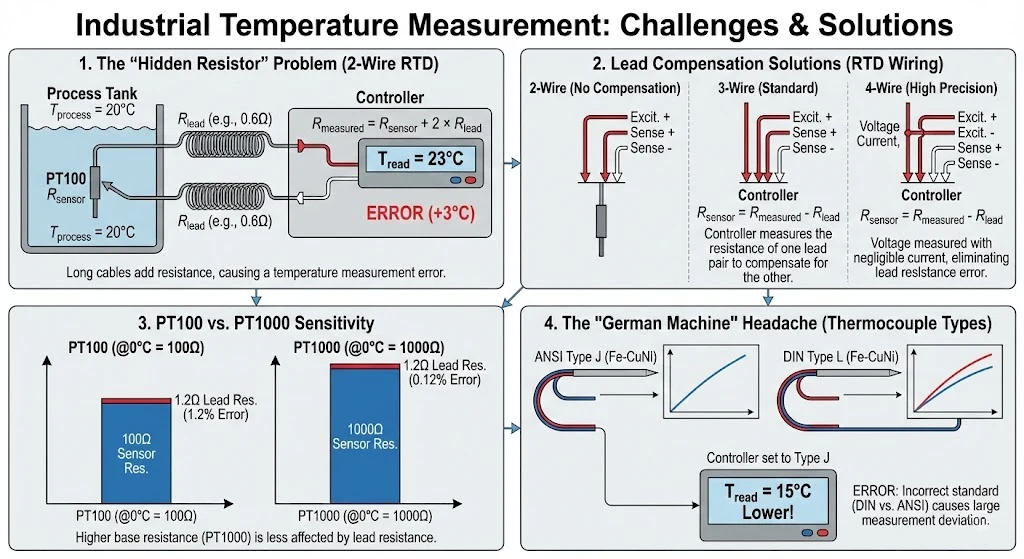
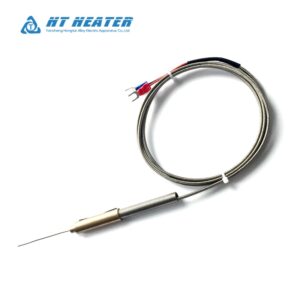
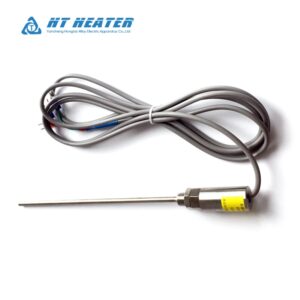
The Scenario: You are the maintenance lead for a bottling plant. Your $500,000 German-made Krones labeler has just stopped because a temperature sensor failed. You open the manual, and the part list simply says: “Thermoelement Type L.”
You check your stockroom, grab a standard Type J thermocouple (since both are Iron/Constantan), and install it. The machine starts, but the temperature reads 15°C lower than the setpoint. The glue doesn’t melt properly, and labels start peeling off.
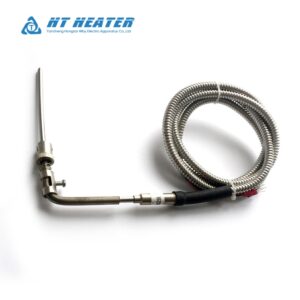
The Definition: First, let’s clear up the translation. “Thermoelement” is simply the German word for Thermocouple.
The Value: However, the name is not the only difference. German industrial engineering follows rigorous DIN Standards (Deutsches Institut für Normung). They have unique dimensions (Metric), unique threads (BSP), and unique legacy calibration curves (Type L/U) that do not match American (ANSI) or modern International (IEC) standards.
This guide will decode DIN 43772 and DIN 43710, helping you source perfect replacements for your European machinery without paying the OEM markup—and without falling into the “Type L” trap.
The “Old” German Standards: Type L and Type U (The Trap)
This is the single most common reason for temperature errors in imported European equipment.
Type L (Fe-CuNi) vs. Type J (Fe-CuNi)
Both Type L and Type J use an Iron Positive leg and a Constantan Negative leg. However, their EMF (Electro-Motive Force) curves are different.
DIN 43710 (Obsolete but common): Defines Type L. It was the standard in Germany until the 1990s. Thousands of machines built before (and even after) this date still specify Type L.
IEC 60584 (Modern): Defines Type J.
The Danger: If you replace a Type L sensor with a Type J sensor, the voltage output will not match the controller’s expectation. At 400°C, this can result in a 15°C to 20°C error.
Action: When ordering, check the machine manual carefully. If it says “Type L” or “Fe-CuNi DIN,” you must specify “DIN 43710 Type L” to your supplier.
Type U (Cu-CuNi) vs. Type T
Similarly, Type U is the old German version of the Copper-Constantan thermocouple. It is not interchangeable with the modern Type T.
DIN 43772: The “Lego System” of Protection Tubes
German engineering loves standardization. DIN 43772 dictates exactly how a sensor protection tube should be built. If you know the “Form” code, you know the dimensions.
Form 2 (Straight Tube): A straight metal sheath (usually 6mm or 8mm) with a G 1/2″ (BSP) process thread welded directly to it.
Form 3 (Tapered): Used for faster response times. The tip is swaged down (e.g., 12mm tapered to 9mm).
Form 4 (Bar Stock): A solid drilled thermowell welded to an extension neck. Designed for high-pressure steam and velocity.
Why it matters: Instead of sending a drawing with 20 dimensions, you can simply send us an RFQ for a “DIN 43772 Form 2G”. We instantly know the thread, neck length, and head connection.
The Iconic “Form B” Head (Connection Standard)
In the US, connection heads come in all shapes. In Europe, they almost always follow DIN 43729.
Form B (The Standard)
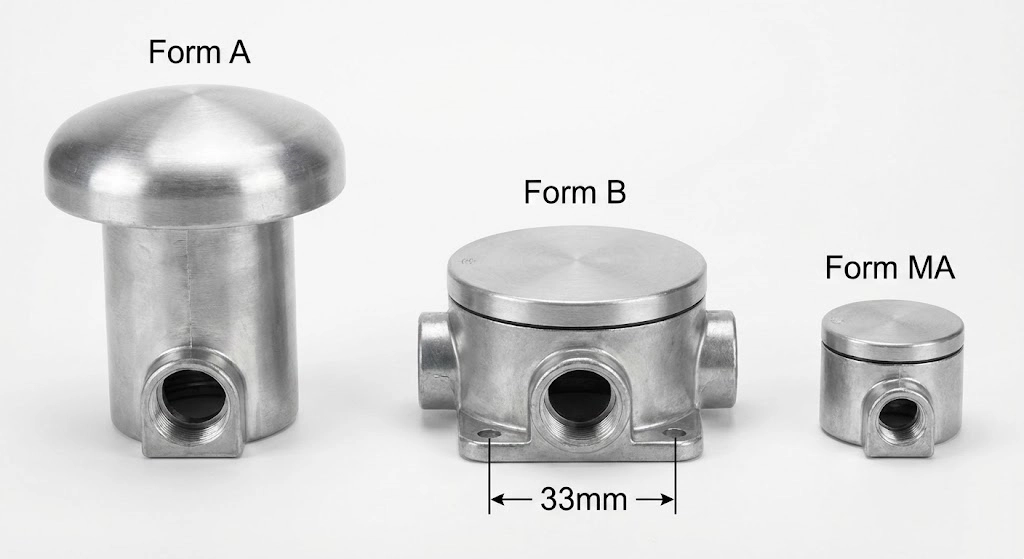
Appearance: The classic “Mushroom” shape. Flat top. Die-cast aluminum.
Size: Designed to fit a standard 42mm diameter ceramic terminal block or a “Hockey Puck” 4-20mA transmitter.
Thread: The conduit entry is typically M20 x 1.5 (Metric), not the 1/2″ NPT found in the US.
Form A (The Heavy Duty)
Appearance: Much larger and taller than Form B.
Use: Historical heavy industry. Allows for larger, thicker terminal blocks.
Form MA (The Mini)
Appearance: A miniature version of Form B.
Use: Tight spaces, typically with 3mm or 4mm probes.
DIN standard thermocouple connection heads Form A Form B and Form MA dimensions.
DIN Color Codes: Red is… Positive? (The Minefield)
If you are wiring a German machine, put down your American codebook.
Old DIN 43710 (The Legacy Standard)
This is where it gets dangerous for US engineers.
Type L:Red is Positive (+) / Blue is Negative (-).
Type U:Red is Positive (+) / Brown is Negative (-).
Warning: In ANSI (US), Red is always Negative. In old DIN, Red is Positive. Check the vintage of the machine!
New IEC 60584 (Germany’s Current Standard)
Modern German equipment now follows the global IEC standard.
European drawings specify materials using Werkstoff numbers (Material Numbers).
The Spec: You will often see “Protective Tube Material: 1.4571“.
The Translation: This is equivalent to AISI 316Ti (Titanium Stabilized Stainless Steel).
The Why: The addition of Titanium prevents intergranular corrosion when the steel is welded. Standard SS316 (1.4401) is often not accepted as a substitute in strict German chemical specs.
Our Promise: We stock 316Ti / 1.4571 material specifically for our European OEM replacement orders.
Comparison Matrix: DIN vs. ANSI
Use this table to translate between European and American specifications.
Feature
DIN (Germany / Europe)
ANSI (USA)
Thread Type
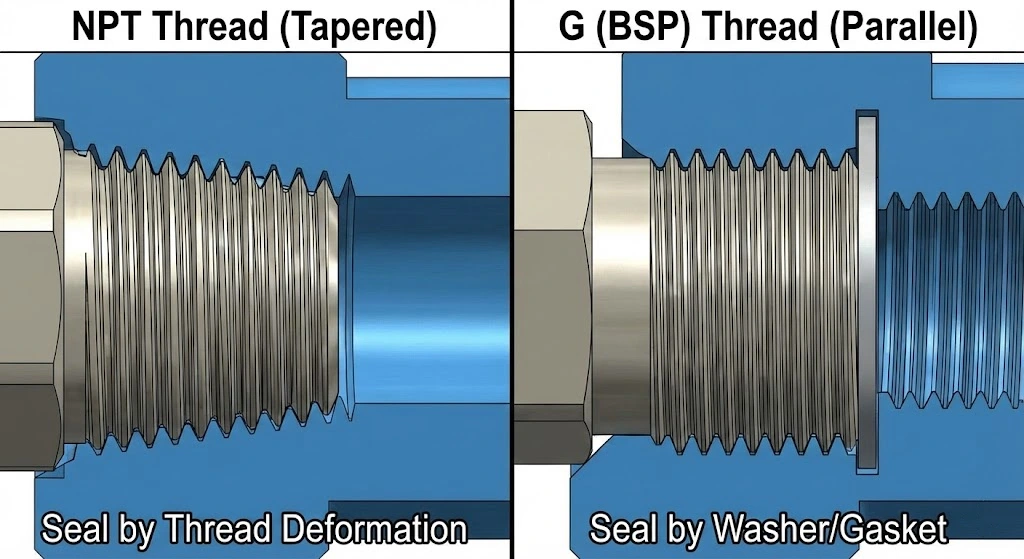
G / BSPP (Parallel)
NPT (Tapered)
Probe Diameter
Metric: 3, 6, 8, 10 mm
Imperial: 1/8″, 1/4″ (6.35mm), 3/8″
Conduit Thread
M20 x 1.5
1/2″ NPT
Type J Color
Black / White (IEC)
White / Red
Flange Standard
DN (e.g., DN25 PN40)
ANSI (e.g., 1″ 150#)
Accuracy Class
Class 1, Class 2
Special Limits, Standard Limits
Difference between NPT tapered thread and BSP parallel thread animation.
Frequently Asked Questions (FAQ)
What is a thermoelement?
“Thermoelement” is simply the German word for Thermocouple. However, in a technical procurement context, asking for a “Thermoelement” often implies a sensor built to DIN 43772 standards or using older DIN 43710 legacy calibration curves (like Type L or Type U), rather than standard American ANSI designs.
What is the difference between Type L and Type J thermocouples?
Both are made of Iron and Constantan, but they follow different EMF (voltage) curves. Type L is an obsolete German standard (DIN 43710), while Type J is the modern international standard (IEC 60584). They are NOT interchangeable. Swapping them will result in significant temperature errors, especially above 200°C.
What is a Form B connection head?
Form B is the most common DIN-standard terminal head for industrial sensors. It features a flat top, is typically made of die-cast aluminum, and has internal mounting holes spaced 33mm apart. It is designed to house a standard ceramic terminal block or a head-mounted 4-20mA transmitter.
Can I replace a DIN sensor with an ANSI sensor?
Physically, it might not fit. DIN sensors use Metric diameters (e.g., 6mm) and Parallel threads (G/BSP), while ANSI sensors use Imperial diameters (e.g., 1/4″ = 6.35mm) and Tapered threads (NPT). A 6.35mm probe will not fit into a precision 6.0mm mounting hole. Always measure the diameter with calipers before ordering.