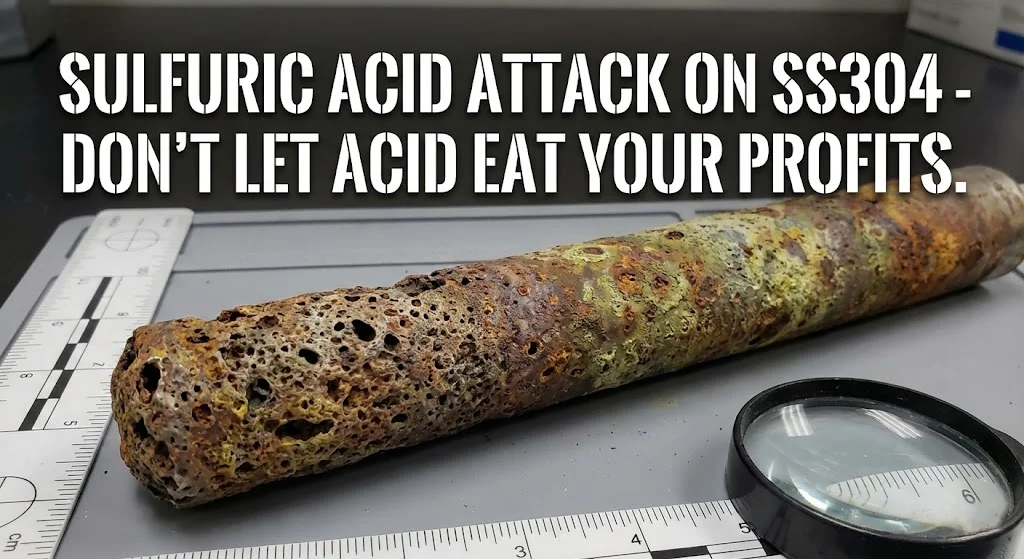
Scenario: A maintenance manager installs a brand new Type K thermocouple into a carburizing furnace running at 950°C. Two days later, the signal goes dead. When he pulls the probe out, the metal sheath has vanished—dissolved into a twisted, blackened skeleton, leaving the bare wires exposed.
The customer blames the sensor quality. But as a forensic engineer, you know the truth: The sensor was fine; the armor failed.
Many buyers assume “Stainless Steel” is invincible. They default to standard SS304 because it is cheap and available. But in the world of high-temperature thermodynamics and chemical corrosion, choosing the wrong alloy is an expensive mistake. At 900°C, SS304 loses its structural integrity and succumbs to oxidation, while high-nickel alloys are just getting warmed up.
This guide moves beyond the catalog part numbers. We will analyze the Metallurgy of the three most common sheath materials—SS304, SS316, and Incoloy 800—and look at when to switch to Ceramics. We will teach you how to match the sheath to the atmosphere to prevent catastrophic failure.
For 90% of industrial applications, your choice will come down to these three alloys. Understanding their grain structure and chemical composition is key to maximizing ROI.
The Pros: It is cost-effective, readily available, and offers decent corrosion resistance in standard environments.
The Cons: Above 850°C, SS304 suffers from rapid Intergranular Corrosion. The grain boundaries break down, causing the tube to become brittle and crack. It is also susceptible to “pitting” in chloride environments.
Best For: Food processing, packaging machinery, low-temp ovens, and general non-corrosive liquids.
2. Stainless Steel 316 (The “Food & Pharma” Choice)
Max Temperature (Air): 900°C (1650°F)
The “Moly” Factor: The critical difference is the addition of 2% Molybdenum (Mo). This element reinforces the passive oxide film on the steel’s surface, making it significantly more resistant to chemical attack.
The Pros: Superior resistance to pitting corrosion caused by chlorides (salt water), sulfuric acid, and fatty acids. It is the FDA-preferred standard for sanitary applications.
Best For: Pharmaceutical reactors, chemical processing tanks, marine environments, and food production where caustic cleaning agents (CIP) are used.
3. Incoloy 800 (The “High-Temp” Hero)
Max Temperature (Air): 1100°C (2012°F)
The Science: This is not a standard stainless steel; it is a Nickel-Iron-Chromium superalloy (32% Nickel, 21% Chromium).
Key Advantage: The high Nickel content provides exceptional resistance to Creep Rupture.
What is Creep? At high temperatures, metal softens and sags under its own weight. A long SS304 probe inserted horizontally into a furnace will eventually bend downwards like a wilted flower. Incoloy 800 maintains its rigid austenitic structure at 870°C and beyond.
Best For: Heat treatment furnaces, carburizing atmospheres, salt baths, and any application where the probe must remain straight and intact above 1000°C.
Thermocouple sheath material selection pyramid SS304 vs SS316 vs Incoloy.
Ceramic Protection Tubes: When Metal Fails (>1200°C)
When process temperatures exceed the melting point of steel, or when the environment allows no metal contamination (like molten glass), you must switch to technical ceramics.
Recrystallized Alumina (Type C799)
Purity: 99.7% $\text{Al}_2\text{O}_3$.
Max Temp: 1700°C (3100°F).
Application: This is the mandatory standard for Noble Metal Thermocouples (Type R, S, B).
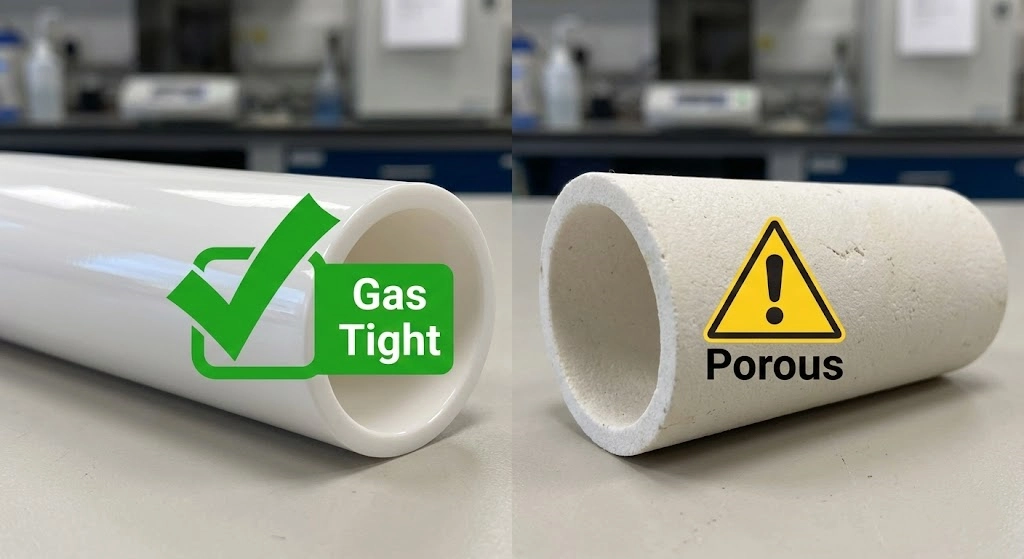
Why? Platinum wires are extremely sensitive to “poisoning” by metal vapors (iron/silicon) from the insulation. High-purity Alumina is gas-tight and chemically inert, acting as a perfect shield.
Mullite (Type C610)
Composition: 60% Alumina, 38% Silica.
Max Temp: 1400°C.
Pros/Cons: It is cheaper than Alumina but is porous (gas permeable). It allows contaminants to pass through.
Best For: Heater element support tubes or low-end kilns where high precision is not critical.
Engineering Warning: Ceramic tubes have poor thermal shock resistance. Inserting a cold ceramic tube directly into a 1500°C kiln will cause it to shatter. Preheat the tube before full immersion.
Difference between Alumina C799 and Mullite C610 ceramic protection tubes.
The “Atmosphere” Check (Chemical Compatibility)
This section separates the salespeople from the engineers. The temperature might be within limits, but the chemistry of the gas can destroy the sheath.
Sulfur Attacks (The Nickel Killer)
In atmospheres containing sulfur dioxide ($\text{SO}_2$) or Hydrogen Sulfide ($\text{H}_2\text{S}$)—common in flue gas or oil firing—Nickel is the weak link.
The Failure: Sulfur reacts with Nickel to form a low-melting-point eutectic. The metal literally dissolves.
The Trap: Incoloy 800 is great for heat, but it has 32% Nickel. It will rot in sulfurous gas.
The Solution: Use SS446 (High Chromium, very low Nickel) or a ceramic sheath.
Reducing Atmospheres (Carburizing)
The Threat: In a reducing atmosphere (low oxygen), standard Type K thermocouples suffer from “Green Rot.”
The Solution: Use Inconel 600 (different from Incoloy 800). Inconel 600 withstands nitrogen/hydrogen atmospheres well and is the standard sheath for Type N thermocouples.
Vacuum Applications
The Threat: At high vacuum and high heat, certain alloy elements (like Manganese or Chromium) can vaporize (outgas), contaminating the vacuum chamber or weakening the probe.
The Solution: Use refractory metals like Tantalum or Molybdenum, or high-purity Alumina.
Use this quick-reference table for your Bill of Materials (BOM).
Sheath Material
Max Temp (Air)
Key Feature
Typical Application
SS 304
850°C
Low Cost
General Purpose, Ovens, Simple Water Tanks
SS 316L
900°C
Corrosion Resistant
Chemical, Food (FDA), Marine, Acidic Washdown
Incoloy 800
1100°C
High Strength (Creep)
Heat Treating, Carburizing Furnaces
Inconel 600
1150°C
Oxidation Resistant
Corrosive Gas, Nuclear, Type N Sensors
SS 446
1050°C
Sulfur Resistant
Flue Gas, Molten Lead/Tin
Alumina (C799)
1700°C
Contamination Free
Molten Glass, Kilns, Platinum Sensors
Wall Thickness & Response Time
Once you pick the material, you must pick the thickness. This is a trade-off between Longevity and Response Time.
Thin Wall (0.5mm – 1.0mm)
Pros: Fast heat transfer. Quick response to temperature spikes.
Cons: Structurally weak. Easy to bend or break under vibration.
Use: Air ducts, stationary ovens, laboratory testing.
Heavy Wall / Thermowells
For high-velocity liquids or high-pressure steam, a simple sheath is not enough. You need a Thermowell.
Drilled Bar Stock: We take a solid bar of SS316 or Incoloy and drill a hole down the center. This creates a tapered, heavy-duty armor.
Engineer’s Rule: If fluid velocity > 5m/s, perform a Wake Frequency Calculation (ASME PTC 19.3 TW) to ensure the wake turbulence won’t snap the probe.
Thermocouple material chemical compatibility chart PDF download.
Frequently Asked Questions (FAQ)
What is the difference between SS304 and SS316 thermocouple sheaths?
SS316 contains 2-3% Molybdenum, which makes it much more resistant to corrosion from chlorides (salt), acids, and marine environments compared to standard SS304. SS304 is cheaper and sufficient for general non-corrosive applications like simple ovens or water tanks, but SS316 is required for food (FDA) and pharmaceutical processing.
Why use Incoloy 800 for thermocouples?
Incoloy 800 is a nickel-iron-chromium alloy designed specifically for high temperatures. It resists oxidation, carburization, and “High-Temperature Creep” (sagging under its own weight) much better than stainless steel at temperatures above 800°C. It is the industry standard for heat treatment furnaces.
Can I use a metal sheath in molten aluminum?
No. Molten aluminum aggressively dissolves standard stainless steel and even Incoloy. The probe will fail in minutes. You must use a specialized cast iron protection tube or, ideally, a Sialon (Silicon Nitride) ceramic sheath to survive the aggressive nature of molten aluminum.
What is the maximum temperature for a 316 stainless steel probe?
While SS316 has a melting point around 1370°C, its practical continuous operating limit in air is about 900°C. Above this temperature, it oxidizes rapidly (scaling) and loses structural strength. For temperatures >900°C, you should upgrade to Incoloy 800 or Ceramic.