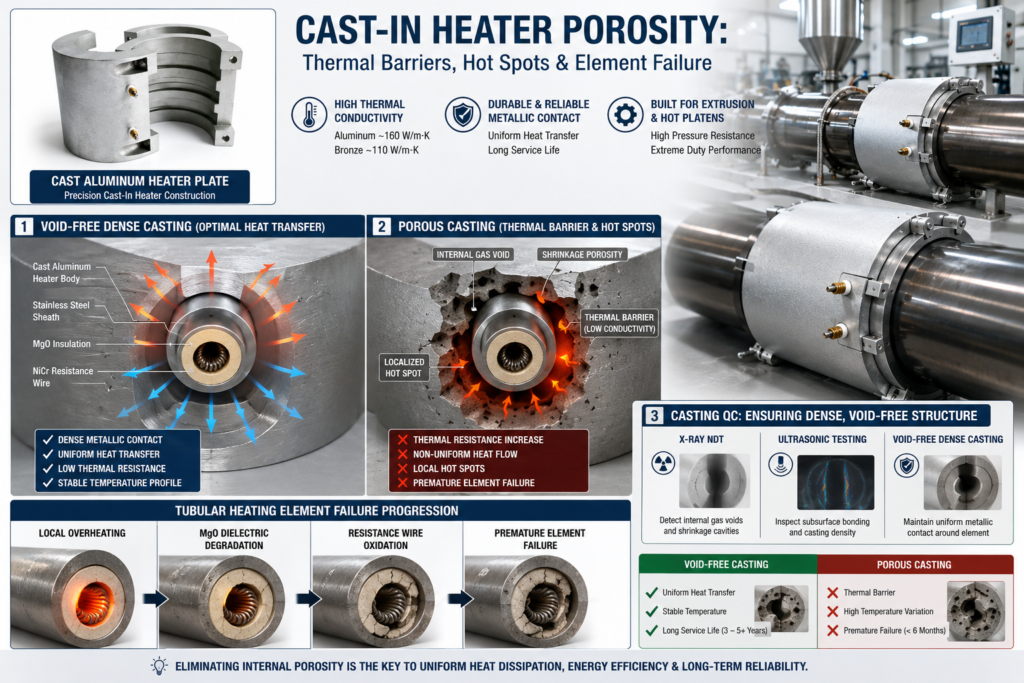
Internal cast in heater porosity created during aluminum or bronze liquid pouring severely undermines thermal conductivity, creating localized thermal barriers and leading to premature internal element failure. For thermal engineers and casting quality control managers, eliminating internal shrinkage and gas voids is critical to maintaining uniform heat dissipation across high-performance extruders and hot platens.
Understanding how subsurface voids disrupt heat flow allows foundry specialists to optimize casting protocols and protect embedded tubular heating elements from dielectric breakdown.
1. Thermodynamic Impact of Cast in Heater Porosity
The primary objective of encapsulation in a cast heater is to establish seamless metallic contact with the internal tubular element. When molten aluminum (thermal conductivity ~160 W/m·K) or bronze (~110 W/m·K) solidifies, gas entrainment and volumetric shrinkage often generate micro-voids:
- Thermal Resistance Spikes: Trapped gas within internal voids exhibits an extremely low thermal conductivity (~0.026 W/m·K). Even a microscopic void adjacent to the element sheath acts as an insulating wall.
- Impaired Heat Dissipation: die casting heater voids force radiant heat back into the tubular heating element rather than conducting it outward to the working surface.
- Disrupted Isothermal Profiles: Subsurface porosity degrades cast aluminum heater thermal uniformity, creating uneven temperature zones across the barrel or platen face.
2. Hot Spots Caused by Cast in Heater Porosity
When cast in heater porosity isolates sections of the embedded heating tube, thermal energy cannot escape. This triggers a destructive thermal feedback loop:
- Localized Overheating (Hot Spots): The sheath temperature at the void interface rapidly spikes hundreds of degrees above the nominal operating target.
- MgO Dielectric Degradation: Extreme localized heat degrades the compacted magnesium oxide (MgO) insulation inside the tubular element, causing electrical resistance drops and leakage currents.
- Resistance Wire Burnout: Prolonged exposure to hot spots accelerates NiCr resistance wire oxidation, leading to open-circuit failure long before the element reaches its design life.
Before diagnosing internal porosity or void ratios, verify that your heating core matches the thermal and mechanical limits of your operating temperature by reviewing our Cast-in Heater Material Selection Guide: Aluminum vs. Bronze vs. Iron.
| Casting Quality Parameter | Void-Free Dense Casting | Porous Casting (High Void Ratio) |
| Effective Thermal Conductivity | Optimal (100% Alloy Rated) | Reduced by 20% – 45% |
| Surface Temperature Variation | ±1°C to ±3°C (High Uniformity) | ±15°C to ±35°C (Severe Hot Spots) |
| Internal Sheath Operating Temp | Controlled (Near Barrel Temp) | Overheated (+150°C local spike) |
| Element Service Life | 3 to 5+ Years Continuous | Premature Failure (<6 Months) |
3. QC Protocols for Preventing Cast in Heater Porosity
To guarantee cast aluminum heater thermal uniformity and eliminate internal voids during manufacturing, quality control managers should enforce strict inspection protocols:
- Tilt-Pouring & Vacuum Assist: Utilize gravity-tilt or vacuum-assisted pressure casting to minimize gas turbulence and liquid oxidation during mold filling.
- Radiographic X-Ray NDT: Subject 100% of critical heater castings to non-destructive X-ray inspection to detect hidden die casting heater voids around internal sheath bends.
- Ultrasonic Flaw Detection: Perform ultrasonic scanning along the contact surface to ensure complete metallic bond density prior to final CNC machining.
If your machinery experiences broader thermal degradation or element failure across neighboring heating zones, consult our diagnostic guide on roubleshooting 101: 5 Common Causes of Band Heater Burn-Out for systematic insulation testing.
For comprehensive engineering specifications across our complete industrial line, explore Industrial Band Heaters: The Ultimate Engineering Guide to Selection, Efficiency & Troubleshooting (2026 Edition).