Ceramic Infrared Heating Element failure halts production and creates massive headaches for maintenance supervisors and after-sales engineers. When you are standing on the factory floor dealing with frequent ceramic heater failure, you need a reliable, step-by-step diagnostic protocol, not guesswork. This guide provides the actionable testing procedures necessary for troubleshooting ir heaters quickly, identifying the root cause of the burnout, and establishing trust with your clients by resolving the underlying system flaws.
1. Visual Inspection: Identifying a Broken Ceramic Heating Element
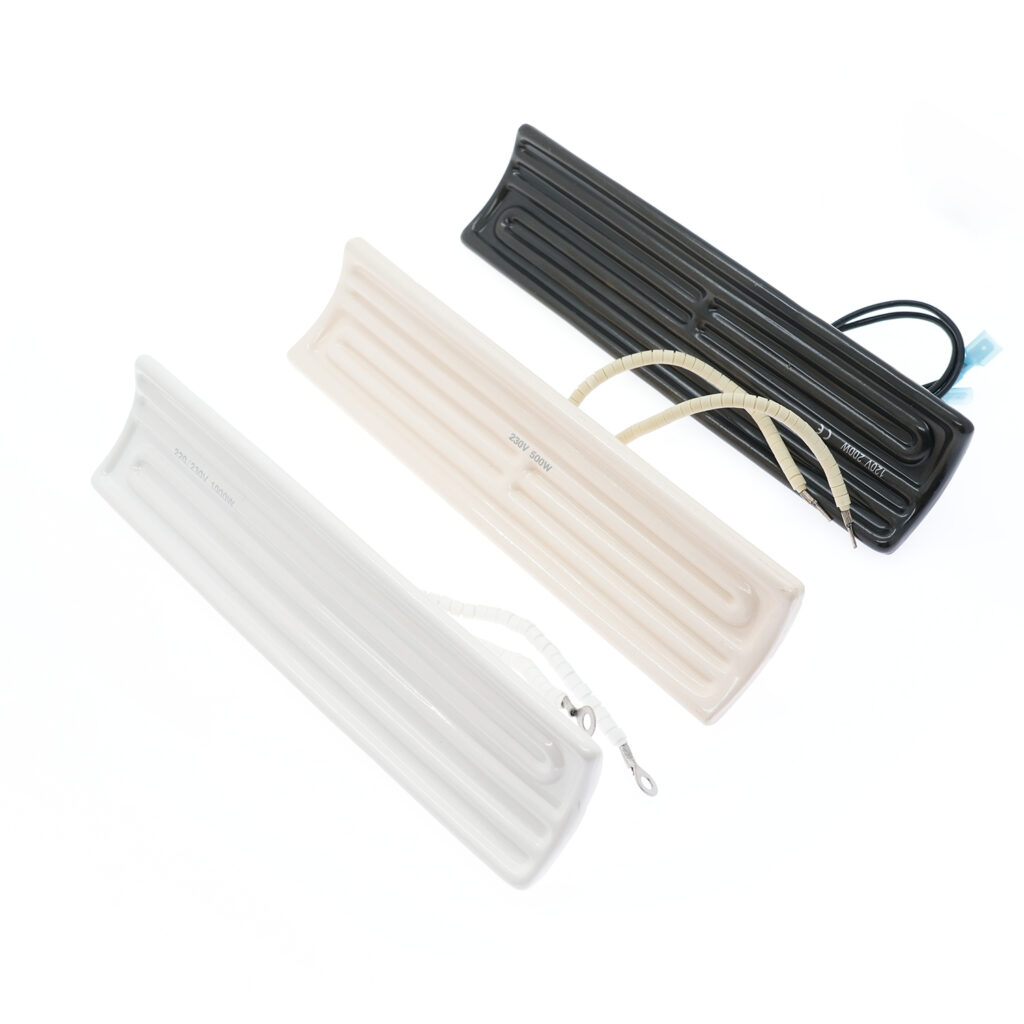
Before grabbing your tools, conduct a thorough visual inspection of the Ceramic Infrared Heating Element array. Physical degradation often tells the story of the failure before you even test the electrical circuit.
- Cracked Refractory Glaze: Spiderweb cracking on the emitting face indicates severe thermal shock (cooling or heating too rapidly). If you notice this specifically on hollow designs used in rapid-cycle packaging, revisit our engineering parameters in Hollow Ceramic Heaters: Minimizing Heat Loss in Thermoforming Machines to ensure your PID ramp rates are within safe limits.
- Oxidized Cold Pins: If the electrical terminals are blackened or melted, the element was likely mounted too tightly against the reflector, trapping convective heat.
- Contamination: Melted plastics, oil, or aggressive chemical washdowns can eat through the ceramic glaze, exposing the internal resistance wire to the atmosphere and causing an immediate short.
2. The Multimeter Diagnostic Test (Standard Operating Procedure)
To accurately diagnose a broken ceramic heating element, maintenance engineers must rely on precise multimeter readings. Follow this SOP to verify the integrity of the internal nickel-chrome circuit:
Step 1: Safety Isolation
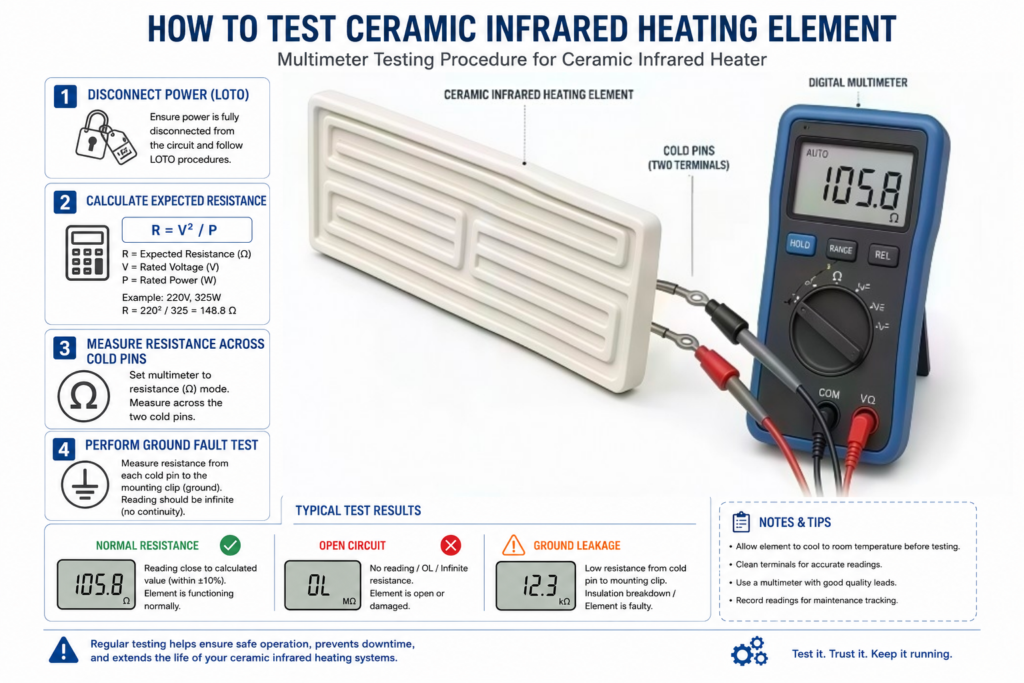
Disconnect all power to the industrial oven or heating panel. Lock out and tag out (LOTO) the main breaker. Disconnect the specific Ceramic Infrared Heating Element from the parallel or series wiring harness to ensure you are only reading the individual heater.
Step 2: Baseline Resistance Calculation
Before measuring, calculate the expected resistance of a healthy heater using Ohm’s Law. You need the rated voltage (V) and the rated wattage (P) printed on the heater’s chassis:
Example: A 230V, 500W heater should have a baseline resistance of (230 × 230) / 500 = 105.8 Ω. Allow for a standard manufacturing tolerance of ±5% to ±10%.
Step 3: Continuity & Resistance Testing
Set your digital multimeter to the Ohms (Ω) setting. Place one probe on each cold pin terminal.
- Reading matches calculation (±10%): The heater’s internal circuit is fully functional. The failure is likely in the external wiring, the SSR (Solid State Relay), or the controller.
- Reading is “OL” (Open Loop) or infinite: The internal resistance wire has snapped or melted. The Ceramic Infrared Heating Element is permanently dead and must be replaced.
Step 4: Dielectric Ground Fault Test
Set the multimeter to the highest Megaohm (MΩ) setting. Place one probe on a cold pin and the other probe directly against the ceramic body or the metal mounting clip. You should read infinite resistance. If you read any continuity, the internal insulation has failed, and the heater is leaking dangerous voltage to the chassis.
3. Root Cause Analysis & System Prevention
Replacing a broken ceramic heating element without fixing the root cause guarantees a repeat service call. If your multimeter tests confirm internal wire melting across multiple units, the system is fundamentally over-specified.
The most frequent culprit for this type of ceramic heater failure is an excessive surface load. If you are continuously replacing units, you must verify your thermal flux mathematics by consulting our technical manual on How to Calculate Watt Density for Ceramic Infrared Heaters.
For a comprehensive review of baseline system parameters to prevent these failures from occurring in new machine builds, ensure your engineering team reviews Ceramic Infrared Heaters: The Complete Engineering & Selection Guide before signing off on the next thermal loop design.