Quartz vs. Ceramic Infrared Heaters represent two fundamentally different approaches to industrial thermal management.For process control engineers, thermal system design often presents a critical dilemma: should the system prioritize rapid thermal cycling, or should it maximize the depth and efficiency of material absorption? Selecting the wrong heating element can lead to severe process bottlenecks, including surface scorching, excessive energy waste, or sluggish production speeds.
When evaluating quartz vs ceramic heater options for industrial machinery, the decision ultimately hinges on two fundamental physical properties: thermal response time and the infrared heater wavelength.
Below is an engineering analysis designed to help you match the correct infrared emitter to your specific substrate and process control requirements.
1. Quartz vs Ceramic Heater Physics: Wien’s Displacement Law
Infrared heating is not a one-size-fits-all solution. The efficiency of heat transfer depends on the peak wavelength emitted by the heater, which is inversely proportional to its surface temperature. This fundamental relationship in any quartz vs ceramic heater evaluation is defined by Wien’s Displacement Law:
λmax = b / T
(Where λmax is the peak wavelength in microns, b is Wien’s displacement constant 2898\mum\cdot K, and T is the absolute temperature in Kelvin).
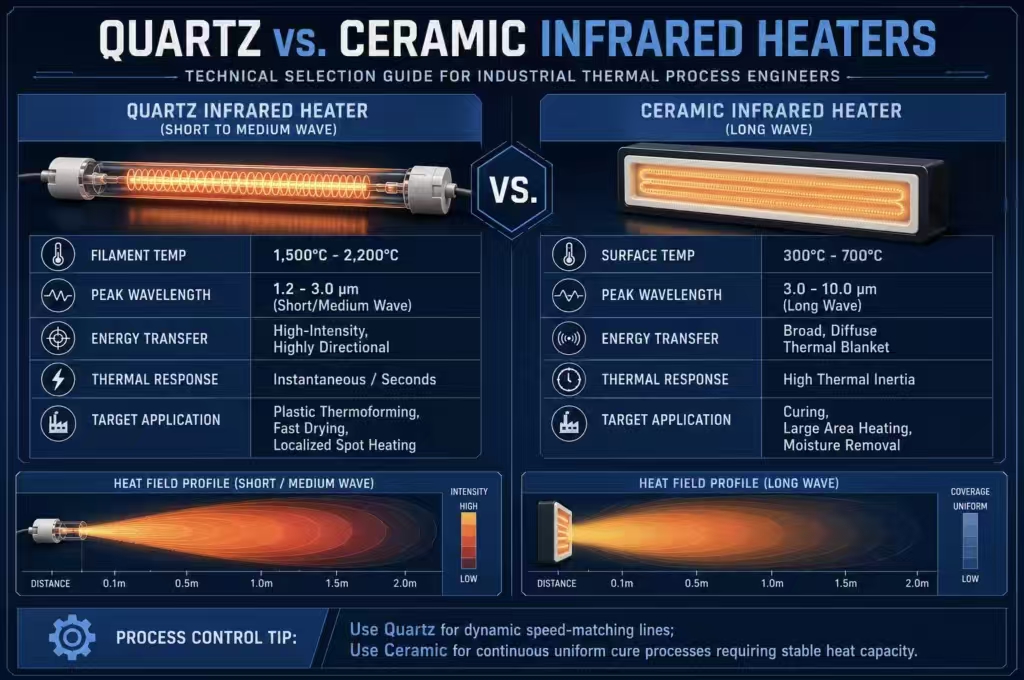
- Quartz Infrared Heaters (Short to Medium Wave): Operating at tungsten filament temperatures between 1,500°C and 2,200°C, quartz lamps emit peak energy in the 1.2 to 3.0 micron range. This high-intensity, short-wave radiation is highly directional and carries immense localized energy.
- Ceramic Infrared Heaters (Long Wave): Operating at surface temperatures between 300°C and 700°C, ceramic elements emit peak energy in the 3.0 to 10.0 micron range. This long-wave radiation provides a broader, more diffuse thermal blanket.
2. Response Time: Quartz vs Ceramic Heater Thermal Inertia
In automated manufacturing, the speed at which a heater can reach its setpoint—and cool down—dictates the cycle time of the machine.
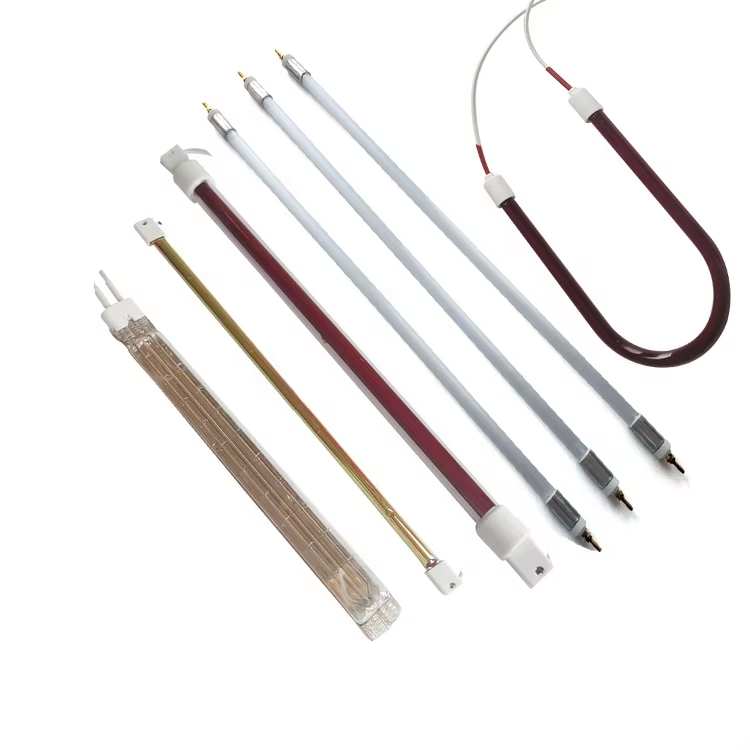
The Fast Response IR Emitter: Quartz
Quartz lamps have virtually zero thermal mass. When energized, the internal tungsten or carbon fiber filament reaches operating temperature within 1 to 3 seconds. More importantly, when the power is cut, the heat dissipates almost instantly.
- Best For: Fast-indexing machinery, continuous web applications that frequently start/stop, and safety-critical environments where the heat source must extinguish immediately if the conveyor halts to prevent fires.
The High Thermal Mass Emitter: Ceramic
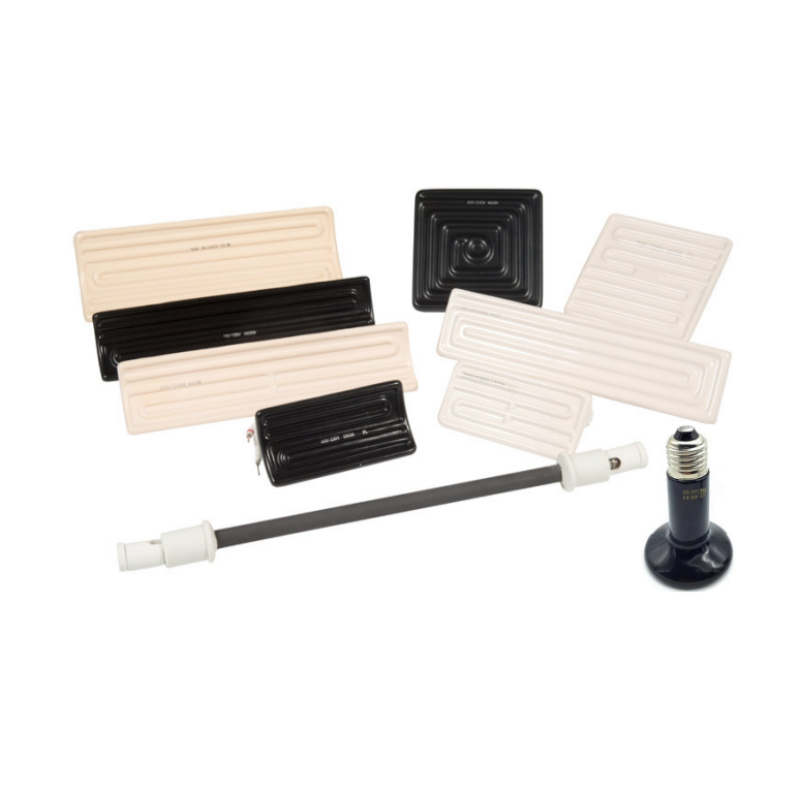
Ceramic heaters rely on a high-density refractory clay body to absorb and radiate the heat generated by the embedded resistance wire. This results in a ramp-up time of 5 to 15 minutes to reach a steady state.
- Best For: Continuous, 24/7 steady-state operations (e.g., curing ovens). The high thermal inertia acts as a buffer, preventing temperature micro-fluctuations. (For continuous large-area processing, read our guide on Flat Ceramic Heaters Engineering Specs).
3. Substrate Absorption: Quartz vs Ceramic Heater Wavelength Matching
The most critical factor in any quartz vs ceramic heater selection process is the target material’s absorption spectrum. If the heater’s wavelength does not match the material’s absorption peak, the energy will either pass straight through the material or bounce off.
- Heating Plastics and Water (Ceramic is King): The C-H and O-H molecular bonds found in most plastics (PVC, PET, Polycarbonate) and water absorb infrared energy most efficiently in the 3.0 to 3.5 micron range and beyond. Because ceramic heaters naturally emit in this long-wave spectrum, the heat penetrates deeply and evenly, avoiding surface blistering.
- Surface Curing and Thin Films (Quartz Excels): If you attempt to heat a clear, thin plastic film with a short-wave quartz lamp, the light will often pass directly through the plastic. However, if the target is an opaque substrate, dark pigment, or a high-speed metal surface curing process, the intense, highly directional short waves of a quartz lamp will flash-cure the surface instantly.
4. Quartz vs Ceramic Heater: Head-to-Head Comparison
| Parameter | Quartz Infrared Heaters | Ceramic Infrared Heaters |
| Peak Wavelength | 1.2 – 3.0 µm (Short/Medium Wave) | 3.0 – 10.0 µm (Long Wave) |
| Response Time | 1 to 3 Seconds (Instant ON/OFF) | 5 to 15 Minutes (Slow Ramp) |
| Thermal Mass | Extremely Low | High (Stable Temperature) |
| Best Substrates | Opaque materials, thin films, metals | Thick plastics, water-based coatings |
| Optimal Process | Rapid indexing, frequent starts/stops | Continuous, steady-state curing & baking |
| Durability | Fragile glass tube; avoids thermal shock | Rugged, impact-resistant; tolerates splashes |
Optimize Your Thermal Loop with HT-Heater
Selecting between quartz and ceramic technology requires a precise calculation of your line speed, substrate material, and controller architecture.
Building a multi-zone curing oven? Contact our engineering team for a custom infrared thermal simulation.
Need instant ON/OFF capabilities for high-speed indexing? Review our Quartz Heating Lamp Customization & Sourcing Guide.
Looking to pair your heaters with closed-loop PID sensors? Read our Industrial Thermocouple & RTD Sensor Guide: Principles, Types, and Selection.