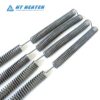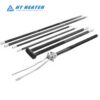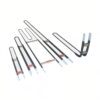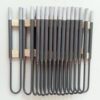
When an industrial furnace process requires continuous operating temperatures between 1500 °C and 1750 °C in oxidizing atmospheres, a MoSi2 heating elements (molybdenum disilicide cermet heater) is the industry standard. Operating well beyond the metallurgical limits of metallic resistance wire and silicon carbide, MoSi₂ forms a self-healing quartz glass (SiO2) surface film that delivers stable, non-aging radiant heat in advanced sintering, crystal growth, and specialty glass manufacturing.
For kiln designers and thermal equipment OEMs, effective specification requires matching MoSi2 element grades, geometric configurations, and hot/cold zone dimensions to chamber atmosphere and electrical control limits. If you are still evaluating element technologies across temperature thresholds, start with our foundational guide: Industrial Furnace Heating Elements: NiCr vs. SiC vs. MoSi₂.
1. MoSi₂ Element Grades: 1700, 1800 and Specialized Grades
Molybdenum disilicide element ratings designate the maximum rated element surface temperature capability in clean air, not the continuous chamber temperature. Because radiant heat transfer requires a thermal gradient between the element and the workload, the element surface typically runs 50°C to 150°C hotter than the chamber thermocouple.
- Grade 1700 (Standard Industrial): Engineered with a balanced molybdenum-to-silicon ratio and ceramic phase. Delivers long campaign life and stable SiO2 film formation for standard high-temperature kilns.
- Grade 1800 (Ultra-High Temperature): Formulated with refined sub-micron grains and high-purity grain boundaries to raise the softening point of the silica glaze and improve high-temperature creep resistance.
- Specialized / Low-Temperature Cyclic Grades: Standard MoSi₂ is susceptible to accelerated intergranular oxidation (“pesting”) when dwelling continuously between 400°C and 700°C. For cyclic batch kilns requiring prolonged low-temperature binder burnout, manufacturers provide specialized grades and pre-oxidized treatments that suppress pesting.
2. U, W, and L Shapes: Matching Geometry to Furnace Design
Because MoSi₂ transitions from a brittle cermet at room temperature to a ductile, plastic material above 1200°C, elements will sag under their own weight if mounted horizontally without support. Therefore, most MoSi2 furnace element designs rely on vertically suspended, pre-formed shapes:
| Shape Profile | Structural Configuration | Suspension & Mounting Requirements | Typical Furnace Applications |
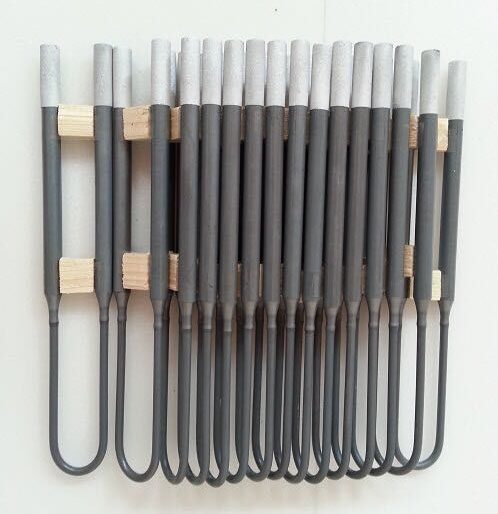
| U-Shape (Standard) | Two cold terminals welded to a single U-shaped heating loop | Vertical roof suspension; hangs freely into the chamber | Box furnaces, elevator (bell) kilns, dental ovens, and high-temperature car-bottom kilns |
| W-Shape (Four-Shank) | Four heating legs formed on a single plane with two cold terminals | Vertical suspension; requires wider roof slot spacing | Wide continuous tunnels, float glass forehearths, and chambers requiring wide radiant coverage |
| L-Shape (90° Bent) | Cold terminals bent at $90^\circ$ relative to the active heating legs | Side-wall horizontal penetration with heating legs hanging vertically | Bell furnaces with overhead hoists, or melting pots where roof penetrations are blocked |

Horizontal Installation Note: If process constraints mandate horizontal mounting, elements must be derated by 150°C to 200°C and supported continuously along their hot length by slotted, high-purity alumina refractory saddles to prevent contact reaction and sagging.
3. How to Specify MoSi₂ Dimensions: D1, D2, Le, Lu, and A
Accurate fabrication drawings and replacement orders require five baseline dimensions:
1.Diameter Combinations (D₁ / D₂): The slender hot zone (D₁) provides electrical resistance, while the cold end (D₂) has roughly twice the diameter (D₂ ≈ 2 × D₁), yielding a 4:1 cross-sectional area ratio to minimize terminal parasitic heat loss. Standard pairings:
- ∅3/6 mm & ∅4/9 mm: Dental sintering ovens and compact laboratory furnaces.
- ∅6/12 mm: Universal production standard for industrial sintering kilns.
- ∅9/18 mm & ∅12/24 mm: High-power, wide-span production kilns requiring maximum creep resistance.
2.Tapered Joint Location: The conical weld joint between D₁ and D₂ must extend clear into the open furnace chamber (typically 15 mm to 30 mm below the refractory face). Drawing the tapered weld into the roof hole traps heat, causing localized thermal runaway and weld burnout.
3.Hearth Clearance: Allow sufficient clearance beneath the bottom U-bend (typically ≥ 30 mm to 50 mm) to accommodate downward thermal expansion and roof brick settling.
4. Operating Atmosphere, Temperature, and Electrical Limits
Process gases react directly with the protective quartz glass (SiO2) layer. The table below outlines operating considerations across typical atmospheres:
| Furnace Atmosphere | Temperature Capability | Chemical Interaction & Engineering Design Precautions |
|---|---|---|
| Clean Air / Dry Oxygen | Full rated capacity (Grade 1700 up to 1700°C; Grade 1800 up to 1800°C) | Ideal baseline. Continuously regenerates protective SiO2 glass layer. |
| Pure Nitrogen (N2) | Typically restricted to 1300°C–1450°C (grade-dependent) | Nitrogen reacts with Si to form Si3N4, depleting the glaze. Periodic baking in clean air restores the quartz film. |
| Dry Hydrogen (H2) / Reducing | Restricted to 1250°C–1400°C (strongly dew-point dependent) | Hydrogen reduces solid SiO2 to volatile silicon monoxide (SiO). Drier atmospheres require deeper temperature derating. |
| Argon (Ar) / Helium (He) | Typically 1500°C–1650°C | Chemically inert, but lacks oxygen to heal cracks. Pre-oxidize elements in air prior to inert gas cycling. |
Electrical Control: Non-Aging Resistance vs. Cold Inrush
- Stable Resistance (No Aging): Unlike silicon carbide, MoSi₂ does not undergo continuous resistance aging. If an element breaks, a new element can be installed into an existing series circuit without voltage-divider imbalance. (For comparative aging mechanisms, review SiC Heating Element Resistance: Aging, Power Control & Replacement).
- Steep PTC Curve & Soft-Start: MoSi₂ exhibits a steep Positive Temperature Coefficient: cold resistance is 10x to 12x lower than operating hot resistance. Energizing elements directly across line voltage causes a trip-level current spike. Power systems require a step-down transformer paired with an SCR power controller with phase-angle soft-start and active current limiting.
5. MoSi₂ Element Selection Checklist for Furnace OEMs
When requesting engineering verification or quotes from Hongtai Heater Factory, compile this standard specification block:
[ STANDARD RFQ SPECIFICATION BLOCK ]
- Part Specification : MoSi2-[Grade] [Shape], Ø[D1/D2] x Le [mm] x Lu [mm] x A [mm]
Example Ordering Code: MoSi2-1800 U-Type, Ø6/12 x Le 300 x Lu 250 x A 50 mm - Operating Baseline: Continuous Chamber Temp: °C | Max Peak Temp: °C
- Atmosphere Profile: Clean Air / Nitrogen / Hydrogen / Argon / Vacuum
- Mounting Style : Vertical Roof Suspension / Horizontal Saddle-Supported / L-Bent
- Power Supply Setup: Secondary Transformer Voltage | SCR Controller Amp Limit
- Required Hardware : Alumina Passage Bricks / Single-Hole Holder Clamps / Aluminum Braids
Partner with Hongtai for Engineered High-Temperature Furnace Heating Solutions
Achieving precise temperature uniformity at 1600°C to 1800°C requires high-purity cermet materials, matched refractory hardware, and current-limited power integration.Hongtai Heater Factory manufactures custom industrial molybdenum disilicide heating elements (Grades 1700 and 1800 in U, W, L, and custom profiles)—supplied complete with matched ceramic passage bricks, terminal clamps, and flexible aluminum braids—engineered to your exact chamber drawings.
- Consult our Engineers: Send your wiring schematics to the Hongtai Heater Factory technical team for a free design review.
- Visit Us:: www.hongtai-heater.com