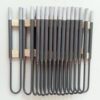
In ultra-high-temperature industrial furnaces operating between 1500°C and 1750°C, molybdenum disilicide (MoSi2) heating elements are engineered to deliver thousands of hours of stable, non-aging radiant power. Under ideal conditions, the element continuously generates a dense, self-healing silica (SiO2) quartz glaze that shields the intermetallic core from degradation.
Yet, maintenance teams frequently encounter sudden MoSi2 heating element failure: yellowish powders shedding from the shanks, brittle fractures across cold shanks, terminal arcing, or elements that sag and short against adjacent legs.
Replacing broken elements without diagnosing the root cause leads to recurring downtime and inflated consumable budgets. This guide provides kiln maintenance managers and field engineers with a systematic diagnostic framework—connecting visual fracture patterns, surface glaze conditions, and electrical logs to actionable corrective measures. If you are experiencing electrical tripping or inrush problems on cold start-up, review our companion guide: MoSi2 Heating Element Power Control: Cold Resistance, Startup Current & SCRs.

1. Visual Failure Location Map & Diagnostic Matrix
When inspecting an underperforming or tripped furnace, identify the exact physical location of the damage along the element profile:
MoSi2 Heater Troubleshooting Matrix
| Observed Symptom | Primary Engineering Root Cause | Diagnostic & Corrective Action |
| Loose yellowish-green powder; shank diameter thinning | Low-temperature intergranular oxidation (pesting) during prolonged dwell in sensitive thermal zones | Inspect ramp profile; accelerate heating through the 400°C–600°C band; check for continuous low-temperature debinding cycles |
| Clean, flat fracture at the roofline or cold shank | Mechanical installation stress, rigid terminal clamping, or refractory brick thermal movement | Verify passage bore alignment; ensure cold ends float freely; loosen terminal braids to eliminate pull forces |
| Tapered weld joint melted, blistered, or fractured | Active transition joint positioned inside the roof insulation sleeve rather than clear in the open chamber | Measure cold end length (Lu); ensure the tapered weld protrudes past the inner refractory face per design drawings |
| Shanks bent into wide arcs, touching adjacent elements | High-temperature creep deformation under self-weight, electrodynamic forces, or misaligned roof holders | Check holder verticality; install ceramic shank spacing combs; verify SCR current limits to eliminate Lorentz-force pulses |
| Glaze running, forming teardrops, or foaming white | Chemical glaze fluxing caused by volatile alkalis, heavy metals, glass fluxes, or halogen vapors | Improve furnace exhaust ventilation; install protective muffles; burn out volatile binders before sealing the chamber |
| Terminal metallizing blackened, burnt, or arcing | Annealed terminal spring clips, loose hardware, undersized braid straps, or grease contamination | Clean metallized surfaces (never apply grease); install new high-temper spring clamps and multi-layer aluminum braids |
2. MoSi₂ Pesting: Low-Temperature Oxidation vs. Normal Glaze Passivation
One of the most misunderstood phenomena in MoSi2 oxidation is low-temperature “pesting,” typically active in the 400°C to 600°C range (and occasionally extending up to 700°C depending on material formulation, porosity, and atmosphere moisture).
Diagnostic Rule: Does Yellow Powder Mean Immediate Replacement?
Not always. Maintenance engineers should classify the severity before scrapping elements:
- Light Yellow Surface Dust: Common after brief pauses in the 400°C–600°C range during initial burnout. If the underlying glass glaze remains coherent and the shank diameter shows no loss, the element remains fully serviceable.
- Surface Spalling with Measurable Cross-Section Loss: The protective film has degraded, leaving a powdery, pitted core. Element failure is imminent; plan replacement during the next scheduled downtime.
- Structural Disintegration (True Pesting): The element body crumbles into powder or fractures under zero mechanical load. This occurs when furnaces dwell for dozens of hours in the pesting band (such as low-temperature ceramic binder burnout without auxiliary exhaust).
Prevention: Program temperature profiles to ramp steadily through the 400°C–600°C band without extended soaks. For batch furnaces that must dwell at low temperatures, specify specialized cyclic-duty grades designed to suppress pesting (see MoSi2 Heating Elements: Grades, Shapes & High-Temperature Applications).
3. Mechanical Stress, Thermal Shock, and MoSi₂ Element Cracking
Molybdenum disilicide displays a dramatic transition in physical ductility: it behaves like brittle glass at ambient temperatures, but transitions to a soft, ductile cermet prone to creep above 1200°C.
Understanding this boundary is critical to diagnosing MoSi2 element cracking:
1. Brittle Cold Fractures
Because MoSi2 has low room-temperature fracture toughness, cold cracking is almost entirely mechanical:
- Bending Stress from Rigid Terminal Straps: If aluminum terminal braids are installed taut without a generous relief loop, furnace shell expansion or roof vibration pulls directly against the brittle terminal, snapping it cleanly.
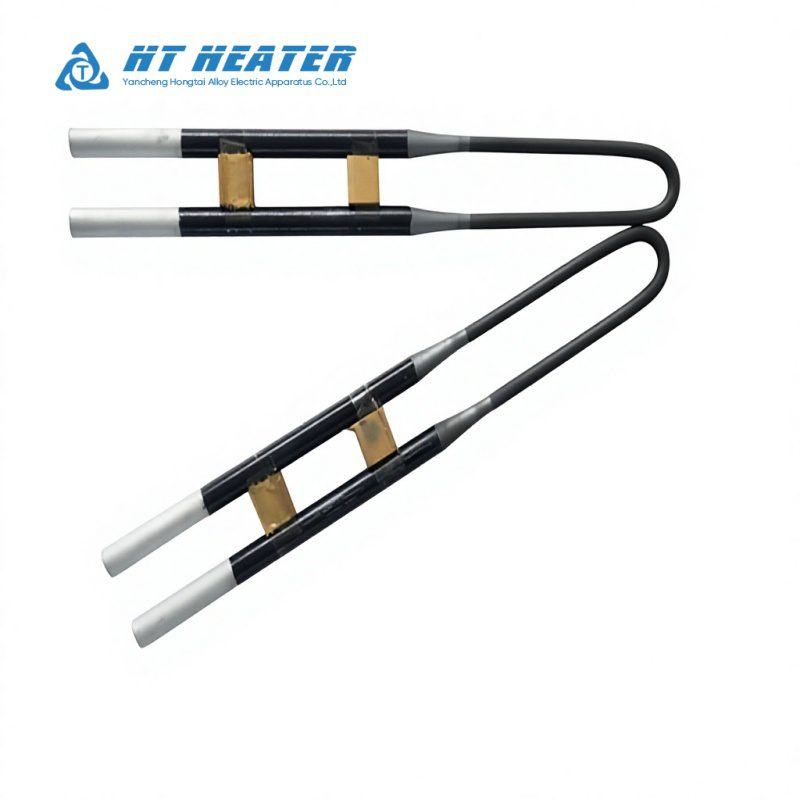
- Passage Hole Misalignment: If the twin holes in the roof holder brick are drilled with inaccurate center-to-center spacing (A) or out of parallel, forcing the element shanks inward creates locked-in shear stress. The element snaps during the first thermal expansion cycle.When installing standard U-shaped and W-shaped MoSi2 elements,always verify hole centers against factory fabrication drawings.
- Hearth Collision: Vertically suspended elements expand downward when hot. If inadequate clearance is left between the bottom U-bend and the hearth refractory (or workload charge), the element bottoms out, causing upward compressive buckling and immediate fracture.
2. High-Temperature Creep and Bending: When is Bending a Failure?
- Normal Creep: Over long campaigns at 1600°C+, vertically suspended U-elements naturally develop a gentle outward bow. Slight deformation does not constitute failure as long as electrical clearances and thermal uniformity are maintained.
- Abnormal Sagging: Severe deformation—where legs twist, touch adjacent elements, or sag into the load—indicates element overheating, tilted roof holders, or intense electromagnetic repulsion caused by unthrottled inrush current during startup.
4. Protective Glaze Degradation: Atmospheres and Chemical Corrosion
The self-healing quartz glass (SiO2) layer protects the core up to 1800°C in clean air. However, chemical vapors, process dust, and reducing gases can break down this barrier:
Chemical Failure Modes and Symptoms:
- The “Glass Teardrop” Phenomenon: When processing ceramic glazes, glass melts, or metal powders containing alkali metals, fluxes condense on the element shanks. This lowers the melting point of the quartz glaze from >1700°C down to 1200°C–1300°C. The liquid glaze flows downward under gravity, accumulating at the bottom U-bend as clear or colored droplets (“teardrops”), leaving upper sections exposed to accelerated oxidation.
- Reducing Gas Thinning: In dry hydrogen or forming gas atmospheres, the glaze is continuously reduced. The allowable maximum element temperature must be derated depending on the gas dew point (often restricted to 1350°C–1450°C).
- Glaze Regeneration Soak: If elements suffer minor glaze stripping from a temporary atmosphere excursion, they can often be re-passivated. Following manufacturer guidelines, bake the unloaded furnace in clean, dry air at high temperatures (typically 1400°C–1450°C) for several hours to regenerate a fresh, coherent quartz glass film. Note: Elements with severe structural thinning cannot be restored by re-glazing.
5. Terminal Overheating, Hardware Fatigue, and Electrical Stress
Over 30% of field service calls originate not inside the hot zone, but at the cold terminals resting outside the furnace roof:
- Annealed Spring Clamps: Stainless steel terminal clamps maintain mechanical contact pressure over the aluminum braid straps. If roof insulation leaks hot gas, or if passage sleeves are unsealed, radiant heat anneals the spring steel. As clamping pressure drops, contact resistance spikes.
- Terminal Arcing and Melted Aluminum: High contact resistance at the sprayed aluminum cold-end generates intense local Joule heating. In severe cases, the metallized aluminum melts, generating electrical arcing that burns through the terminal shank.
- The Grease Pitfall: Never apply conductive grease, anti-seize paste, or lubricants to MoSi2 terminal shanks. Under continuous operating temperatures, organic binders carbonize into high-resistance carbon tracks that trigger terminal flashover.
6. Root-Cause Investigation & Preventive Maintenance Checklist
When logging a MoSi2 heating element failure, do not discard the broken parts immediately. Record the following evidence to determine whether the issue is mechanical, chemical, or electrical:
Field Failure Evidence Checklist
- Physical Evidence: Photo of the fracture surface (clean cleavage vs. porous slagging), location of break (hot zone, tapered weld, or cold shank), and presence of surface glassy teardrops or yellow powder.
- Electrical History: Operating voltage and current per zone, SCR control mode (confirm phase-angle firing), and cold startup current logs (verify against MoSi2 cold resistance and startup current specifications).
- Process Data: Peak furnace temperature, soak duration in the 400°C–600°C band, atmosphere composition, gas dew point, and workload chemical formulation.
- Operational Timeline: Total run hours on the failed element, batch cycle frequency, and date of last furnace relining.
Monthly Preventive Maintenance SOP
- Cold Check (Power Off): Inspect roof holder blocks for cracks or tilt; check that flexible aluminum braids have natural slack; measure circuit resistance across each branch.
- Live Hot Check (At Operating Temp): Sight through observation ports to verify that heating legs hang straight and clear of the hearth; verify uniform color across all shanks; check roof penetrations for glowing hot gas leaks.
- Replacement Protocol: Unlike silicon carbide (which requires matching resistance due to aging; see SiC heating element resistance and aging), a single broken MoSi2 element can be replaced independently without replacing the entire series branch, provided the new element matches the original grade, geometry, and diameter.
Partner with Hongtai for Engineered Ultra-High-Temperature Heating Solutions
Eliminating premature element breakage and extending kiln campaigns to multi-year horizons requires combining ultra-pure cermet metallurgy with precision roof mounting hardware. Hongtai Heater Factory manufactures premium industrial molybdenum disilicide heating elements (Grade 1700 and Grade 1800 in U, W, L, and custom configurations)—complete with matched ceramic holder bricks, heavy-duty suspension clamps, and low-resistance flexible terminal braids.
- Consult our Engineers: Send your wiring schematics to the Hongtai Heater Factory technical team for a free design review.
- Visit Us:: www.hongtai-heater.com