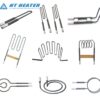
Heating air in HVAC ducts, industrial ovens, and load-aging chambers presents a fundamental thermodynamic challenge: air has a low thermal mass and acts as an insulator. To transfer heat efficiently without burning out the element, surface area must be maximized.
A finned tubular heater solves this by permanently attaching continuous spiral or square metal fins to the outer sheath, increasing the effective heat dissipation area by 200% to 300%. This guide provides the complete engineering workflow—from power calculation to watt density limits and material selection—to ensure safe, highly efficient forced-air heating.
1. How to Calculate Finned Tubular Heater Power (Heat Load)
The first step in sizing an air duct heater is determining the total electrical power (Kilowatts) required to raise the air temperature at a specific flow rate.
The standard HVAC engineering formula for calculating required heating power is:
Where:
- CFM: Airflow volume in Cubic Feet per Minute.
- Δ T: The required temperature rise (Outlet Temp – Inlet Temp) in Fahrenheit.
- 3192: A constant derived from the specific heat and density of standard air.
Air Temperature Rise Calculation Example:
An industrial oven requires heating 1,500 CFM of air from an ambient 70°F to 150°F (Δ T = 80°F).
Engineering Rule of Thumb: Always add a 20% safety factor to account for duct heat losses and voltage fluctuations. The specified heater rating for this application should be approximately 45 kW.
2. Finned Tubular Heater Watt Density: Why It Matters
Watt density (measured in $W/in^2$ or $W/cm^2$) defines how much power is packed into the surface area of the heated section. Because finned tubular heaters have exponentially more surface area than bare tubes, they can operate at much higher overall wattages while maintaining lower, safer sheath temperatures.
The maximum allowable watt density is strictly dictated by the air velocity (FPM – Feet Per Minute) moving across the fins and the maximum operating temperature.
| Minimum Air Velocity (FPM) | Max Operating Temp (°C) | Recommended Max Watt Density (W/in2) |
| Natural Convection (Still Air) | < 150°C | 15 – 20 W/in2 (Derating required) |
| 500 FPM (2.5 m/s) | 250°C | 30 – 40 W/in2 |
| 900 FPM (4.5 m/s) | 300°C | 40 – 50W/in2 |
| > 1500 FPM (7.6 m/s) | 400°C | 50 – 60 W/in2 |
Warning: Specifying a watt density that is too high for the available airflow will cause the element to overheat rapidly, oxidizing the fins and leading to catastrophic dielectric failure of the internal Magnesium Oxide (MgO).
3. Selecting the Right Fin Type: Spiral-Wound vs. Square
At Hongtai heater factory, we manufacture fins in two distinct profiles to match specific airflow dynamics and spatial constraints.
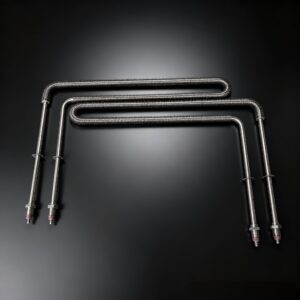
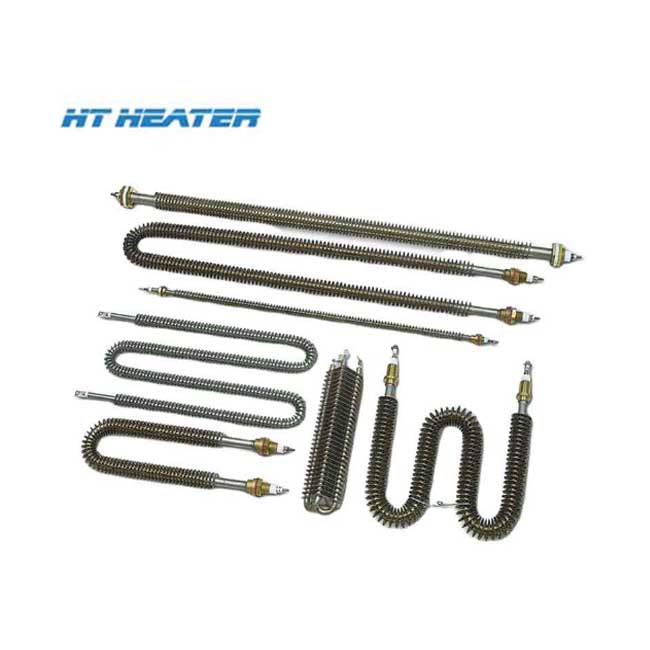
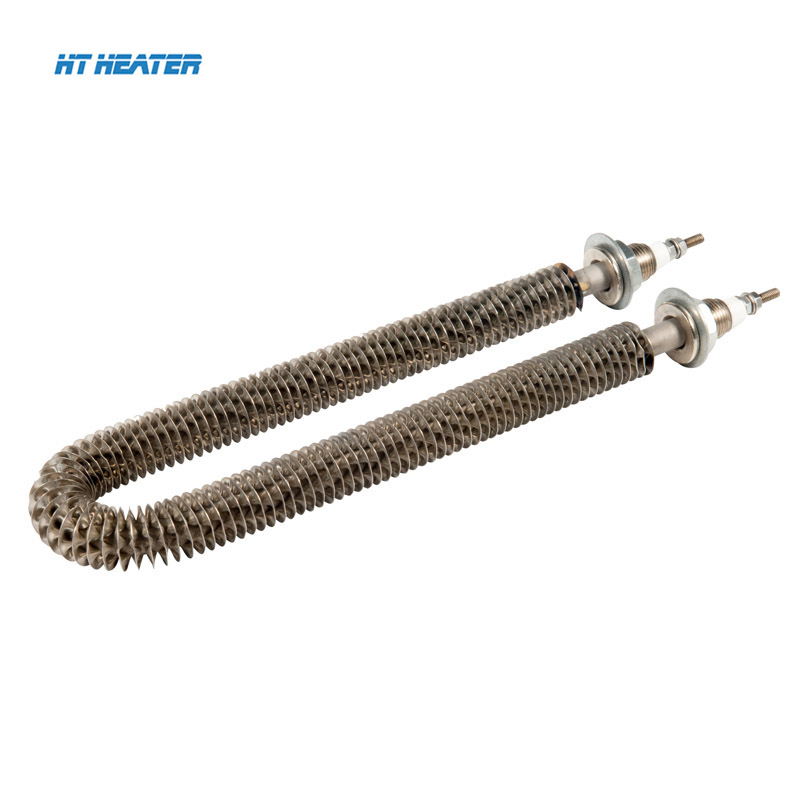
Spiral-Wound (Crimped) Fins: A continuous metal strip is helically wound and mechanically crimped along the tube.
Best for: Custom U-shapes, W-shapes, and circular duct heaters.
Advantage: The tube can be factory-bent after the fins are applied, making it highly versatile for compact industrial baking ovens.
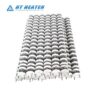
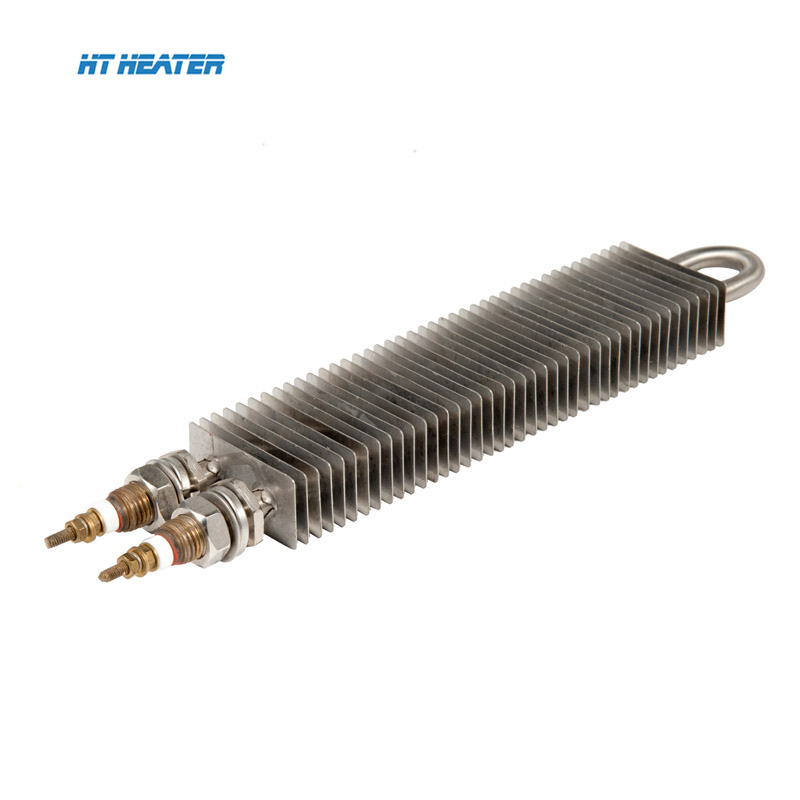
Square / Rectangular Fins: Flat, punched rectangular plates are press-fitted over single or parallel tubes.
Best for: Large HVAC duct banks and high-velocity rectangular channels.
Advantage: When stacked neatly in a duct frame, square fins force the air stream to weave aggressively between the plates, maximizing turbulence and heat capture without creating dead zones.
4. Material Selection Guide
The material of both the tubular sheath and the fins must be matched to the peak operating temperature and the air environment (humidity, corrosive gases).
- Standard Steel Sheath & Steel Fins: Economical choice for dry, non-corrosive air heating up to 400°C (750°F). Commonly used in comfort HVAC heating.
- 304 Stainless Steel Sheath & SS Fins: Required for humid environments, recirculating ovens, or food-processing applications. Good for temperatures up to 650°C (1200°F).
- Incoloy 800/840 Sheath & SS Fins: Premium specification for extreme high-temperature ovens, aggressive thermal cycling, and high-velocity load aging test chambers.
5. Finned Tubular Heater Installation & Maintenance
Proper installation is critical to ensure heat transfer and prevent early burnout. Engineers and maintenance teams should adhere to the following protocols:
- How to secure the heaters: Ensure the unheated cold sections (terminal ends) are properly supported outside the heated airflow zone. Use bulkheads or mounting flanges to prevent vibration fatigue in high-velocity ducts.
- Preventing fin deformation: Handle finned heaters carefully during installation. Crushed or bent fins restrict local airflow, creating isolated hot spots that will degrade the internal resistance wire.
- Ensuring proper airflow: Space the heaters evenly across the duct face area. Do not pack them too tightly, as this will create an excessive static pressure drop that can choke the blower fan.
- Cleaning: Dust, lint, and industrial debris acting as insulation on the fins will cause overheating. Schedule periodic maintenance to blow out the finned sections with compressed air.
- Wiring inspections: Thermal cycling can cause terminal nuts to loosen. Inspect and retighten electrical connections annually to prevent arcing.
- Fan Failure Protection: Never operate a finned heater designed for forced convection without airflow. You must interlock the heater circuit with a differential pressure switch, airflow sensor, and a high-limit thermal cutout. If the fan fails, power to the heaters must be cut instantly.
OEM Selection Checklist: What We Need to Quote
Hongtai heater factory custom-engineers each heating element to match your exact thermal and spatial requirements. Providing complete operational parameters upfront eliminates design guesswork and significantly accelerates your RFQ turnaround time.
To eliminate guesswork and engineer a heater that guarantees exact thermal performance, please provide the following parameters when submitting an RFQ (Request for Quote) to the Hongtai engineering team:
- Duct or Oven Dimensions: The physical space available for the heater bank.
- Airflow Data: CFM (volume) and FPM (velocity).
- Temperature Requirements: Inlet air temperature and target outlet air temperature.
- Electrical Specs: Required Total Wattage (kW), Voltage, and Phase (e.g., 240V/480V, 3-Phase).
- Sheath & Fin Material: Steel, 304 SS, or Incoloy.
- Physical Dimensions: Tube diameter (typically 8.0mm to 16.0mm), fin diameter, overall length, and cold section length.
- Mounting Style: Flange, threaded bushing, or standard bulkhead fittings.
Company: Hongtai heater factory
Technical Sales Consultation: Contact Hongtai Engineering Team
Contact Hongtai Engineering Team for Sizing Support: www.hongtai-heater.com