Introduction
In the field of thermal engineering, the heating element itself is rarely the point of failure. When a silicone heater fails in the field, it is almost invariably due to one of two oversight categories: interface failure (the adhesive gave up) or thermal overload (the watt density exceeded the dissipation rate).
Designing a robust heating system requires more than just specifying dimensions and voltage. It requires a deep understanding of the chemical limits of pressure-sensitive adhesives (PSA) and the thermodynamic limits of silicone polymers.
This guide delves into the technical nuance of 3M adhesive selection, the physics of watt density safety margins, and sensor integration, ensuring your next design survives the rigors of real-world operation.
For a broader overview of flexible heating technologies, refer to our [Ultimate Guide to Flexible Heaters].
1. The Adhesion Truth: Selecting the Right PSA (Pressure Sensitive Adhesive)
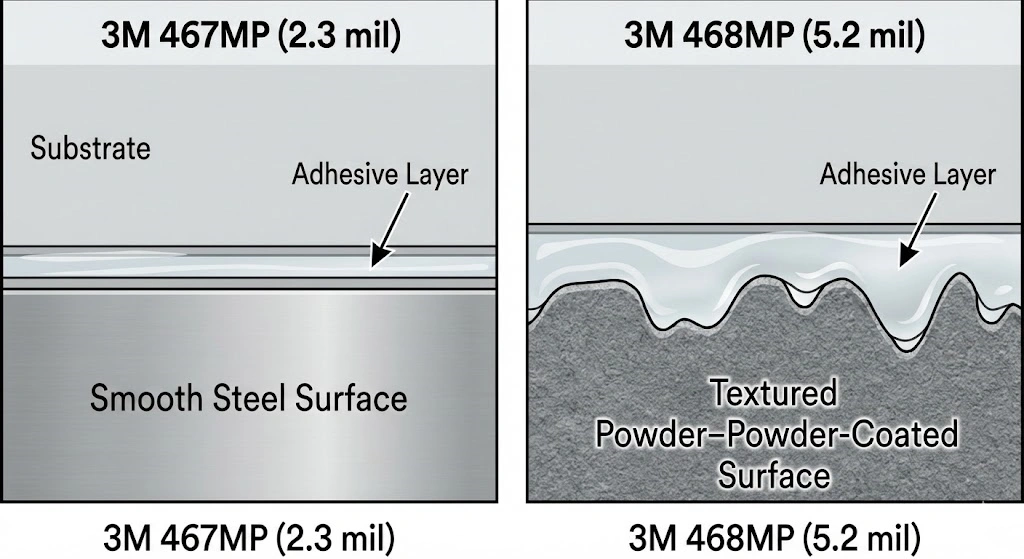
A common RFQ mistake is simply specifying “3M Backing.” 3M produces hundreds of transfer tapes. Selecting the wrong one for your surface energy or roughness leads to delamination, air gaps, and eventual heater burnout.
At HT-Heater, we primarily utilize the 3M™ 200MP High-Performance Acrylic Adhesive family, specifically the 467MP and 468MP series. Here is the engineering logic behind the choice:
3M 467MP (2.3 mil / 0.06mm): The Standard for Smooth Surfaces
- Construction: A transfer tape consisting solely of 2.3 mils of adhesive (no carrier).
- Best Application: Perfectly smooth surfaces like polished stainless steel, glass, or anodized aluminum.
- Physics: Because it is thin, it offers minimal thermal resistance (R_th). Heat transfers rapidly from the silicone element to the heat sink.
- Risk: If applied to a rough or cast metal surface, the thin adhesive cannot “wet out” into the micro-valleys, creating microscopic air pockets that block heat transfer.
3M 468MP (5.2 mil / 0.13mm): The Solution for Texture
- Construction: Same acrylic chemistry as 467MP, but more than double the thickness.
- Best Application: Powder-coated enclosures, cast iron, or unpolished machined parts.
- Physics: The thicker adhesive layer flows into surface irregularities, maximizing the contact area on textured parts. This mechanical interlocking significantly increases shear strength.
Temperature Limits (Crucial Data)
Both 467MP and 468MP share the same thermal profile:
- Continuous Operating Limit: 149°C (300°F)
- Short-Term Spike Limit: 204°C (400°F)
Engineering Verdict: If your application requires the interface to hold at temperatures consistently above 150°C, or if the heater must be submerged in oil/water, you must abandon PSA. In these cases, we recommend Factory Vulcanization, where the heater is chemically fused to your part under heat and pressure, eliminating the adhesive weak point entirely.
2. Preventing Burnout: The Watt Density Calculation Rule
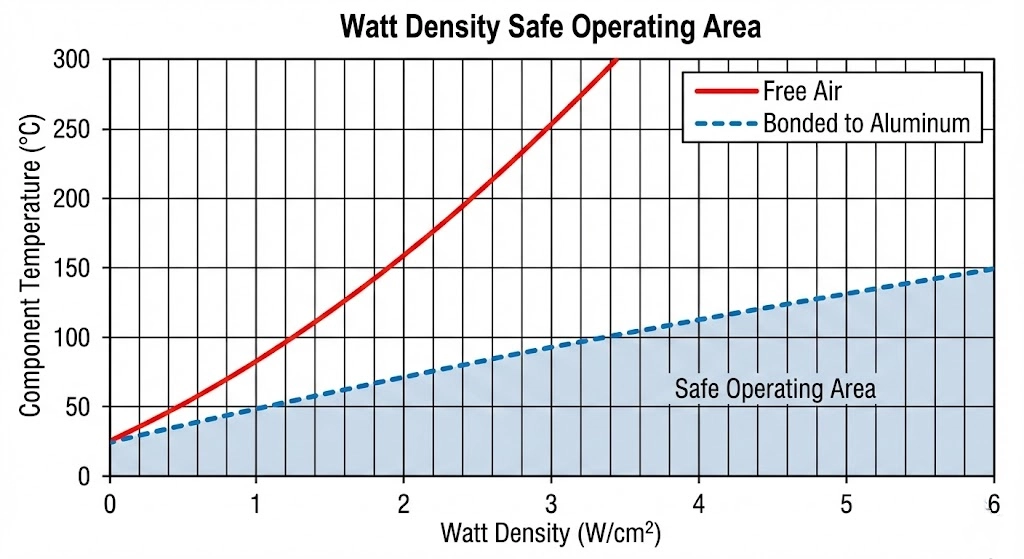
Watt Density (W/cm^2) is the measure of power flux flowing through the heater surface. It is the single most critical variable in heater life expectancy.
Silicone rubber is a thermal insulator (0.22 W/m\cdot K). If you generate heat faster than it can pass through the silicone insulation and into your heat sink, the internal wire temperature will skyrocket, eventually carbonizing the silicone (breakdown occurs at ~260°C).
The “Safe Zone” Standards
For standard etched foil silicone heaters, follow these design rules:
- Free Air / Poor Contact: < 0.4 W/cm²If the heater is not perfectly bonded (e.g., strapped on loosely), it cannot dissipate heat efficiently.
- PSA Bonded (Standard): 0.6 – 0.8 W/cm²This is the industry “Gold Standard.” It provides a rapid ramp-up without risking the long-term degradation of the 3M adhesive or the silicone matrix.
- Vulcanized / Clamped: > 1.5 W/cm²When the heater is vulcanized directly to a conductive metal heat sink (like an aluminum build plate), the metal acts as a thermal sponge, pulling heat away instantly. This allows you to drive the heater much harder.
Calculation Example
You have a 10cm x 10cm heater (Area = 100 cm²).
- Scenario A: You want 500 Watts.Density = 500W / 100cm^2 = 5 W/cm^2.Verdict: Fatal. This will burn out instantly unless submerged in flowing water.
- Scenario B: You want 60 Watts.Density = 60W / 100cm^2 = 0.6 W/cm^2.Verdict: Safe for standard 3M adhesive application.
[Unsure about your calculation? Verify with our Engineering Team before tooling.]
3. Sensor Integration: Closing the Control Loop
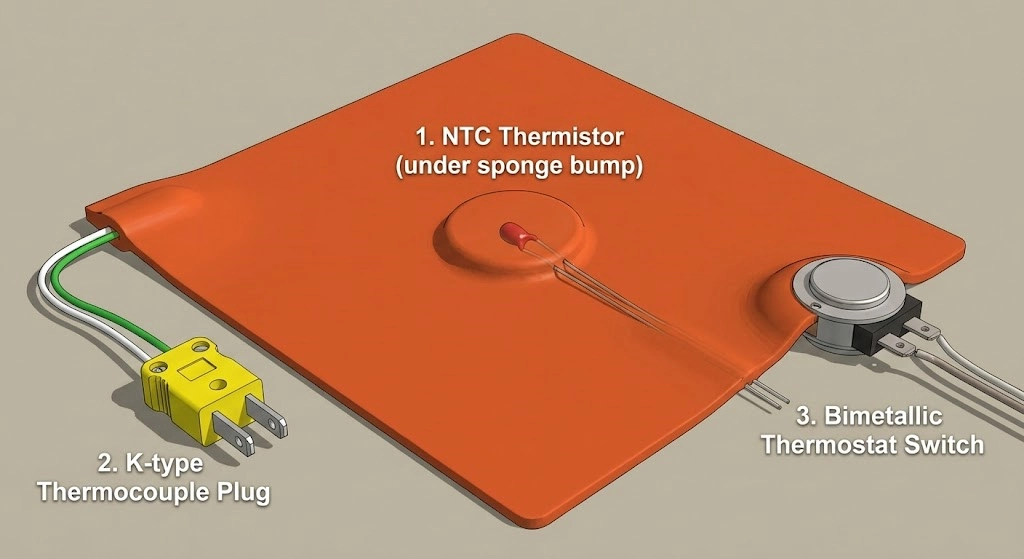
Flexible heaters have low thermal mass, meaning they can overshoot target temperatures in seconds. Integrated control is not optional; it is mandatory.
1. NTC 100K Thermistor (The 3D Printing Standard)
- Type: NTC 3950 1% (Beta Value 3950K).
- Why it’s popular: High resistance (100kΩ at 25°C) minimizes noise interference. It is the standard native sensor for most PCB controllers (Marlin, RepRap).
- Best For: Heated beds, medical devices, and precision electronics up to 200°C.
2. Thermocouples (The Industrial Standard)
- Type: Type J (Iron/Constantan) or Type K (Chromel/Alumel).
- Why it’s popular: Extremely rugged and standardized across industrial PLCs.
- Best For: Harsh environments, long cable runs, and temperatures > 200°C.
- Note: We can weld the thermocouple junction directly to the internal foil for the fastest possible response time.
3. Bimetallic Thermostats (The Failsafe)
- Function: A mechanical switch that opens the circuit when a set temp is reached (e.g., Open at 150°C, Close at 130°C).
- Role: This is rarely used for precision control. It is a safety limiter to prevent fire if the main controller fails.
4. Lead Wire & Stress Relief Configuration
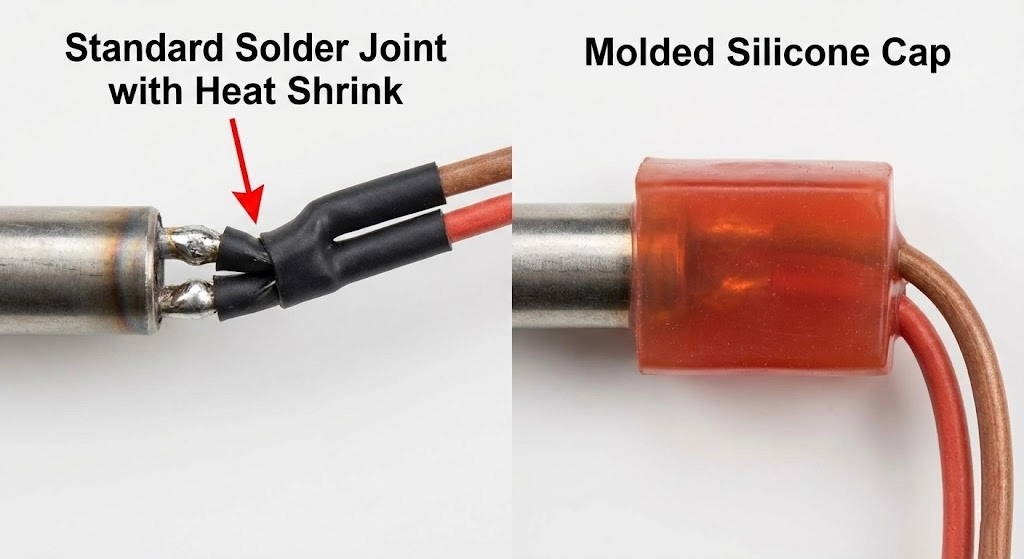
Mechanical stress on the lead wire exit point is the second most common cause of failure. If the wire is pulled, it can tear the internal foil circuit.
- Standard: Silicone Bonded PatchA piece of silicone is RTV-bonded over the solder joint. Good for static applications.
- Premium: Molded Cap (IP65)We place the heater in a mold and inject liquid silicone rubber (LSR) around the wire exit. This fuses the wire jacket to the heater body, creating a waterproof, pull-proof seal.
- Spec: Withstands 15N x 15N tension tests (per our lab standards).
- Recommendation: Mandatory for portable devices or vibrating machinery.
Frequently Asked Questions (FAQ)
What is the maximum temperature a silicone heater adhesive can withstand?
The industry-standard 3M 467MP/468MP acrylic adhesives are rated for 149°C (300°F) continuous use and short-term spikes up to 204°C (400°F). If your application requires sustained temperatures above 160°C, the adhesive will eventually carbonize and lose bond strength. For these high-temp applications, we recommend Factory Vulcanization or mechanical fasteners (springs/clamps).
Why did my silicone heater smoke and burn out after a few seconds?
This is a classic symptom of “Free Air” operation. Silicone heaters have very low thermal mass. If you power them up (especially at densities > 0.5 W/cm²) without attaching them to a heat sink (your metal part), the energy has nowhere to go. The temperature can shoot past 300°C in under 10 seconds, destroying the silicone. Always mount the heater to the heat sink before testing.
Can you manufacture heaters with custom holes and cutouts?
Yes. We can accommodate any shape, including internal holes for bolts or irregular outer geometries. However, you must provide a CAD drawing (DXF/DWG). Crucial Rule: We require a safety margin (typically 3-5mm) around any hole where no heating element can be placed. This ensures the internal circuit is sealed and insulated from the cut edge.