A custom ceramic ir heater specification directly dictates film forming speed, seal integrity, and overall equipment efficiency in automated vacuum thermoforming and tray-sealing packaging machinery. When mechanical designers and procurement specialists submit incomplete RFQs, engineering delays and quotation cycles stall project delivery. Standardizing your technical inquiry parameters for every custom ceramic ir heater ensures rapid RFQ processing, precise factory tooling, and seamless integration into automated packaging lines.
1. Engineering Parameters for a Custom Ceramic IR Heater
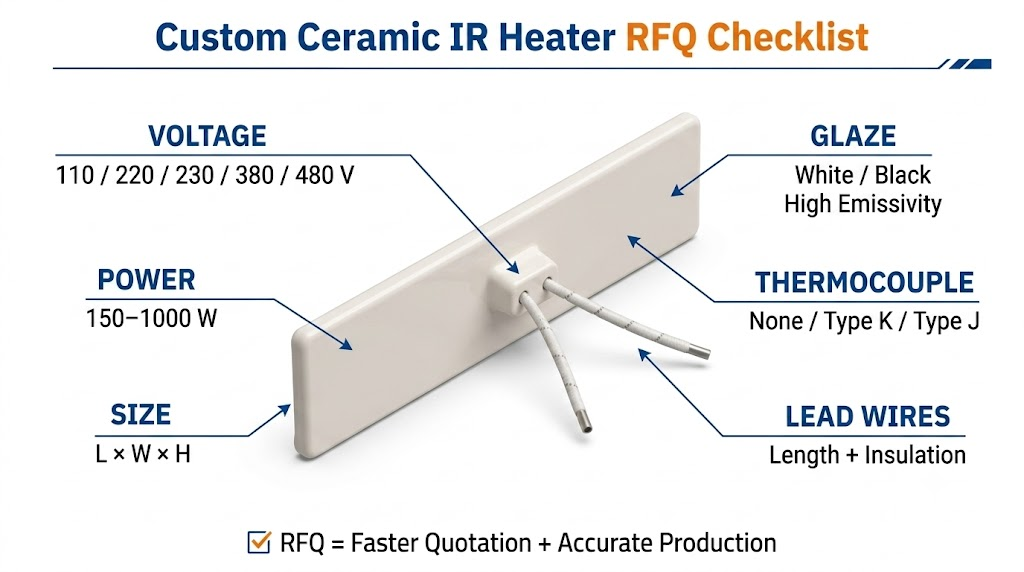
To specify infrared heating element requirements accurately for high-speed vacuum packaging machinery, mechanical engineers must define baseline electrical and physical dimensions when configuring a custom ceramic ir heater:
- Voltage & Electrical Phase: Specify exact supply voltage (e.g., 220V, 230V, 380V, or 480V) and wiring configuration (single-phase vs. balanced three-phase banks).
- Wattage & Power Density: Select target power (typically 150W to 1000W per element) matching film thickness (e.g., PE, PET, or multi-layer barrier films). Calculate surface heat density using the standard formula:
- Watt Density = Power (W) / Surface Radiation Area (cm²)
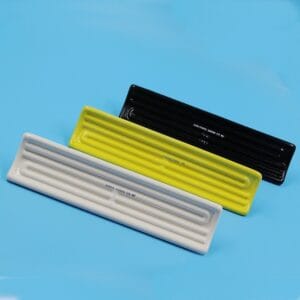
- Element Geometry & Contour: Choose between trough/curved elements (for focused directional radiant energy) and flat ceramic tiles (for uniform planar heat distribution). Standard footprints for a custom ceramic ir heater include 245 x 60 mm, 122 x 60 mm, and 122 x 122 mm.
Before finalizing surface power density limits, review our technical breakdown on How to Calculate Watt Density for Ceramic Infrared Heaters.
2. Lead Wire Specs for Custom Ceramic IR Heater Assemblies
A high-performance vacuum packaging heater array operates under continuous thermal cycling and mechanical vibration. Specifying robust lead terminations on a custom ceramic ir heater prevents electrical shorts and unexpected machine downtime:
- Lead Wire Type & Insulation: High-temperature nickel wire insulated with flexible ceramic beads, standard fiberglass sleeving, or stainless steel overbraid for severe wear environments.
- Lead Wire Exit Position: Specify rear-exit lead configurations (exiting straight out the back of the ceramic stud) to clear mounting reflector brackets cleanly.
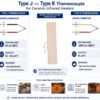
- Thermocouple Integration: Select an integrated Type K or Type J thermocouple embedded directly behind the ceramic face for closed-loop PID control. Consult Selecting the Right Thermocouple (Type J vs. Type K) for Ceramic Heaters for sensor matching guidelines.
3. Standardized RFQ Spec Sheet for Custom Ceramic IR Heater Orders
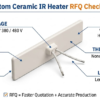
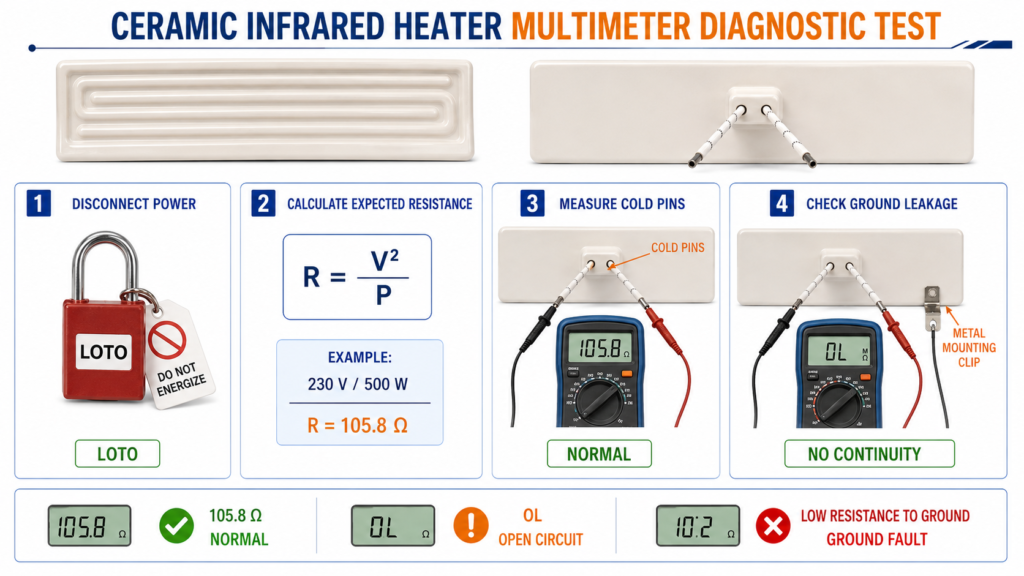
To eliminate technical back-and-forth and receive immediate factory-direct pricing, procurement specialists can copy and submit this standardized custom ceramic ir heater specification checklist:
| Specification Parameter | Technical Option / Value | Example Production Spec |
| Operating Voltage | 110V / 220V / 230V / 380V / 480V | 230V AC (Single Phase) |
| Rated Power (Wattage) | 150W to 1000W | 650W |
| Dimensions (L x W x H) | 245 x 60 mm / 122 x 60 mm / Custom | 245 x 60 mm (Trough Type) |
| Glaze & Ceramic Body Color | White / Black Glaze (High Emissivity) | Black Glaze (ε ≥ 0.92) |
| Thermocouple Type | None / Type K Built-In / Type J Built-In | Type K (Built-In, Rear Exit) |
| Lead Wire Length & Type | Length (mm) + Ceramic Bead / Braided | 150 mm Ceramic Bead Insulated |
| Mounting Hardware | M8 Studs / Spring Clips / Custom Plate | Stainless Steel M8 Cast-In Stud |
For comprehensive background on array layouts and modular reflector banks, reference our primary technical manual: Ceramic Infrared Heaters: The Complete Engineering & Selection Guide. If you are replacing failed elements on an existing line, check Troubleshooting Premature Failure in Ceramic Infrared Heating Elements: A Diagnostic Guide to correct thermal faults before installing custom units.