Pumping viscous fluids—whether heavy crude oil, industrial resins, bitumen/asphalt, or food-grade syrups—is a constant battle against thermodynamics. In these systems, ambient temperature drops do not merely reduce efficiency; they halt production.
When fluid temperatures fall below critical thresholds, viscosity spikes logarithmically. A localized “cold spot” at an uninsulated pipe flange, gate valve, or pump housing causes the fluid to coagulate against the internal steel walls. This rapidly reduces the effective inner diameter of the pipe, dead-heading pumps, risking cavitation, and ultimately shutting down the entire process line. Furthermore, when engineers attempt to apply standard heating elements to these outdoor or chemical environments, the corrosive atmosphere and moisture inevitably cause the components to rot and short-circuit within months.
This engineering guide details the precise methodologies for specifying heavy-duty band heaters for complex pipeline components. We will compare localized band heating against traditional heat trace cabling, and explain how to engineer the heater sheath metallurgy and electrical terminations to survive corrosive chemical exposure and severe outdoor weather.

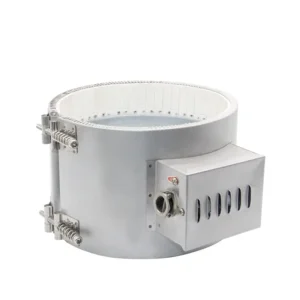
The engineering baseline is this: For complex pipe geometries (valves, flanges, pumps) requiring rapid, localized heat transfer, customized Two-Piece Mica or Ceramic Band Heaters vastly outperform standard heat trace cables. However, to survive the realities of a chemical plant, these heaters must be strictly specified with 316L stainless steel sheaths, Teflon-insulated leads, and NEMA 4/IP65 moisture-resistant terminal boxes.
If you are heating standard cylindrical vessels indoors and need to calculate basic surface loads, review our [Ultimate Industrial Band Heaters Guide] first.
1. The Viscosity Challenge: Why Pipes Choke
To maintain steady-state flow in a pipeline, thermal energy must be managed just as carefully as pump pressure.
Temperature-Dependent Viscosity
For non-Newtonian fluids and heavy petrochemicals, the relationship between temperature and dynamic viscosity ($\mu$) is often exponential or logarithmic. A localized temperature drop of just $10^\circ C$ at an exposed pipe elbow can increase fluid flow resistance by 50% or more.
When the fluid at the boundary layer (touching the pipe wall) cools and thickens, it reduces the cross-sectional area available for active flow. This forces the pump motor to draw significantly more amperage to maintain the required volumetric flow rate (GPM), leading to premature mechanical wear, blown seals, or motor burnout.
The “Heat Sink” Effect of Pipe Fittings
Straight runs of insulated pipe generally maintain fluid temperature well. The thermal bottlenecks occur at the fittings.
Thick metal components like gate valves, Y-strainers, and massive ANSI steel flanges possess tremendous thermal mass. They act as highly efficient “heat sinks,” rapidly draining thermal energy away from the fluid passing through them and radiating it into the surrounding environment. To prevent coagulation at these junctions, massive amounts of localized thermal energy must be injected back into the steel.
2. Localized Band Heaters vs. Heat Trace Cable
When piping engineers identify a cold spot, the default reaction is often to apply more heat trace cable. This is frequently a misapplication of the technology.
The Limits of Heat Tracing
Heat trace (or heat tape) is exceptionally effective for maintaining the temperature of long, straight runs of pipe. However, its primary limitation is its Watt Density (W/in² or W/m). Heat trace provides low, steady-state heat over a vast area. It simply lacks the concentrated thermal wattage required to rapidly raise or recover the temperature of a massive, dense steel valve body or flange. Attempting to wrap a valve in 20 layers of heat trace is inefficient, bulky, and makes maintenance access impossible.
High-Density Localized Heat
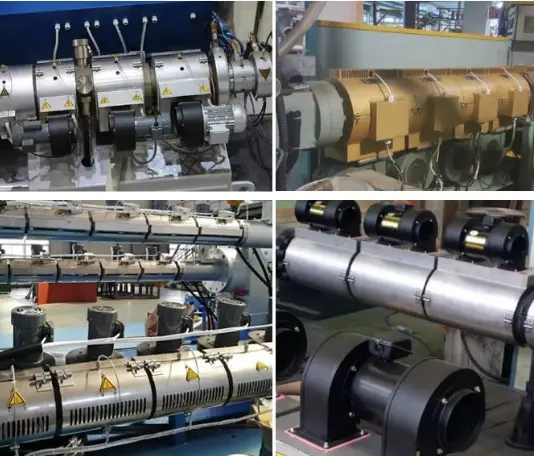
For high-mass components, a custom Band Heater clamped directly over the valve body or flange is the superior engineering solution. Because band heaters can safely deliver between 3 W/cm² and 6 W/cm², they provide the concentrated, high-density thermal wattage required to penetrate the thick steel of the fitting. This immediate burst of thermal energy is what breaks down solidified resins, un-jams gate valves, and restores fluid flow.
3. Surviving the Chemical Plant: Materials and Metallurgy
An industrial heater cannot transfer heat if its exterior has rotted away. Chemical processing plants and coastal refineries present highly corrosive atmospheric threats.
Upgrading the Sheath: 304 vs. 316L Stainless Steel
Standard industrial band heaters are encased in aluminized steel or 304 stainless steel. In a petrochemical plant exposed to acidic vapors, sulfur compounds, or salt spray, 304 stainless will suffer from severe pitting and stress corrosion cracking.
For these environments, engineers must specify 316L Stainless Steel for the heater sheath and clamping hardware. The addition of molybdenum (typically 2-3%) in the 316L alloy matrix drastically improves the metal’s resistance to localized pitting caused by chlorides and acidic industrial wash-downs.
Defeating Moisture and Chemical Wash-Downs
The electrical termination is the most vulnerable point of any outdoor heater. Standard high-temperature fiberglass lead wires are highly porous; through capillary action, they act like sponges, drawing ambient moisture, rainwater, or leaked chemicals directly into the heater’s dielectric core, causing immediate short circuits.
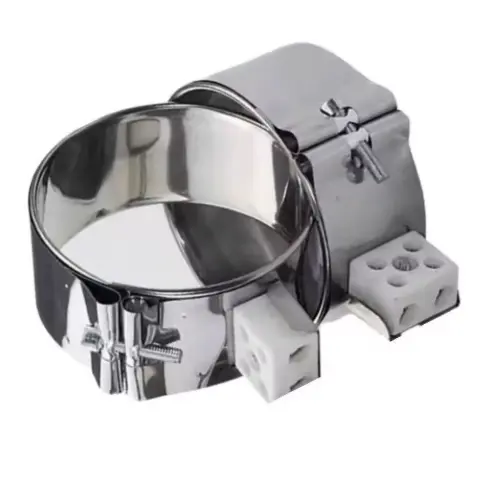
For harsh environments, Teflon (PTFE) insulated lead wires are mandatory. Teflon is chemically inert, highly hydrophobic (water-repellent), and maintains excellent dielectric strength. When paired with a NEMA 4 (IP65) sealed terminal box, the entire electrical connection is completely isolated from atmospheric threats.
4. Engineering for Complex Pipe Geometries
Band heaters are traditionally cylindrical, but pipeline fittings are rarely perfectly round and unobstructed.
Two-Piece and Hinge Designs
You cannot slide a continuous, solid-ring band heater over a pipe flange that is already welded into a pipeline network. Dismantling the pipe to install a heater is financially unviable.
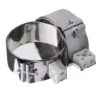
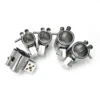
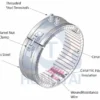
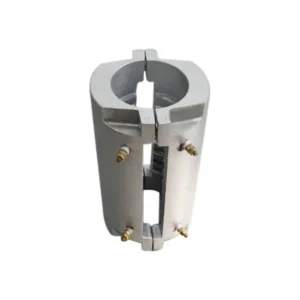
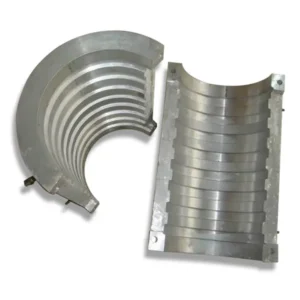
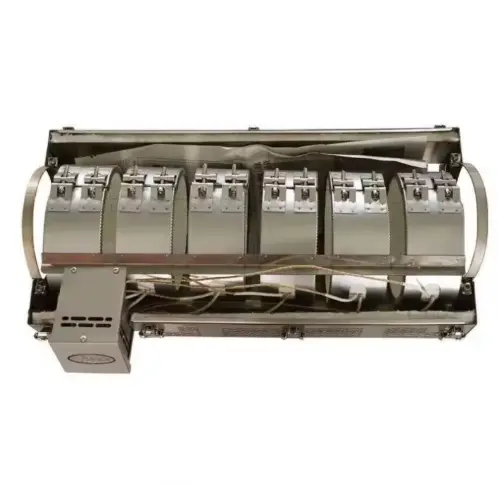
To solve this, pipeline heaters must be specified as Two-Piece or Hinged designs. These configurations allow the heater to be physically split into two halves, wrapped securely around the existing infrastructure, and bolted together, achieving the tight mechanical fit required for conduction heating without breaking the fluid seal of the pipe.
Accommodating Flange Bolts and Valve Stems
Drafting the RFQ (Request for Quotation) requires precise geometry. A valve body is covered in structural bolts, bleed valves, and instrument ports.
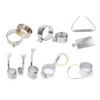
When specifying a custom mica band heater for these components, engineers must map the X and Y coordinates of these obstructions. The manufacturer will then engineer the heater with precision cut-outs and oversized clamping gaps, routing the internal NiCr resistance wire safely around the voids to ensure a perfect mechanical fit without creating electrical shorts.
5. Fighting the Wind Chill: Outdoor Insulation
Generating heat is only half the thermodynamic equation; retaining it is the other. If an uninsulated pipe heater is installed outdoors, the ambient environment will actively steal the thermal output.
The Convection Thief
Convective heat loss is severe in outdoor installations. If a band heater is operating on a pipe flange in a $5^\circ C$ environment, a moderate 15 mph wind can strip away up to 40% of the generated thermal energy before it ever penetrates the steel pipe. The heater will run continuously at 100% duty cycle, wasting electricity and eventually burning out.
Integrated vs. External Insulation
To defeat convective heat loss, the heater must be insulated from the wind.
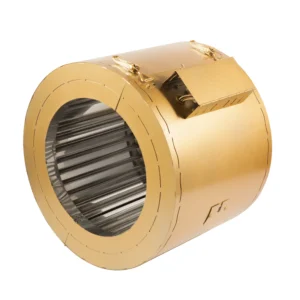
- Integrated Insulation: Specify Ceramic Band Heaters, which feature a built-in 1/4-inch ceramic fiber insulating blanket beneath the outer stainless steel sheath. This forces the radiant and conductive heat inward toward the fluid.
- External Weatherproofing: For extreme environments, add an external Silicone-Coated Insulation Sleeve over the installed heater. These heavy-duty thermal jackets are entirely waterproof, trap the heat directly against the pipe fitting, and completely neutralize the wind-chill factor.
6. Pipeline Heater Specification Matrix
Use the following decision matrix to specify the correct thermal architecture based on the specific pipeline component and fluid type.
| Pipe Component | Fluid Type | Recommended Heater Specification |
|---|---|---|
| Welded ANSI Flange | Heavy Oil / Bitumen / Asphalt | Two-Piece Mica, high watt density, equipped with Spring-Loaded Clamps. |
| Pump Housing / Volute | Chemical Resins / Polymers | Custom-shaped Mica with engineered cut-outs, 316L SS sheath. |
| Outdoor Gate Valve | Water / Syrups / Food Grade | Ceramic Band (insulated) with a NEMA 4/IP65 Terminal Box. |
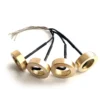
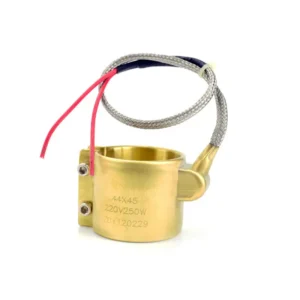
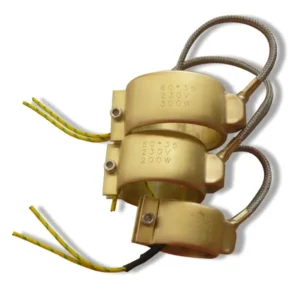
| Corrosive Splash Zone | Acids / Bases / Chlorides | Fully Encapsulated Brass, Teflon (PTFE) Leads, zero exposed wire. |
7. Pipeline Installation SOP and Safety Protocols
Installing electrical equipment on heavy steel piping requires strict adherence to mechanical and electrical safety protocols.
Grounding and Hazardous Locations
Chemical plants and refineries frequently operate in classified hazardous locations (e.g., Class I, Div 1 or ATEX Zone 1) where explosive vapors may be present.
- The SOP: Ensure that every heater specification includes a dedicated, mechanically fastened earth ground wire welded directly to the heater sheath. When installing heaters in explosive atmospheres, standard NEMA 4 boxes are insufficient; you must legally specify Explosion-Proof (ATEX/IECEx compliant) terminal housings to contain any potential electrical arcing.
Surface Preparation for Rusty Pipes
A band heater operates via thermal conduction. It cannot efficiently transfer thermal energy through a 3mm layer of oxidized steel (rust) or old, flaking paint. Rust acts as a thermal insulator.
- The SOP: Before clamping any band heater to an existing steel pipeline, the target area must be aggressively prepped. Use a wire wheel or grinding disc to remove all rust, scale, and paint down to bare, shiny metal. Ensuring flush metal-to-metal contact is the only way to prevent the heater from trapping its own heat and burning out prematurely.
Frequently Asked Questions
Can I use a band heater instead of heat trace cable on my pipes?
Band heaters and heat trace cables serve different thermodynamic purposes. Heat trace cable is ideal for maintaining a steady temperature over long, straight pipe runs. Band heaters are vastly superior for localized, high-mass components like valves, flanges, and pump housings where you need concentrated, high-watt-density heat to quickly penetrate the steel and prevent fluid coagulation.
How do I protect an industrial band heater installed outdoors?
For outdoor environments, you must specify a heater with a moisture-resistant terminal box (NEMA 4 or IP65 rating) and Teflon-insulated (PTFE) lead wires. Additionally, installing a waterproof, silicone-coated fiberglass insulation sleeve over the heater will protect it from rain, chemical splash, and prevent convective wind-chill from stealing the generated heat.
What material should the heater sheath be for a corrosive chemical environment?
In highly corrosive environments containing acidic vapors, salt spray, or chlorides, you should upgrade the heater’s outer sheath to 316L Stainless Steel. Standard aluminized steel or 304 stainless will pit and corrode much faster, eventually exposing the internal electrical resistance wire and causing a ground fault.
How do you install a band heater on a pipe flange that is already welded in place?
You must specify a Two-Piece Band Heater or a Hinged Band Heater. These specific mechanical designs split into two separate halves, allowing maintenance teams to wrap the heating element completely around the existing flange or valve body and securely bolt it together, completely eliminating the need to dismantle the pipeline or break the fluid seal.