Scenario: You are running a 2,000 HP diesel generator set. The vibration is intense. You install a standard rigid thermocouple to monitor exhaust gas temperatures. Two weeks later, the reading goes “Open Circuit.”
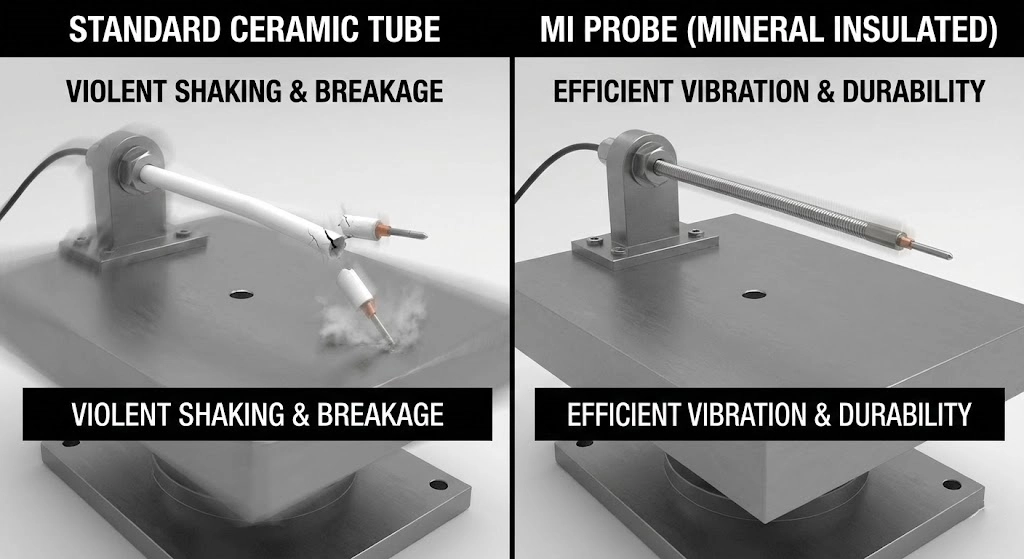
You pull the sensor out, and it sounds like a maraca. Inside the steel tube, the ceramic insulators have shattered due to vibration, severing the sensor wires.
The Solution: This is why Mineral Insulated (MI) Cable exists.
Think of an MI cable as a geological paradox: It is a set of wires buried inside a solid rock, yet that rock is flexible enough to be tied into a knot.
For heavy industry—marine, power generation, and heat treatment—MI technology is the only viable upgrade from standard “Tube-and-Wire” assemblies. It transforms the sensor from a fragile instrument into a rugged structural component capable of withstanding 50G vibration and temperatures up to 1150°C.
To understand why it is virtually unbreakable, we must look at its construction. It is a solid-state “sandwich” of three components, compressed into a single entity.
Outer Sheath (The Armor): A metal tube made of SS316, Incoloy 800, or Inconel 600.
Insulation (The Rock): High-purity Magnesium Oxide (MgO) powder.
Conductors (The Sensor): Thermocouple wires (e.g., Chromel/Alumel) running through the center.
The Manufacturing Process
An MI cable doesn’t start as a cable; it starts as a massive pipe. Manufacturers assemble the rods and powder inside a large diameter tube (e.g., 20mm). Through a process of drawing and annealing, the tube is pulled through a series of dies, shrinking it down to 6mm, 3mm, or even 0.5mm.
The Result: The internal pressure is immense. The MgO powder is compacted until it becomes a solid mass, locking the wires in place so they cannot move, rub, or short out.
Cross section micrograph of Mineral Insulated thermocouple cable showing MgO density.
Top 3 Advantages over “Tube-and-Wire”
Standard thermocouples use loose ceramic beads sliding inside a tube. Here is why MI Cable is the superior engineering choice.
1. Extreme Vibration Resistance
In a standard sensor, the wires hang loosely inside the ceramic beads. Under vibration, the ceramic acts like a hammer, smashing the wire against the tube wall until it snaps. In MI cable, the conductors are hydraulically compressed into the MgO. There are no moving parts. The wire cannot move.
Because the internal “rock” (MgO) is pulverized powder, the cable can be bent without damaging the insulation.
The Rule: Minimum Bend Radius = 2x Sheath Diameter.
The Benefit: You can route the sensor like electrical wire. You can snake it around pipes, bend it to fit into tight machine housings, or coil it to surface-mount on a heater. A standard ceramic probe would snap instantly if bent.
3. High Insulation Resistance (IR)
Compacted MgO is an excellent dielectric. It prevents high-voltage leakage from heaters or motors from crossing over into the low-voltage thermocouple signal.
Result: Cleaner signals and fewer ground loops.
Flexible MI thermocouple cable tied in a knot demonstrating durability.
Technical Specs: What Engineers Need to Know
When specifying MI cable on your Bill of Materials (BOM), focus on these parameters.
Temperature Limits
The limit is usually determined by the sheath alloy, not the MgO.
SS316 Sheath: Up to 900°C.
Inconel 600 Sheath: Up to 1150°C.
Pyrosil / Nicrobell: Up to 1250°C (Specialized for Type N).
Diameter Options
0.5mm – 1.5mm: Ultra-fast response (<0.1s). Used in laboratories or gas turbines. Fragile.
3.0mm – 6.0mm:The Industrial Standard. Perfect balance of speed and structural strength.
8.0mm – 12.7mm: Heavy duty. Used where the probe must support its own weight horizontally in a kiln.
The “Green Rot” Suppression
For Type K thermocouples, MI cable offers a hidden chemical advantage. “Green Rot” occurs when oxygen levels are low but present. Because MI cable is compacted to near-theoretical density, there is virtually zero air inside the sheath. This oxygen-starved environment prevents the Chromium depletion that causes Type K drift.
The “Termination” Challenge (The Trap)
We must be honest about the one weakness of MI cable: Moisture.
The Hygroscopic Problem
Magnesium Oxide (MgO) is extremely hygroscopic. It absorbs water from the air like a sponge.
The Risk: If you leave the end of an MI cable open to the air for just 30 minutes, moisture will wick down the cable. This turns the insulator into a conductor.
The Symptom: Insulation Resistance (IR) drops from >100MΩ to <10kΩ. The sensor reading becomes erratic or fails to ground.
The Solution: The Seal
The termination end (“Cold End”) must be hermetically sealed immediately after manufacturing.
Epoxy Seal: Standard for temperatures < 200°C at the pot seal.
Glass/Ceramic Seal: Required if the termination area will get hot (> 200°C).
Our Protocol: Every HT-Heater MI sensor undergoes a 500V Insulation Resistance Test before shipping to guarantee the seal is intact.
Vibration testing comparison between ceramic tube and mineral insulated thermocouple.
Application Gallery
1. Diesel Engines (Exhaust Manifolds) The combination of heat (600°C) and massive vibration makes standard sensors fail in days. MI cable is the OEM standard for CAT, Cummins, and MTU exhaust sensors.
2. Kilns & Furnaces Because MI cable is manufactured in continuous rolls, we can make probes that are 50 meters long without a single splice. This allows the sensor to run from the control room, through the roof, and deep into the furnace without expensive extension wires or connectors inside the conduit.
3. Nuclear Power MI technology was originally refined for nuclear reactors. It is the only sensor type that can survive the radiation and pressure of a reactor core while maintaining a hermetic seal.
Selection Checklist
Is it time to upgrade to Mineral Insulated Cable?
[ ] High Vibration: Is the sensor mounted on a motor, pump, or compressor? -> YES
[ ] Complex Routing: Do you need to bend the probe to fit it into the machine? -> YES
[ ] Length: Do you need a probe longer than 1 meter? -> YES
[ ] Response Time: Do you need a grounded junction with a small diameter (<3mm)? -> YES
[ ] Durability: Are you replacing standard probes more than once a year? -> YES
Frequently Asked Questions (FAQ)
What does MI stand for in thermocouples?
MI stands for “Mineral Insulated”. It refers to the Magnesium Oxide (MgO) powder used to insulate the thermocouple wires inside the metal sheath. The powder is hydraulically compressed to create a solid, durable, and fireproof sensor structure that eliminates air gaps.
Can you cut a mineral insulated thermocouple?
Yes, but you must be very careful. Because MgO is hygroscopic (absorbs water), the moment you cut the sheath, the powder begins sucking moisture from the air. You must immediately seal the exposed end with epoxy or a resin barrier to prevent the Insulation Resistance (IR) from dropping, which would destroy the sensor’s accuracy.
What is the minimum bend radius of MI cable?
Typically, the minimum bend radius is 2 times the sheath diameter (2x OD). For example, a 6mm probe can be bent into a 12mm radius curve without damaging the internal wires or rupturing the sheath. This flexibility allows MI cables to be routed through complex machinery like electrical wiring.
Why is MgO used in thermocouples?
Magnesium Oxide (MgO) is unique because it possesses high dielectric strength (it is an excellent electrical insulator) but also high thermal conductivity (it transfers heat very well). This allows the sensor to respond quickly to temperature changes while keeping the wires electrically isolated from the metal sheath.