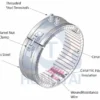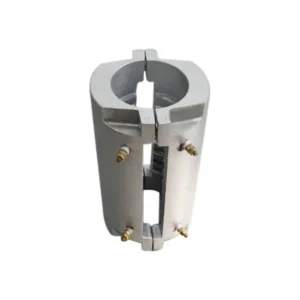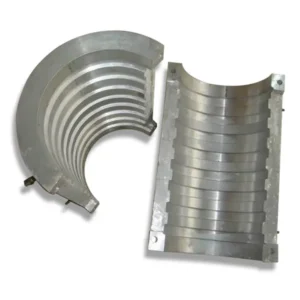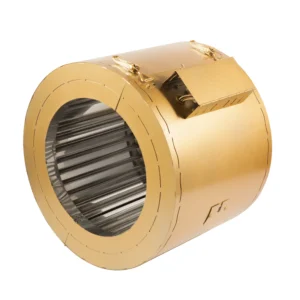
In medical device manufacturing, producing multi-lumen cardiovascular catheters, neurovascular micro-tubing, or critical IV delivery systems is an exercise in microscopic precision. In these applications, the margin for error is effectively zero. A temperature fluctuation of just 1℃ within the extruder barrel is not a minor process variation; it is a critical failure that directly alters the melt viscosity of advanced medical-grade polymers like Polyurethane, FEP, or Pebax.
This thermal instability inevitably results in uneven wall thicknesses, failed Inner Diameter/Outer Diameter (ID/OD) dimensional tolerances, and compromised mechanical properties. Ultimately, this leads to the quarantining and scrapping of entire production batches, triggering severe non-conformance reports during ISO 13485 audits.
This engineering guide analyzes the unforgiving thermal requirements of medical tubing extrusion. We will explore the thermodynamics of polymer rheology, detail how to eliminate systemic “thermal lag,” prevent particulate shedding in ISO-certified cleanrooms, and achieve the absolute thermal uniformity required for micro-extrusion processes.
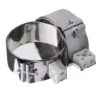
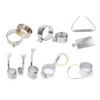
The engineering BLUF (Bottom Line Up Front) is this: Medical extrusion demands zero thermal overshoot and strict cleanroom particulate compliance. Upgrading from standard industrial components to fully encapsulated Stainless Steel Mica Heaters or high-response Nano Band Heaters with integrated thermocouples guarantees ±1℃ accuracy. Furthermore, these material upgrades permanently eliminate the atmospheric particulate contamination caused by the thermal cycling of standard aluminized steel heaters.
To understand the baseline performance differences between standard insulation materials before moving into medical-grade specifics, review our [Ceramic vs. Mica Band Heater Guide].
1. The Physics of Medical Extrusion: Why 1℃ Dictates Quality
In general industrial molding, a 5℃ temperature swing is often absorbed by the process. In medical extrusion, the laws of polymer rheology dictate that even minute thermal deviations fundamentally alter the physical architecture of the extrudate.
Melt Viscosity and Dimensional Tolerance
Medical-grade thermoplastics are highly sensitive non-Newtonian fluids. Their viscosity (η) is a direct function of both shear rate (γ) and temperature (T). For materials like PTFE, FEP, and medical PVC, the temperature-viscosity relationship is exponential.
If a band heater experiences a 2℃ drop because of poor clamping or ambient draft, the localized viscosity of the melt increases. When this cooler, thicker melt reaches the extrusion die, it exhibits a different “die swell” ratio than the warmer polymer ahead of it. The extruder puller is running at a constant speed, meaning the variation in die swell instantly translates to a variation in the tubing’s Outer Diameter (OD) and Inner Diameter (ID). When producing a multi-lumen catheter where the internal lumen must precisely accommodate a guidewire, a dimensional shift of 0.001 inches causes the product to fail critical flow-rate and insertion-force tests.
Preventing Polymer Degradation (Black Specks)
Conversely, localized overheating is equally disastrous. Medical resins are extremely sensitive to thermal degradation. If a heating element utilizes an incorrect watt density, or if microscopic air gaps exist between the heater and the barrel, it creates a “hot spot.”
The polymer flowing adjacent to this hot spot along the barrel wall absorbs excessive thermal energy. The polymer chains begin to break down, carbonizing into microscopic “black specks.” In transparent IV tubing or implantable devices, a single black speck constitutes a critical visual and structural defect, resulting in immediate lot rejection and a mandatory purging of the entire extrusion line.
2. Eradicating Thermal Lag: The Role of Integrated Sensing
To achieve a flat-line temperature profile, the extrusion line’s control system must be fed accurate, instantaneous data. The most common cause of thermal instability is not a defective heater, but “thermal lag” within the closed-loop control system.
The Flaw of External Thermocouples
Thermal lag is the physical time delay between the heater generating thermal energy and the machine’s sensor detecting it.
In many legacy extruders, the machine’s primary thermocouple is mounted deep within the thick steel barrel wall. When the PID (Proportional-Integral-Derivative) controller demands heat, the band heater energizes. The heat must conduct through the heater sheath, across the barrel interface, and through inches of steel before reaching the sensor tip.
By the time the deep-set thermocouple registers that the setpoint has been reached, the band heater has been firing at 100% duty cycle for too long. The massive amount of thermal energy already loaded into the steel continues to travel inward, causing a massive temperature “overshoot” in the polymer melt. The PID controller then cuts power completely, leading to a subsequent “undershoot.” This creates a continuous, destructive sine wave of temperature fluctuations.
Built-in J-Type Thermocouples (Millisecond Response)
To eradicate this phase delay, medical extrusion systems must specify custom band heaters with built-in J-type or K-type thermocouples.
By integrating the sensor directly into the heater’s internal structure—resting mere millimeters from the resistance wire and the external barrel surface—the thermocouple reads the source temperature instantly. This real-time data allows modern PID controllers to utilize their Derivative (D) function effectively. The controller can pulse the Solid State Relays (SSRs) in milliseconds, easing the heater into the setpoint without over-saturating the barrel, thereby flattening the temperature curve to a perfect horizontal line.
3. Cleanroom Compliance: Designing for ISO Class 7 and 8
Medical tubing is manufactured inside strictly controlled cleanrooms (typically ISO Class 7 or Class 8). Every component introduced into this environment must be evaluated for particulate shedding, outgassing, and airborne contamination risks. Standard industrial heaters fail these audits.
The Particulate Shedding Problem
The standard commodity band heater utilizes an aluminized steel sheath and exposed mica edges. At ambient temperatures, aluminized steel is stable. However, when subjected to the continuous 200℃ – 400℃ thermal cycling of an extruder, the aluminum-silicon coating degrades. The underlying carbon steel oxidizes, creating iron oxide (Fe2O3).
As the heater expands and contracts, microscopic flakes of rust and oxidized metal spall off into the surrounding air. Simultaneously, exposed mica edges fracture under clamping pressure, releasing silicate dust. These airborne particulates are immediately captured by the cleanroom’s particle counters, risking the facility’s ISO certification and potentially contaminating the extruded medical tubing via static charge attraction.
304/316L Stainless Steel Encapsulation
For medical applications, heaters must be engineered as sealed, non-shedding components.
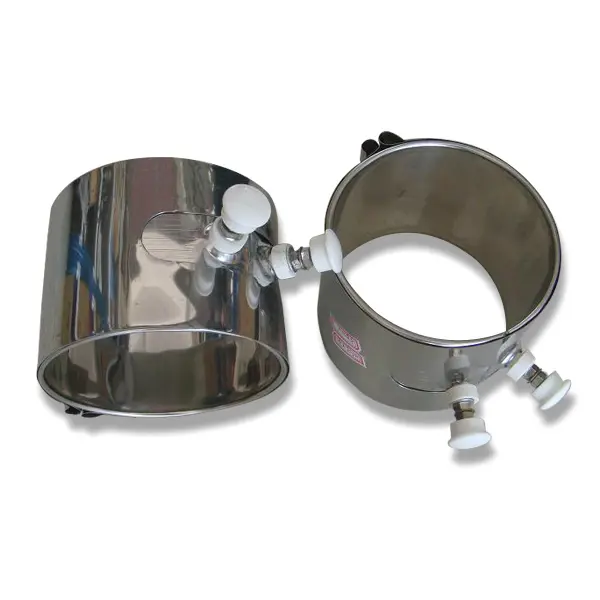
The Engineering Requirement: Medical extruders must strictly specify 304 or 316L Stainless Steel sheaths. Furthermore, the heater must utilize a “folded and sealed” edge construction (or fully TIG-welded encapsulation in the case of nozzle heaters).
Stainless steel forms a passive chromium oxide layer that prevents high-temperature oxidation and rust. The encapsulated design physically traps all internal dielectric insulation (mica or ceramic dust) within the metal housing. This ensures the heating element remains hermetically clean, easily passing rigorous cleanroom air-quality audits and wipe-down sanitation protocols.
4. Nano Infrared Heaters for Micro-Extrusion Stability
The rise of minimally invasive surgery has driven the demand for micro-catheters. The micro-extruders used to produce these 0.5mm tubes present a unique thermodynamic challenge: they have extremely small barrel masses.
The Micro-Tube Challenge
Heat transfer is governed by the equation Q = mc△T, where mass (m) is a critical variable. A micro-extruder barrel (often 3/4-inch or smaller in diameter) possesses very little thermal mass.
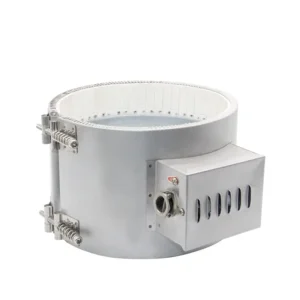
If an engineer specifies a standard, heavy Ceramic Band Heater for a micro-extruder, the heater itself weighs almost as much as the barrel zone it is heating. Steatite ceramic has high thermal inertia; it acts as a “thermal battery.” When the PID controller cuts power, the ceramic tiles hold massive amounts of residual heat, which continues to bleed into the tiny barrel, cooking the delicate polymer and causing severe temperature overshoot.
Radiant Heating for Perfect Uniformity
To achieve micro-extrusion stability, engineers must switch from high-mass conduction heaters to zero-inertia radiant heaters. Nano Band Heaters are the optimal solution.
Nano heaters utilize a specialized internal coating that generates far-infrared radiation, directed inward by an aerospace-grade aerogel insulation layer. They possess virtually zero thermal mass. When energized, the infrared waves heat the steel barrel instantly. The millisecond the PID controller cuts the power, the heat emission stops completely. There is no residual thermal bleed. This extreme thermodynamic agility allows for the precise, rapid-pulse temperature control required for continuous micro-extrusion stability.
5. Validating the Process: IQ/OQ/PQ Support
In the medical device industry, you cannot simply swap a broken part and resume production. The FDA and ISO 13485 mandate strict validation protocols: Installation Qualification (IQ), Operational Qualification (OQ), and Performance Qualification (PQ).
Repeatability in Heater Performance
Medical validation requires the manufacturing process to remain statistically identical over time. If a band heater fails, and the replacement heater ordered from a commodity supplier has a +15% variance in total wattage or a different resistance profile, the thermal dynamics of the extruder will change. This process shift will trigger a PQ failure, requiring a costly, weeks-long re-validation of the entire extrusion line.
Hongtai manufactures medical-grade heaters to absolute precision. By utilizing CNC wire winding and strict metallurgical controls, we maintain watt density and total wattage tolerances of +5% / -10% (exceeding standard industry baselines). This guarantees that a replacement heater performs exactly like the original component validated years prior, allowing maintenance teams to execute direct 1:1 swaps without triggering re-validation protocols.
Documentation and Material Traceability
In a highly regulated environment, undocumented parts are a liability. Professional medical heater suppliers provide comprehensive material certifications. This includes traceability reports for the 304/316L stainless steel, CE certifications for electrical safety, and RoHS compliance documentation ensuring no hazardous heavy metals are present in the heating element that could outgas into the cleanroom.
6. Medical Extrusion Heater Specification Matrix
To assist cleanroom facility managers and extrusion engineers in navigating the procurement process, use the following decision matrix to align the heater architecture with specific medical compliance requirements.
| Medical Application | Recommended Heater Type | Key Compliance / Performance Feature |
|---|---|---|
| Cleanroom Extrusion (ISO 7/8) | Stainless Steel Mica Band | 304/316L SS sheath and folded edges prevent high-temp oxidation and particulate shedding. |
| Catheter Micro-Extrusion | Nano Infrared Band Heater | Zero thermal inertia prevents destructive temperature overshoot on low-mass barrels. |
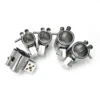
| High-Temp Resins (PEEK/PTFE) | High-Density Ceramic Band | Sustains 400°C+ efficiently without degrading internal wire, ensuring stable long-term heat. |
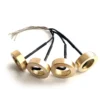
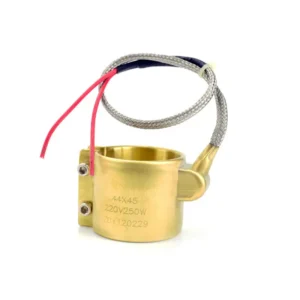
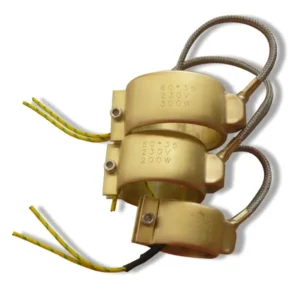
| Medical Mold / Die Heating | Sealed Brass Nozzle Heater | Hermetic, contamination-proof design ensures precise, void-free heat transfer at the die. |
7. Maintenance SOP for Cleanroom Heaters
Maintaining industrial equipment inside a pristine medical cleanroom requires a specialized Standard Operating Procedure (SOP). Traditional “heavy industry” maintenance habits will immediately contaminate the controlled environment.
Contamination-Free Installation
Critical Warning: Never use standard anti-seize lubricants, copper pastes, or thermal conductive greases when installing band heaters on a medical extruder.
These hydrocarbon-based pastes are not designed for 300℃ operating temperatures. During the initial machine heat-up, these compounds will aggressively smoke, boil off, and outgas Volatile Organic Compounds (VOCs). This outgassing will instantly contaminate the cleanroom’s ambient air, trigger air-quality alarms, and severely degrade the facility’s expensive HEPA filtration system.
- The Medical SOP: Ensure the barrel is polished completely clean using isopropyl alcohol and lint-free cleanroom wipes. Install the heater completely dry. Achieve optimal thermal transfer through rigorous, flush metal-to-metal contact and precise clamping tension, not through chemical pastes.
Preventative Replacement Cycles
In commodity plastics, running a heater until it fails mid-batch is an annoyance. In medical manufacturing, an unexpected mid-batch failure forces the scrapping of thousands of dollars of medical-grade resin and triggers a complex QA deviation report.
- The Medical SOP: Implement proactive Megohmmeter (insulation resistance) testing during scheduled monthly maintenance. By trending the dielectric health of the heater, technicians can identify microscopic wire degradation or insulation breakdown before the unit fails. Replace heaters showing declining resistance curves during scheduled shutdowns to guarantee 100% uptime during validated production runs.
Frequently Asked Questions
Why can’t I use standard aluminized steel band heaters in a medical cleanroom?
Standard aluminized steel oxidizes and rusts under high heat and normal atmospheric moisture. Over hundreds of thermal cycles, this creates microscopic metallic flakes that shed into the air. This airborne debris can contaminate sterile medical products and cause your facility to fail ISO Class 7 or 8 cleanroom particulate audits. Always specify 304 or 316L stainless steel encapsulation for cleanroom environments.
How do I stop temperature overshoots on my medical micro-extruder?
Temperature overshoot on small equipment is caused by “thermal inertia”—the heavy heater retains heat and continues to warm the barrel even after the PID controller turns the power off. To eliminate this, you must switch to a heating element with lower mass and faster response, such as a Nano Infrared heater, and ensure your thermocouple is integrated directly into the heater to eliminate sensor delay.
Are thermal pastes safe to use on cleanroom injection molding machines?
No. Thermal pastes, greases, and anti-seize lubricants contain oils and compounds that will smoke and violently outgas Volatile Organic Compounds (VOCs) when heated to polymer extrusion temperatures. This smoke will immediately contaminate the cleanroom environment and foul HEPA filters. Clean, dry, metal-to-metal contact with proper mechanical clamping tension is the only acceptable installation method.
What is the best band heater for processing high-temperature medical PEEK?
High-performance polymers like PEEK require extremely high processing temperatures, often exceeding 350°C to 400°C. Standard mica heaters will experience dielectric binder failure and degrade rapidly at these temperatures. You must specify Ceramic Insulated Band Heaters capable of safely sustaining 600°C, ensuring stable, continuous heat delivery without the risk of wire burnout.