ul 499 heater standard compliance is the non-negotiable gateway for industrial machinery OEMs and component exporters targeting the North American market. Failing a field inspection by a local Authority Having Jurisdiction (AHJ) or having shipments seized at European customs due to non-compliant Low Voltage Directive (LVD) documentation costs manufacturers tens of thousands of dollars in downtime and retrofits.
Building a compliant ceramic Infrared heater system requires aligning electrical creepage distances, ground bonding, and dielectric insulation directly with international safety frameworks. This engineering guide breaks down the core testing criteria for both CE and UL certification to clear clearance obstacles and establish brand trust.
1. Electrical Isolation and the UL 499 Heater Standard
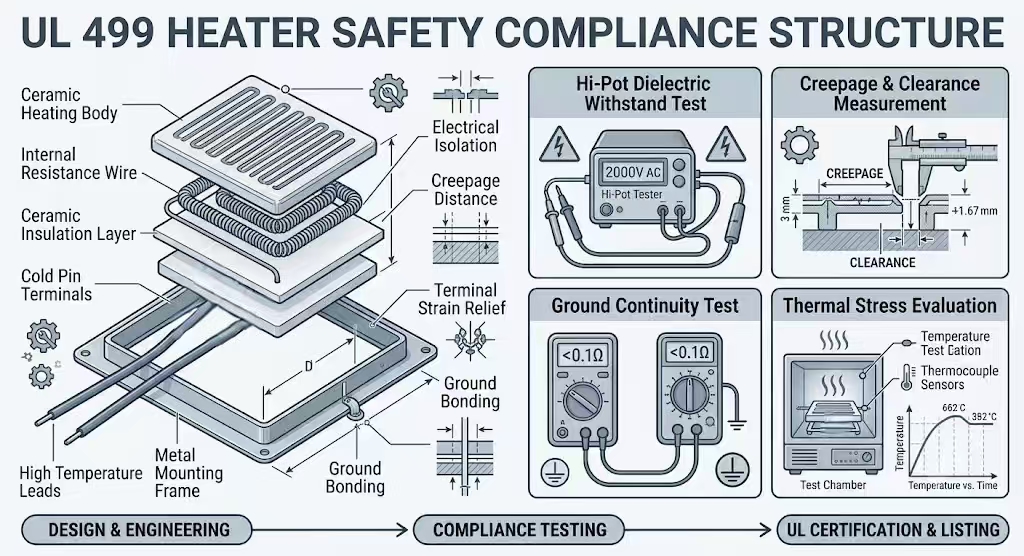
Under the UL 499 Standard for Electric Heating Appliances, industrial electric heaters undergo rigorous electrical and thermal stress evaluations to eliminate fire and shock hazards. For a high-density ceramic infrared array, compliance hinges on four key hardware criteria:
- Dielectric Voltage-Withstand (Hi-Pot Test): Elements must withstand 1,000V plus twice the rated operating voltage (e.g., 1,460V for a 230V heater) applied between live terminals and the grounded metal sheath for 60 seconds without dielectric breakdown.
- Creepage and Clearance Distances: The ul 499 heater standard strictly defines minimum spacing across ceramic insulator surfaces and through air gap channels to prevent electrical arcing under high humidity or airborne contamination.
- Terminal Strain Relief: Cold pins and ceramic wire leads must withstand a minimum pulling force without loosening the internal resistance wire solder or weld points.
- Grounding Continuity: All exposed non-current-carrying metal parts (including reflectors and mounting frames) must maintain a continuous, low-resistance ground path (less than 0.1 Ω).
When designing custom mounting frames, verifying surface power density ensures operating temperatures do not degrade surrounding ceramic standoff insulators. Cross-reference your design limits using How to Calculate Watt Density for Ceramic Infrared Heaters.
2. Harmonized EU Rules for a CE Certified Ceramic Heater
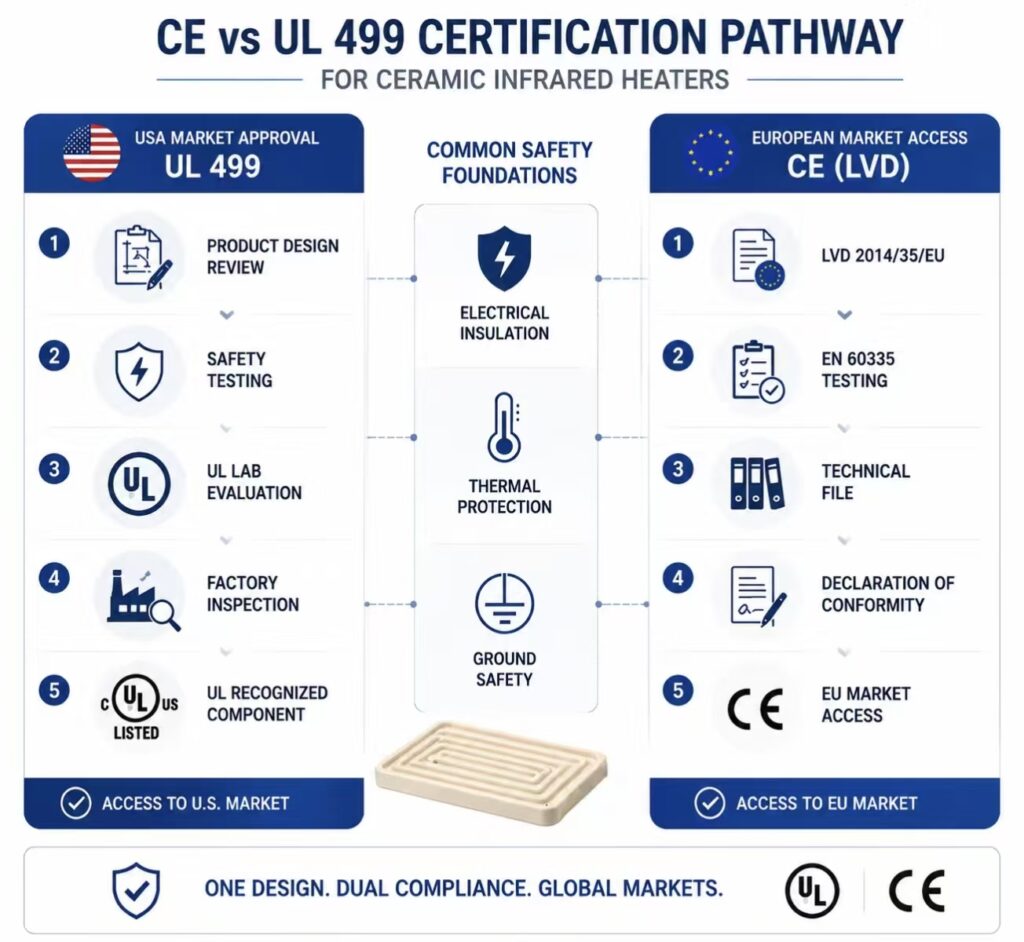
Exporting thermal processing equipment to the European Union requires compliance with the Low Voltage Directive (LVD 2014/35/EU), governed by the harmonized European standard EN 60335-1 and EN 60335-2-45 for industrial heating appliances.
To achieve market entry as a ce certified ceramic heater, the component must meet an overall industrial heater safety standard that accounts for electromagnetic compatibility (EMC), thermal runaway protection, and hazardous substance restrictions (RoHS/REACH).
Unlike UL certification—which relies on mandatory third-party laboratory testing and factory follow-up inspections—CE compliance allows for a manufacturer’s Declaration of Conformity (DoC) backed by a comprehensive Technical Construction File (TCF). However, European customs officials frequently demand valid laboratory test reports verifying IP (Ingress Protection) ratings and glow-wire flammability tests for ceramic terminal blocks.
For baseline design parameters that fulfill EU structural requirements, consult our master guide: Ceramic Infrared Heaters: The Complete Engineering & Selection Guide.
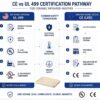
3. Testing Matrix: CE LVD vs. UL 499 Heater Standard Requirements
To streamline quality control for multi-market exporters, compliance managers should audit their production line against this unified engineering testing matrix:
| Compliance Parameter | CE (LVD / EN 60335-2-45) Protocol | UL 499 Heater Standard Protocol |
| Hi-Pot (Dielectric Withstand) | 1,250V AC for 1 minute (Basic Insulation) | 1,000V + 2x Rated Voltage for 60 sec |
| Leakage Current Limit | Max 0.75 mA under operating temperature | Max 0.5 mA to 0.75 mA depending on frame |
| Flammability Standard | IEC 60695 Glow-Wire Test at 850°C | UL 94 V-0 flame rating on insulators |
| Factory Quality Audits | Self-declaration (TCF) or CE Notified Body | Mandatory quarterly UL field audits |
If field units fail insulation tests during local audits, maintenance engineers can isolate dielectric leakage using the multimeter protocols outlined in Troubleshooting Premature Failure in Ceramic Infrared Heating Elements: A Diagnostic Guide.
4. Field Execution SOP: Meeting UL 499 Heater Standard Requirements
Before placing your equipment on an overseas freight container, ensure your engineering team executes this ul 499 heater standard pre-shipment audit:
- Markings and Labels: Are element wattage, voltage, manufacturer logo, and certification marks (UL Recognized Component / CE mark) permanently stamped or laser-etched onto the ceramic body?
- High-Temperature Lead Insulation: Are all terminal connections wired using nickel-plated wire with fiberglass/mica sleeving rated for at least 450°C?
- Thermal Cut-Off Integration: Does the primary control panel include an over-temperature safety limit controller independent of the primary PID loop?
By embedding these testing protocols into your manufacturing workflow, exporters eliminate customs clearance delays and build a bulletproof reputation for safety across international markets.