The Scenario: You are designing a wireless, battery-powered temperature logger for a cold chain logistics crate. You default to specifying a Pt100 sensor because “that is what we used on the steam turbine project.”
Two weeks into testing, you hit two walls:
The Battery Wall: Your device is draining power too fast.
The Wiring Wall: To save cost, you used a 2-wire connector. Now, your readings are consistently drifting 2°C higher than the actual ambient temperature.
The Physics: Both Pt100 and Pt1000 sensors are made of the exact same material—Platinum. They both follow the same IEC 60751 tolerance curves. The only difference is the reference resistance at 0°C: 100Ω vs 1000Ω.
That single extra “zero” seems trivial, but in the world of circuit design, it creates a butterfly effect that dictates power consumption, wiring architecture, and total system accuracy.
This guide analyzes the physics behind the 10x Multiplier. We will explain why the industrial world clings to Pt100, while the modern IoT and HVAC sectors are aggressively migrating to Pt1000.
Round 1: The “Lead Wire” Immunity (Core Advantage)
This is the single strongest engineering argument for choosing a Pt1000 sensor: It makes 2-wire connections viable.
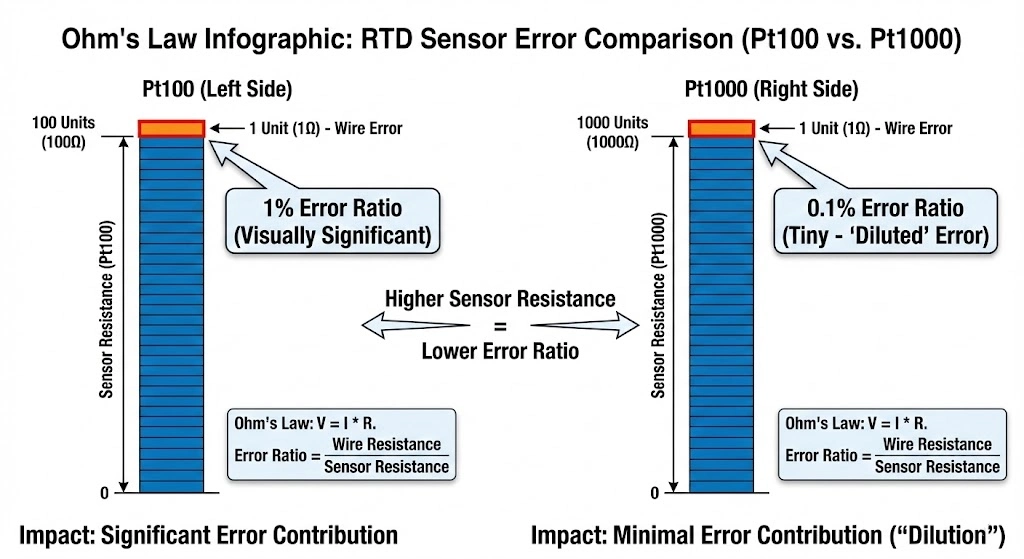
The Math: Calculating the “Cable Error”
In a standard 2-wire circuit, the controller cannot distinguish between the sensor resistance and the wire resistance. It simply adds them together (R_{Total} = R_{Sensor} + R_{Wire}).
Let’s simulate a real-world installation with 50 meters of standard copper cable, introducing a total loop resistance of 1.0 Ω.
Case A: Using a Pt100 Sensor
Base Resistance: 100 Ω at 0°C.
Sensitivity: ~0.385 Ω/°C.
The Error: 1.0 Ω ÷ 0.385 Ω/℃ = 2.6℃ Error
Verdict: Catastrophic. A 2.6°C offset ruins any precision measurement. You are forced to upgrade to a 3-wire or 4-wire circuit to compensate, which increases cabling costs by 50-100%.
Case B: Using a Pt1000 Sensor
Base Resistance: 1000 Ω at 0°C.
Sensitivity: ~3.85 Ω°C (10x higher sensitivity).
The Error: 1.0 Ω ÷ 3.85 Ω/℃ = 0.26℃ Error
Verdict: Negligible. The error is small enough that many HVAC and Building Management Systems (BMS) can ignore it entirely.
Conclusion: If you are constrained to 2-wire connections (common in slip rings or legacy building wiring), Pt1000 is the only technical option.
Pt100 vs Pt1000 lead wire resistance error comparison infographic.
Round 2: Power Consumption & Self-Heating
Every sensor follows Joule’s Law: P = I^2*R. When you run a current through a resistor, it generates heat. This is called Self-Heating. If the sensor heats itself up, it is no longer measuring the process temperature accurately.
The Power Efficiency Calculation
To read the sensor, the measuring electronics must push an excitation current through it to generate a measurable voltage signal (usually around 1 Volt).
Pt100 Circuit:To get a decent signal voltage, we typically push 1 mA to 5 mA of current.
Result: Higher current consumption. Higher self-heating. Bad for batteries.
Pt1000 Circuit:Because the resistance is 10x higher, we need 10x less current to generate the same voltage drop. We typically use 0.1 mA to 0.5 mA.
Result: Extremely low power consumption. Negligible self-heating.
The “IoT” Application
If you are designing:
Wireless Data Loggers (LoRaWAN / Zigbee)
Refrigerated Truck Sensors
Portable Medical Devices
Pt1000 is the winner. Switching from Pt100 to Pt1000 can literally double the battery life of your device while improving measurement stability in stagnant air (where self-heating is most pronounced).
Round 3: Industrial Ecosystem (Compatibility)
If Pt1000 is so great, why does Pt100 still dominate 90% of the market? It comes down to Infrastructure Inertia.
Where Pt100 Wins: Heavy Industry
In Oil & Gas, Power Generation, and Chemical Processing, power consumption is irrelevant (the grid is infinite).
The Ecosystem: Every major PLC manufacturer (Siemens, Allen-Bradley, Emerson) designed their standard Analog Input Cards for Pt100.
The Risk: If you try to connect a Pt1000 sensor to a standard Siemens S7-300 RTD module, it will likely read “Over Range” or “Wire Break” because the resistance is outside its expected window.
Rule: For process control with standard PLCs, stick to Pt100 (3-Wire or 4-Wire).
Where Pt1000 Wins: HVAC & BMS
In Building Management Systems (Honeywell, Johnson Controls), runs are long, and wires are often pre-installed twisted pair (2-wire).
The Standard: The BMS industry standardized on high-resistance sensors (Pt1000, NTC 10k) to allow for 100+ meter cable runs without expensive 3-wire compensation.
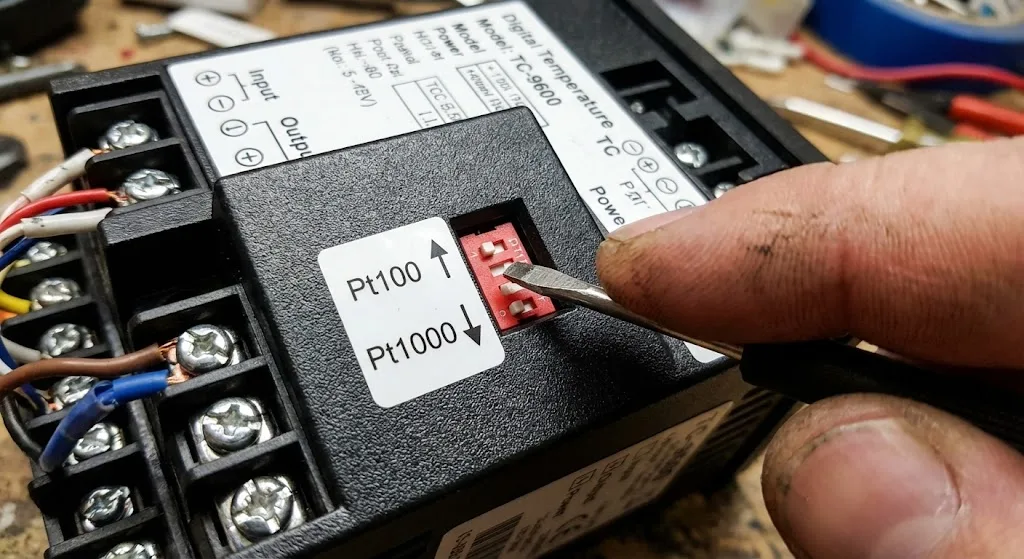
Changing controller input settings from Pt100 to Pt1000.
The “Multiplier” Conversion Trick
For field technicians, identifying a sensor without a part number can be frustrating. Here is the quick diagnostic rule using a multimeter.
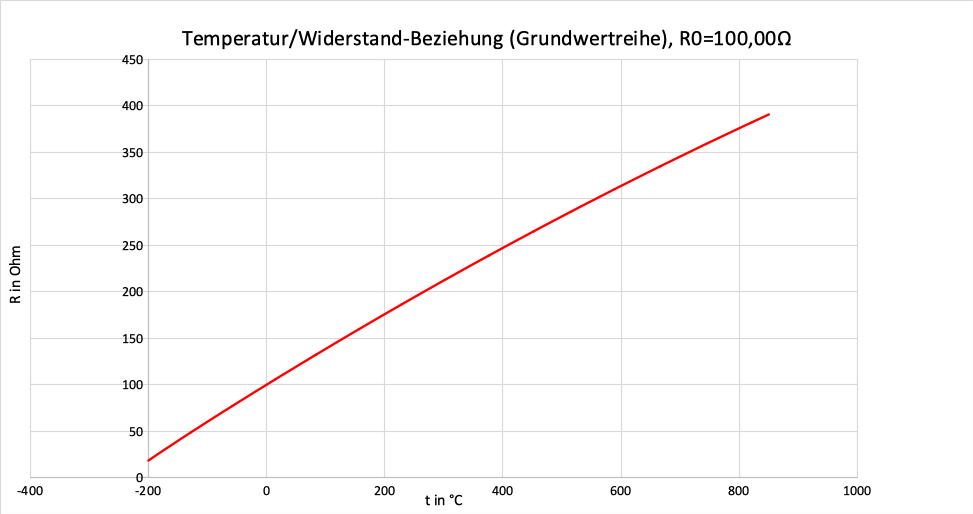
The Rule: Pt1000 behaves exactly like Pt100, just multiplied by 10.
Pt100 Sensitivity: ~0.385 Ω per °C.
Pt1000 Sensitivity: ~3.85 Ω per °C.
The Quick Multimeter Check
Measure the resistance across the sensor leads (Red and White):
Reading ~100 Ω to 110 Ω :It is a Pt100 near room temperature.
Reading ~1000 Ω to 1100 Ω:It is a Pt1000 near room temperature.
Reading ~10 Ω or ~10,000 Ω:It is NOT a Platinum RTD. It is likely a Thermistor (NTC/PTC).
Pt100 vs Pt1000 resistance curve sensitivity graph.
Summary Selection Matrix
Use this decision matrix to finalize your Bill of Materials (BOM).
Scenario
Winner
Why?
Heavy Process Control (PLC)
Pt100
Universal compatibility with standard IO cards. 3-wire/4-wire is standard.
Long Distance 2-Wire
Pt1000
Resistance magnitude minimizes cable error impact (1Ω error is negligible).
Battery / IoT Devices
Pt1000
Uses 1/10th the excitation current. Longer battery life. Less self-heating.
HVAC / Building Automation
Pt1000
Industry standard for BMS controllers to reduce cabling costs.
High Vibration
Draw
Both use the same “Thin Film” chip technology. Durability is identical.
High Accuracy Lab
Pt100
4-Wire Pt100 measurement bridges are more common in metrology.
Frequently Asked Questions (FAQ)
Is Pt1000 more accurate than Pt100?
Not intrinsically. Both sensors use the same Platinum element technology and adhere to the same IEC 60751 tolerance classes (Class A, Class B). However, in a 2-wire circuit, a Pt1000 appears more accurate because it is significantly less affected by the electrical resistance of the extension cables.
Can I replace a Pt100 with a Pt1000?
Only if your controller supports it. You cannot simply swap the sensors. You must enter the controller’s programming menu and change the “Input Type” from Pt100 to Pt1000. If you swap them without reprogramming, the controller will read a resistance of 1000$\Omega$, think it is a Pt100 at extremely high temperature (approx 2600°C), and trigger an “Over Range” alarm.
Why is Pt100 more common than Pt1000?
Historical inertia. In the early days of analog electronics, it was difficult to build stable current sources for high-resistance measurements. Pt100 (100$\Omega$) became the global standard for industrial process control, creating a massive installed base of compatible instruments. Pt1000 is a newer preference driven by modern low-power electronics.
Does Pt1000 use 3 wires?
It can, but it usually doesn’t need to. The primary purpose of the 3rd wire is to compensate for lead resistance. Since Pt1000 is inherently resistant to lead wire errors (due to its high base resistance), a simple 2-wire connection is sufficient for most applications, saving the cost of the third wire and the extra terminal block.