The Scenario: You manage a factory with 50 critical monitoring points spread across a 5,000 square meter floor. To install traditional wired sensors, you are looking at kilometers of cable trays, conduit, and labor costs exceeding $10,000. And if one cable breaks inside a wall? Good luck troubleshooting it.
The Shift: In the Industry 4.0 era, data should not be locked inside a local control cabinet. It needs to be accessible on your phone, your cloud dashboard, and your ERP system simultaneously.
The Value: This guide cuts through the hype. We will compare the “Big Three” industrial wireless technologies—WiFi, LoRaWAN, and 4G/NB-IoT—to help you find the most cost-effective architecture for your specific environment. We will also explore why a $50 “Smart Home” sensor will fail in a factory, and how to deploy ruggedized Digital Probes (DS18B20) for massive scalability.
There is no “one size fits all” in wireless. The choice depends entirely on Range, Power, and Data Rate.
1. WiFi Sensors (High Speed, Short Range)
Pros: No need for a dedicated gateway; it connects directly to your existing factory router. High bandwidth allows for real-time data streaming (e.g., every second).
Cons: Power hungry. WiFi chips drain batteries quickly, often requiring external 5V/12V power. Poor wall penetration.
Best For: IT Server Rooms, Constant Temperature Laboratories, clean manufacturing floors with abundant power outlets.
2. LoRaWAN (Long Range, Low Power)
Pros: The king of industrial IoT. A single gateway can cover an entire industrial park (up to 10km line-of-sight). Extremely low power consumption—batteries can last 5-10 years. Excellent penetration through concrete walls and tank shells.
Cons: Low data rate. You cannot stream video or high-speed vibration data; it is designed for small packets (e.g., temperature every 15 minutes).
Best For: Agricultural Greenhouses, Large Chemical Plants, Tank Farms, sprawling Campuses.
3. 4G / NB-IoT (Mobile)
Pros: Truly autonomous. Each sensor has its own SIM card. No local network infrastructure required. Unlimited range (global roaming).
Cons: Monthly data fees per sensor. Higher power consumption than LoRaWAN.
Best For:Refrigerated Trucks (Cold Chain), Shipping Containers, Remote Pumping Stations.
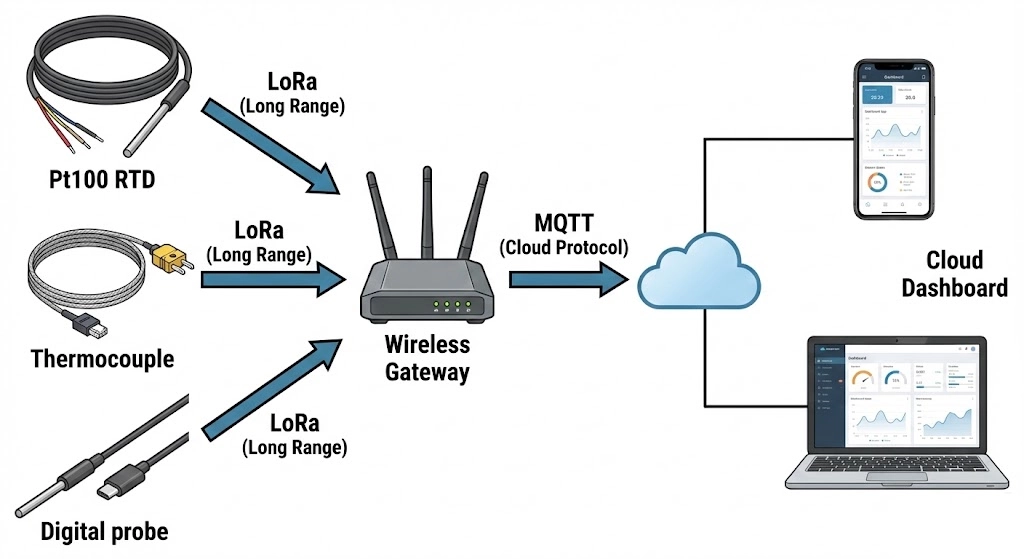
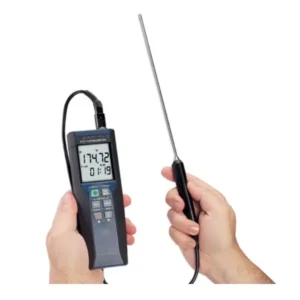
Industrial wireless IoT temperature monitoring system architecture diagram.
The “Digital Probe” Revolution: DS18B20 vs. NTC
We see 50,000+ searches a month for “DS18B20”. Why? Because it changes the economics of sensing.
The DS18B20 Advantage
Traditional sensors (Pt100, Thermocouple) output an Analog Signal (Resistance or Voltage). To read them wirelessly, you need an expensive Analog-to-Digital Converter (ADC) chip at every node.
The DS18B20 is a Digital Sensor. It outputs a direct digital signal via a 1-Wire Bus.
Scalability: You can daisy-chain multiple sensors on a single wire.
Cost: The chip is incredibly cheap, making high-density monitoring affordable.
Our Solution: Industrial Packaging
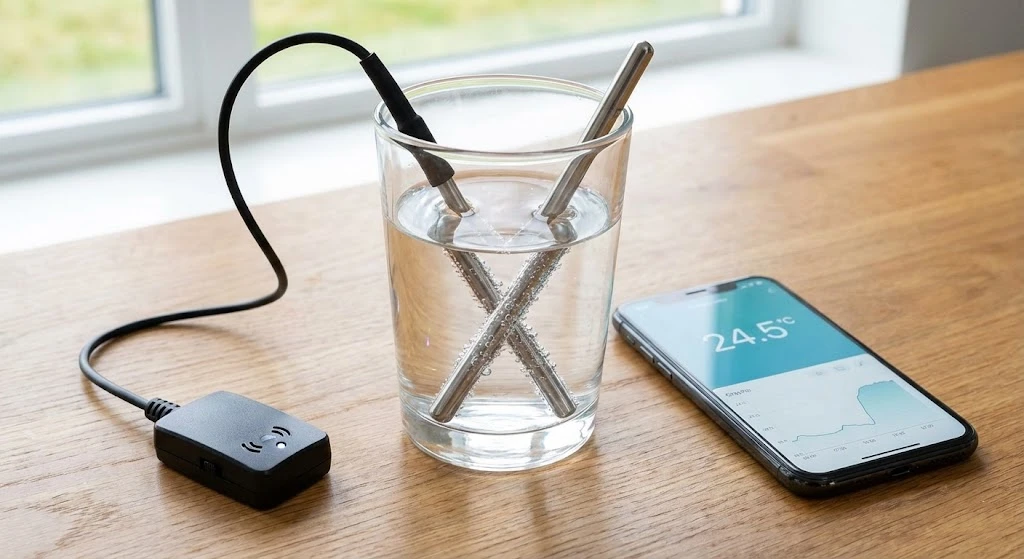
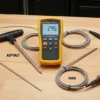
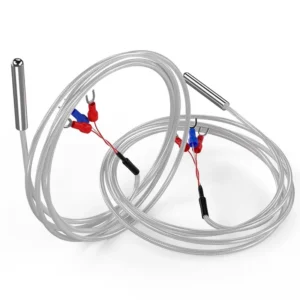
We do not sell bare chips. A bare chip will short out in humidity. We manufacture IP68 Waterproof Digital Probes.
The Armor: The digital chip is encapsulated inside a SS316 stainless steel tube.
The Seal: We use a double-potting epoxy process to ensure it is completely watertight, even when submerged in glycol or water tanks.
Waterproof DS18B20 digital temperature sensor probe for industrial IoT.
Industrial vs. Consumer Grade: Don’t Buy Toys
It is tempting to buy a $20 “Smart Life” sensor from Amazon. Do not do it for your business.
Consumer (Amazon Grade)
Casing: Cheap ABS plastic. Not waterproof.
Power: Coin cell battery (lasts 3 months).
Failure Mode: If the WiFi drops, the data is lost forever.
Alerts: Push notification only (easy to miss).
Industrial Grade (Our Grade)
Data Buffering (Breakpoint Resume): If the network goes down, the sensor stores data locally in its memory. When the network returns, it automatically uploads the missing history. Zero Data Loss.
Rugged Enclosure: IP67 / IP68 rated polycarbonate or metal housings. Resistant to acid, alkali, and washdowns.
Alerts: Multi-channel alarming. SMS, Phone Call, and Email to the maintenance supervisor.
For food logistics, “I think it was cold” is not a legal defense.
The Solution: 4G Wireless Loggers installed in trucks.
The Result: Automatic generation of temperature curves PDF reports. If the truck compressor fails at 3 AM, the fleet manager gets a phone call immediately, saving the cargo.
Motor Vibration & Temp (Predictive Maintenance)
Motors get hot before they burn out.
The Solution: A wireless magnetic-mount thermocouple node.
The Result: By monitoring the casing temperature trend, you can predict bearing failure weeks in advance (Predictive Maintenance) rather than reacting to a fire (Corrective Maintenance).
Wireless System Architecture
How does it all fit together?
Sensor Node: The edge device. It reads the physical probe (Pt100/TC/DS18B20) and transmits data wirelessly.
Gateway (Concentrator): The bridge. It collects data from hundreds of nodes and pushes it to the server via Ethernet or 4G.
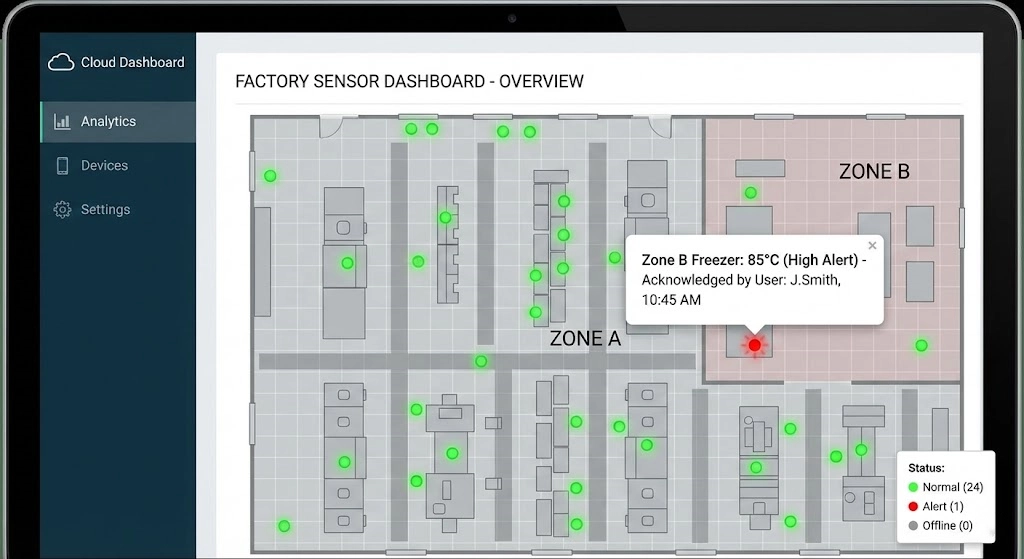
Cloud Platform: The brain. A web-based dashboard where you view curves, set alarm thresholds, and export reports.
API Integration: We provide open APIs (MQTT / REST) to feed data directly into your existing SCADA, MES, or ERP system.
Remote temperature monitoring system cloud dashboard software interface.
Selection Checklist
Use this table to choose the right protocol for your environment.
Environment
Power Availability
Recommended Technology
Key Feature
Inside Factory
AC Power Available
WiFi / Ethernet
High Speed, Real-time
Outdoor / Agriculture
Battery Only
LoRaWAN
Extreme Range, 5yr+ Battery
Moving Truck / Cargo
Battery (Rechargeable)
4G / NB-IoT
No Range Limit (Cellular)
Low Cost / High Density
Wired Bus
DS18B20 (1-Wire)
Lowest Cost Per Point
IT Server Room
AC Power
WiFi / SNMP
Integration with IT systems
Frequently Asked Questions (FAQ)
What is the range of a wireless temperature sensor?
It depends on the technology. WiFi sensors typically cover 30-50 meters indoors (dependent on router placement). LoRaWAN sensors can transmit up to 2km in dense urban areas and 10km in open rural areas (Line of Sight). 4G/Cellular sensors have unlimited range as long as there is cell service coverage.
Can I use DS18B20 for industrial applications?
Yes, but only if packaged correctly. The bare TO-92 chip is fragile and not waterproof. For industrial use, you must specify a DS18B20 probe encapsulated in a stainless steel tube with epoxy potting (IP68 rated). This ensures it can survive moisture, chemicals, and physical impact.
How long do wireless sensor batteries last?
Industrial LoRaWAN sensors optimized for low power can last 5-10 years on a single non-rechargeable Li-SOCl2 battery, assuming a data transmission interval of 15-30 minutes. WiFi and 4G sensors consume significantly more power and typically require battery replacement every 6-12 months or a permanent external power source.
Is wireless temperature monitoring secure?
Yes. Industrial-grade systems use AES-128 or AES-256 encryption for data transmission. This ensures that your production data cannot be intercepted, read, or tampered with by hackers. Additionally, on-premise gateways can keep data within your local intranet if cloud security is a concern.