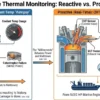
The Scenario: You are a QA manager standing on a freezing loading dock, inspecting a pallet of frozen beef. Or you are a civil engineer watching a steamroller compact fresh asphalt. You stick your thermometer in, and the numbers crawl… 10°C… 12°C… 15°C… taking 30 seconds to stabilize.
The Problem: In a home kitchen, waiting 30 seconds for a roast chicken reading is annoying. In an industrial environment, it is unacceptable. Cheap “all-in-one” thermometers typically use thermistors, which have high thermal mass and slow response times. In production, time is money, and temperature lag leads to false passes and spoiled inventory.
The Solution: Professional engineers do not use gadgets; they use Industrial Thermocouple Systems.
The Value: By separating the “Brain” (the meter) from the “Sensor” (the probe), you gain the ability to measure a frozen steak in 0.8 seconds, then swap the probe to measure a steam pipe in the next minute. This guide explores the physics of high-speed Type K handheld systems and how to select the right probe for HACCP, HVAC, and Civil Engineering applications.
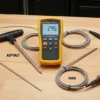
Industrial handheld thermocouple thermometer with interchangeable probe kit.
The biggest misconception in B2B procurement is buying a thermometer as a single, disposable unit. The professional approach is Modular.
The “Brain” (The Meter)
You only need to buy the meter once. A robust, industrial Type K Digital Thermometer (identifiable by the yellow Mini Connector socket) is an asset. It provides the cold junction compensation, the battery power, and the digital display.
The “Hands” (The Probes)
The probe is the consumable. It is the specialized tool designed for a specific task.
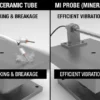
Physics of Speed: Industrial probes use Mineral Insulated (MI) technology or Exposed Ribbons to minimize thermal mass. Less mass = faster heat transfer = instant readings.
Versatility: With one meter, you can connect a 1.5mm needle probe for food, a heavy-duty spike for asphalt, or a surface probe for steel molds.
Probe Types: Choosing the Right Weapon
A probe designed for air will fail if used on steel. Selecting the right geometry is critical for accuracy.
1. Penetration Probes (Food / Rubber / Compost)
Application: Core temperature checks for HACCP compliance, rubber tire curing, and biomass fermentation.
Design: A sharp, pointed tip made of food-grade Stainless Steel (SS316).
The “Reduced Tip” Technology: Standard probes are 3mm thick. High-speed probes feature a swaged tip reduced to 1.5mm diameter for the last 15mm.
Why it matters: The thinner tip has 1/4th the thermal mass of the shaft. This allows it to reach thermal equilibrium in 0.5 seconds, preventing the “cooling effect” where a cold probe freezes the meat around it.
2. Surface Probes (HVAC / Industrial)
Application: Hot plates, injection molds, motor casings, and copper pipes.
Design: The Spring-Loaded Ribbon.
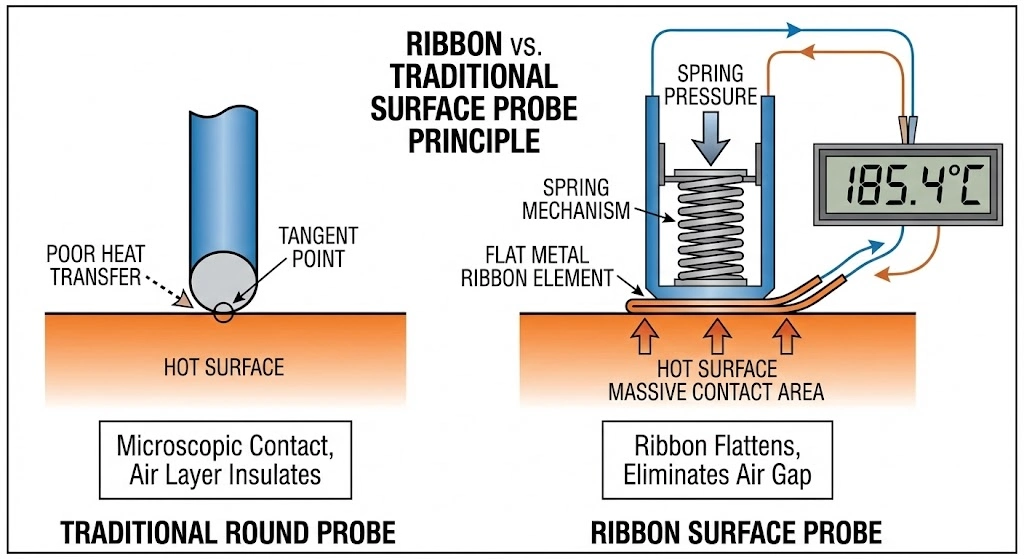
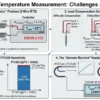
The Physics: A traditional round probe touches a flat surface at only one microscopic point (tangent). Heat transfer is terrible. A Ribbon Probe uses a flat band of thermocouple metal stretched across a spring bow.
Benefit: When pressed against a surface, the ribbon flattens out, creating a massive contact area. The spring maintains positive pressure, eliminating the insulating air layer.
Surface temperature probe with ribbon element measuring hot steel plate.
Immersion: A round, blunt tip (no sharp point) designed for liquids like deep fryer oil or chemical baths. The blunt tip prevents puncture accidents.
Air/Gas: Features a Perforated Shield (Cage) protecting the sensor. The sensor tip is often an Exposed Junction (bare wire) to catch rapid changes in airflow temperature in HVAC ducts.
Industry Focus: Where Reliability Matters
Food Safety (HACCP Compliance)
In food processing, the “Danger Zone” (5°C to 60°C) is where bacteria multiply.
The Requirement: You must verify that cooked food reaches 75°C rapidly or cooled food drops below 5°C quickly.
The Gear: A Type T (Copper-Constantan) or Type K reduced-tip probe.
Hygiene: The probe handle must be IP67 Waterproof and seamless to prevent bacteria traps. It should be able to survive a cycle in an industrial dishwasher.
Civil Engineering (Asphalt & Concrete)
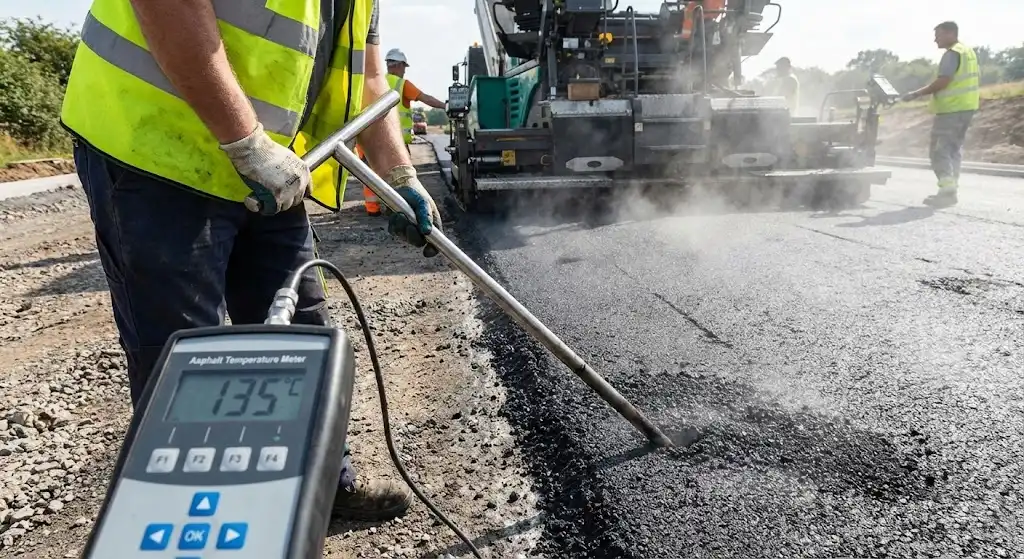
Asphalt must be compacted within a specific temperature window (usually 130°C to 160°C). Too cold, and it cracks; too hot, and it won’t set.
The Gear: A delicate food probe will snap instantly in aggregate. You need a Heavy Duty Penetration Probe.
Specs: 6mm or 8mm diameter shaft with a reinforced “T-Handle” to allow the operator to push with body weight into the semi-solid road surface.
Heavy duty asphalt temperature probe with T-handle measuring road surface.
Cable & Handle Selection (The Details)
Don’t let a melted handle ruin your day.
Cable Style
Coiled Cable (Retractable): Stretches to 1.5 meters but snaps back to 30cm. Perfect for moving around a workshop or vehicle. It stays out of the way.
Straight Cable: Better for fixed-station monitoring where tension on the coil might pull the probe out of position.
Handle Material
ABS / Polypropylene: Standard plastic. Good for up to 80°C-100°C. Cheap and waterproof.
Bakelite (Phenolic): A thermoset plastic that can withstand 200°C+.
Why choose Bakelite? If you are measuring a 300°C hot plate, the radiant heat will melt a standard plastic handle. Bakelite protects the operator’s hand and the probe integrity.
Selection Checklist for Buyers
Use this matrix to match the probe to your job.
What are you measuring?
Recommended Probe Style
Key Specification
Frozen Meat / Fruit
Penetration (Needle)
Reduced Tip (1.5mm) for speed.
Hot Steel Plate / Mold
Surface (Ribbon)
Spring-Loaded Ribbon + Bakelite Handle.
Deep Fryer Oil
Immersion (Blunt)
SS316 Sheath (Food Grade).
HVAC Air Duct
Air (Caged)
Exposed Junction for <1s response.
Asphalt / Roadbed
Heavy Duty Penetration
6mm Shaft + Reinforced T-Handle.
Frequently Asked Questions (FAQ)
What is the fastest response temperature probe?
For solid insertion (like food), a “reduced tip” thermocouple probe is fastest (approx 0.5 – 1 second) because the swaged tip has very low thermal mass. For surface measurement, a “ribbon element” probe is fastest because the flat band creates a large surface area contact with the object, transferring heat almost instantly.
Are Type K thermocouples food safe?
Yes, provided the probe sheath is made of food-grade Stainless Steel (304 or 316) and the design eliminates bacteria traps (smooth transitions between handle and probe). They are widely used for HACCP compliance checks in kitchens and factories.
Why is my surface probe reading low?
Surface measurements are notoriously difficult. Low readings are usually caused by poor contact angle, insufficient pressure, or an oxide layer on the metal acting as an insulator. Using a spring-loaded ribbon probe (instead of a stick probe) and adding a dab of thermal grease can significantly improve accuracy.
Can I use a K-type probe on a J-type meter?
No. The meter and the probe must match. A Type K probe connected to a Type J meter will give wildly incorrect readings because the voltage curves are different. Always match the connector color and type: Yellow for Type K, Black for Type J.