Flat ceramic heaters,In thermoforming, paint curing, and industrial drying, temperature uniformity is not just an operational metric—it is the deciding factor between a high-yield production run and severe scrap losses. For process engineers and oven designers, achieving perfect edge-to-edge heating across large surface areas remains a persistent challenge.
Relying on improperly specified industrial oven heating elements often results in localized hot spots or cold zones, leading to blistering, warping, or uneven curing of the substrate.
The optimal solution for large-area thermal consistency is the flat ceramic heater. Below is a comprehensive engineering and specification guide on how to integrate flat infrared panels to eliminate temperature variances and reduce defect rates in industrial ovens.
1. The Physics of Thermal Uniformity
Traditional radiant elements, such as round tubular heaters, emit infrared energy in a 360-degree radial pattern. While effective for ambient heating, this geometry creates overlapping radiation zones and unpredictable thermal footprints when arrayed in a flat plane.
A flat ceramic heater is specifically engineered to project infrared energy strictly forward in a directional, uniform plane.
- Embedded Resistance Coil: The internal NiCr (Nickel-Chromium) resistance wire is precisely coiled and embedded at equal distances across the ceramic body.
- Thermal Mass: The glazed ceramic material acts as a highly efficient thermal reservoir, absorbing the intense heat of the internal wire and diffusing it evenly across its flat face, effectively “smoothing out” micro-fluctuations in temperature.
2. Key Engineering Specifications for Oven Designers
When designing the thermal zones of a new curing or baking oven, matching the correct element specifications to the substrate’s absorption rate is critical.
| Specification Parameter | Technical Range / Detail | Engineering Application |
| Infrared Wavelength | 2.0 to 10.0 microns (Far-Infrared) | perfectly matches the absorption spectrum of plastics, organic materials, paints, and water. |
| Max Surface Temperature | Up to 700°C (1292°F) | Ideal for continuous, high-temperature industrial processes. |
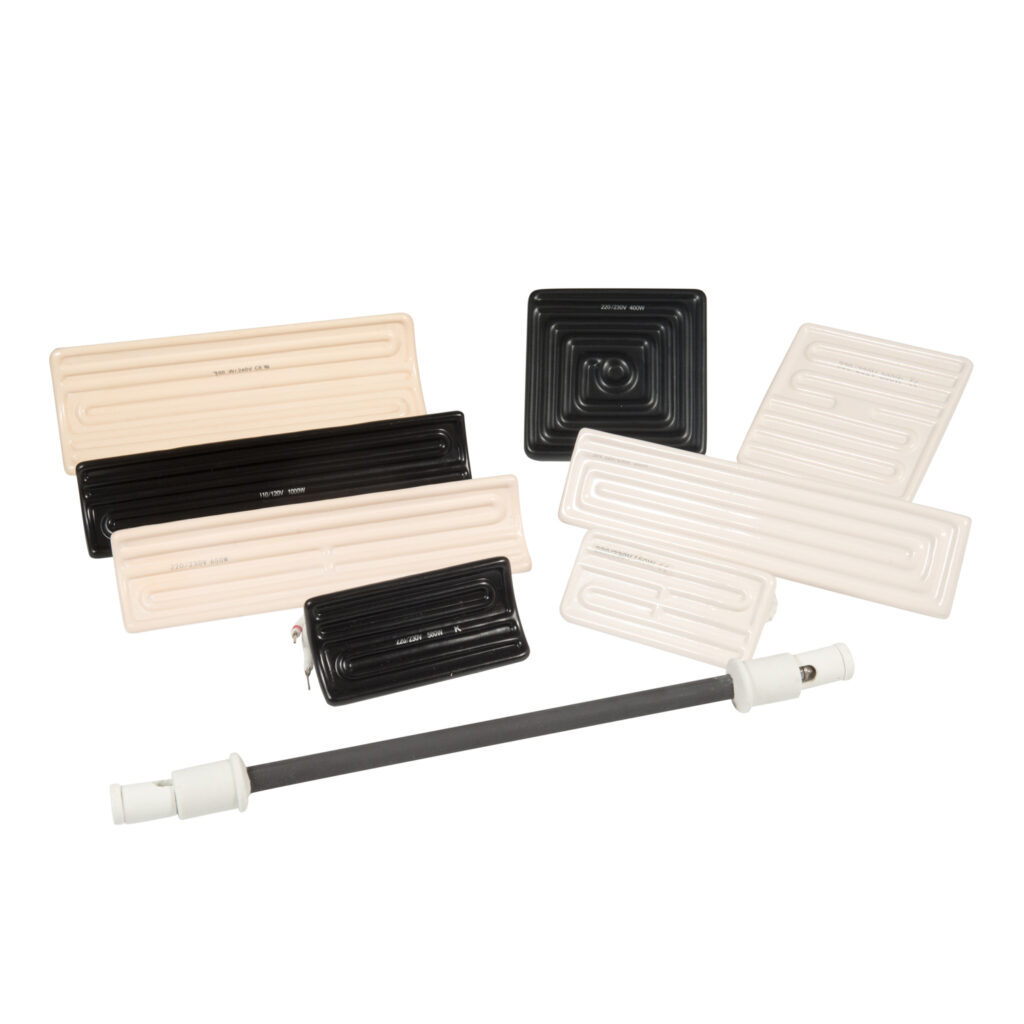
| Standard Dimensions | 122 x 122 mm, 245 x 60 mm, 245 x 122 mm | Modular sizing allows for seamless edge-to-edge array building. |
| Watt Density | 15 kW/m² to 64 kW/m² | Adjustable power outputs depending on the required ramp-up speed and steady-state thermal load. |
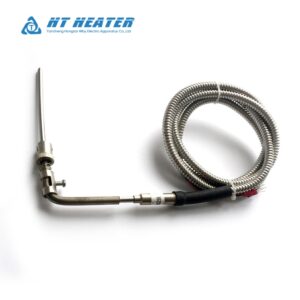
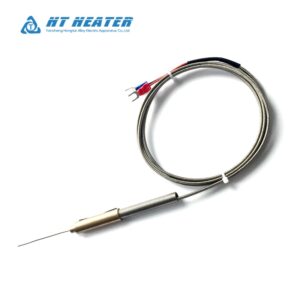
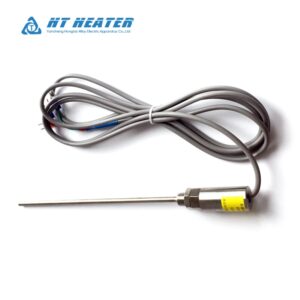
| Thermocouple Integration | Built-in Type K or Type J | Allows for closed-loop PID control directly at the emitting surface, preventing thermal lag. |
3. Eliminating Edge Heat Loss with Strategic Zoning
One of the most common causes of high defect rates in large-panel heating is the “edge effect.” The outer perimeters of an industrial oven naturally lose heat to the surrounding environment and machinery walls much faster than the center.
By utilizing modular flat infrared panels, process engineers can design independent control zones to solve this:
- High-Density Perimeter Zones: Install flat ceramic heaters with higher wattage ratings (e.g., 650W or 1000W elements) along the outer edges of the heating matrix.
- Lower-Density Center Zones: Utilize lower wattage elements (e.g., 400W) in the center of the array where ambient heat naturally accumulates.
- Closed-Loop Feedback: Pair each zone with elements containing integrated Type K thermocouples, allowing the PLC to independently drive the SSRs (Solid State Relays) and maintain a perfect thermal blanket across the entire substrate.
4. Operational Advantages on the Factory Floor
Beyond pure thermal uniformity, integrating flat ceramic technology into industrial ovens provides significant operational benefits:
- Zero Glare: Unlike quartz halogen lamps, ceramic heaters do not emit visible light, preventing operator eye strain during inspection and maintenance.
- Contamination Resistance: The glazed ceramic surface is impervious to splashing, oxidation, and corrosive fumes commonly found in paint curing or chemical drying processes.
- Extended MTBF (Mean Time Between Failures): The embedded wire is completely protected from atmospheric oxygen, extending the element’s lifespan to over 10,000 operating hours under normal conditions.
Upgrade Your Thermal Processing at HT-Heater
Whether you are retrofitting an existing drying tunnel or prototyping a new vacuum forming machine, achieving thermal uniformity starts with the right components.
HT-Heater manufactures industrial-grade flat ceramic heaters engineered for precision and durability. Send us your oven dimensions, target temperatures, and power requirements, and our engineering team will assist in designing the optimal multi-zone infrared array for your process.