Introduction to Industrial IR Heaters
In the world of industrial thermal management, efficiency, uniformity, and reliability are paramount. Ceramic infrared heaters have emerged as the industry standard for processes requiring consistent, non-contact heat. Unlike traditional convection heaters that warm the surrounding air, ceramic IR heaters utilize far-infrared (FIR) radiation to transfer heat directly to the target material.
Whether you are a purchasing manager looking to upgrade your facility’s energy efficiency or a mechanical engineer designing a new thermoforming machine, understanding the core mechanics of ceramic heater elements is critical. This comprehensive guide will walk you through the engineering principles, types, selection criteria, and best practices for integrating ceramic heating technology into your applications.
How Do Ceramic Infrared Heaters Work?
At their core, far infrared ceramic heaters operate on the principle of radiant heat transfer. The heater consists of a high-resistance heating alloy (typically Nickel-Chrome, NiCr) embedded within a specially formulated refractory ceramic body.
When electrical current passes through the resistance wire, it generates intense heat. The ceramic body absorbs this heat and emits it as electromagnetic radiation in the infrared spectrum—specifically in the far-infrared range (typically 2 to 10 microns).
The Science of Far-Infrared (FIR) Heating
This specific wavelength is crucial. Most industrial materials—including plastics, organics, water, and polymers—absorb far-infrared radiation highly efficiently. Instead of wasting energy heating the ambient air, the radiant energy penetrates the surface of the target material, resulting in faster heating times and significantly lower energy consumption.
Key Components and Construction
High-quality ceramic heater elements are engineered for durability in harsh industrial environments. A standard unit comprises:
- Resistance Wire: Precision-coiled NiCr wire designed for optimal heat generation and longevity.
- Ceramic Matrix: A thermally conductive but electrically insulating ceramic body that protects the wire from oxidation and chemical attacks.
- Glaze Coating: A specialized external glaze that prevents moisture ingress, protects against corrosive gases, and maximizes the emissivity of the infrared radiation.
- Integrated Temperature Sensors: Many advanced models feature a built-in sensor for precise thermal regulation (Note for Webmaster: Add internal link here to your Thermocouple Page).
Types of Ceramic Heater Elements
Not all ceramic heaters are built the same. Depending on your process requirements, you will need to choose the correct physical configuration:
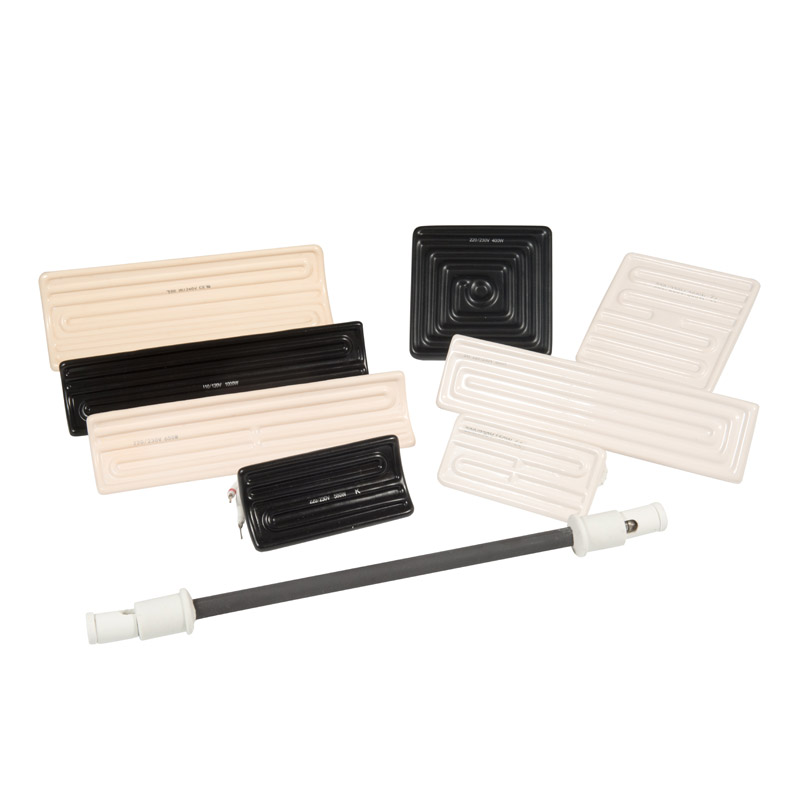
1. Solid vs. Hollow Ceramic Heaters
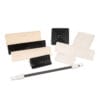
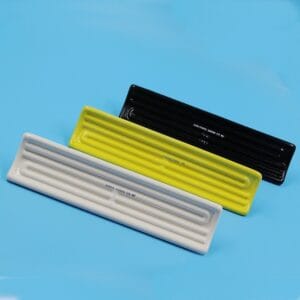
- Solid Ceramic Heaters: The standard workhorse for general industrial applications. They are robust, cost-effective, and provide excellent thermal mass.
- Hollow Ceramic Heaters: Designed with an internal air cavity, these heaters significantly reduce rear heat loss, ensuring that the maximum amount of radiant energy is directed forward. They offer faster heat-up and cool-down times, making them highly energy-efficient. (Note for Webmaster: Add internal link to your upcoming “Through vs. Solid/Hollow Ceramic Heaters” article).
2. Trough (Curved) vs. Flat Ceramic Heaters
- Trough Heaters: Feature a concave surface that concentrates the infrared radiation into a specific focal area, ideal for distance heating.
- Flat Ceramic Heaters: Provide a broad, uniform distribution of heat. They are the preferred choice for large-area heating applications where surface temperature uniformity is non-negotiable. (Note for Webmaster: Add internal link to your upcoming “Flat Ceramic Heaters Engineering Specs” article).
3. Edison Bulb Ceramic Heaters
Often used in vertical installations, these heaters feature a standard E27 screw base. While widely used in animal enclosures and agricultural settings, they are also utilized in small-scale industrial curing and drying stations.
Engineering Advantages of Ceramic IR Technology
Why do engineers consistently specify ceramic infrared heaters over quartz or metal-sheathed alternatives?
- Exceptional Lifespan: With the resistance wire fully encapsulated, it is protected from atmospheric oxygen and corrosive industrial fumes, drastically reducing the risk of premature burnout.
- High Emissivity: Ceramic materials boast an emissivity rating of over 0.9, meaning they convert nearly all electrical energy into usable radiant heat.
- Zoning Capabilities: Multiple ceramic emitters can be arranged in a panel and controlled independently, creating customized heat zones for complex thermoforming molds.
- Safety and Durability: They are splash-proof, vibration-resistant, and do not shatter easily like quartz glass heaters.
Sizing and Selection: How to Specify Your Heater
Choosing the right heater requires calculating specific parameters. When consulting with a manufacturer, ensure you have the following data:
- Watt Density: Calculated in Watts per square inch (or cm²). Higher watt densities heat up faster but require careful temperature control to avoid element failure.
- Operating Temperature Range: Standard ceramic heaters safely operate between 300°C and 700°C (572°F to 1292°F).
- Target Material: Understand the absorption spectrum of the material you are heating. Plastics like PVC, PET, and PC have different peak absorption rates.
- Voltage Requirements: Ensure compatibility with your facility’s power supply (commonly 120V, 240V, or 480V).
Temperature Control: The Role of Thermocouples
To maximize efficiency and prevent overheating, precise closed-loop temperature control is mandatory. Many industrial ceramic heaters come with a thermocouple cast directly into the ceramic body.
Type K and Type J thermocouples are the most common choices. The built-in thermocouple measures the actual temperature of the emitter surface, feeding data back to a PID controller. Selecting the correct thermocouple type is critical for process stability. (Note for Webmaster: Add a prominent internal link here with the anchor text: “Learn more about Selecting the Right Thermocouple (Type J vs. Type K) for Ceramic Heaters”).
Typical Industrial Applications
Because of their versatility, ceramic IR heaters are utilized across a wide spectrum of industries:
- Plastics & Thermoforming: Softening plastic sheets for vacuum forming without burning the surface.
- Packaging Machinery: Heat shrinking and blister packaging operations.
- Food & Beverage: Keeping food warm in commercial settings or drying processes.
- Paint & Coating Curing: Rapidly drying automotive paints, powder coatings, and printing inks.
- Textile & Paper: Drying fabrics and paper pulp with uniform heat distribution.
Troubleshooting and Maintenance
While ceramic heaters are highly durable, poor installation or lack of maintenance can lead to issues. Common causes of failure include excessive watt density, poor wiring connections, or lack of proper temperature feedback leading to thermal runaway.
If you are experiencing frequent heater burnouts, a systematic diagnostic approach is required to check voltage inputs and controller settings. (Note for Webmaster: Add internal link to your upcoming “Troubleshooting Premature Failure in Ceramic Elements” article).
Conclusion
Ceramic infrared heaters offer an unmatched combination of energy efficiency, uniform heat distribution, and long-term durability. By understanding the differences in heater geometries, watt densities, and temperature control mechanisms, engineers can design thermal systems that reduce operating costs and improve product quality.
Need help selecting the perfect heating element for your project? Contact our thermal engineering team today for a custom quote, ROI energy analysis, and CAD design support for your specific application.