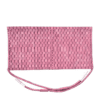
Heating large cylindrical pipes, pressure vessels, or irregular structural weldments poses a recurring challenge for equipment designers and thermal engineers: rigid heaters cannot conform to curved surfaces, while silicone rubber heaters degrade above 200°C–250°C. A Flexible Ceramic Pad Heaters bridges this gap—combining articulated high-alumina ceramic beads with multi-stranded nickel-chromium resistance wire to deliver high-temperature conductive and radiant heat directly onto contoured metal surfaces.
Unlike rigid ceramic infrared emitters designed to radiate across an open air gap in ovens, a flexible ceramic heater is engineered for intimate physical contact with the workpiece. This guide covers its layered construction, heat-transfer mechanics, mounting best practices, and key sizing rules for industrial procurement and OEM integration.
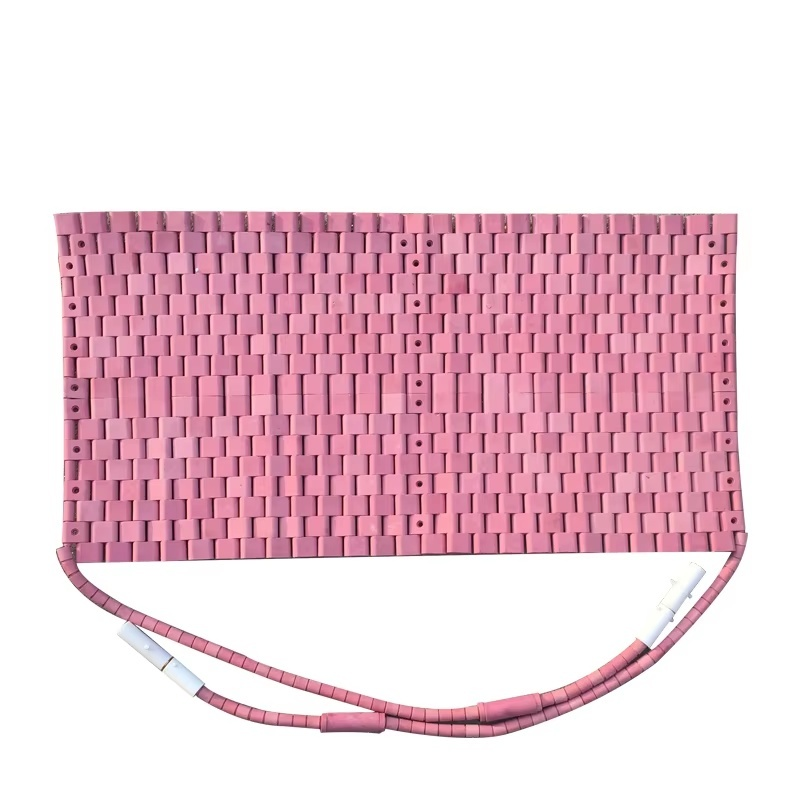
1. Layered Construction of a Flexible Ceramic Pad Heater
The mechanical flexibility and high-temperature dielectric durability of a ceramic heating pad come from its articulated bead-and-wire architecture rather than a continuous solid housing:
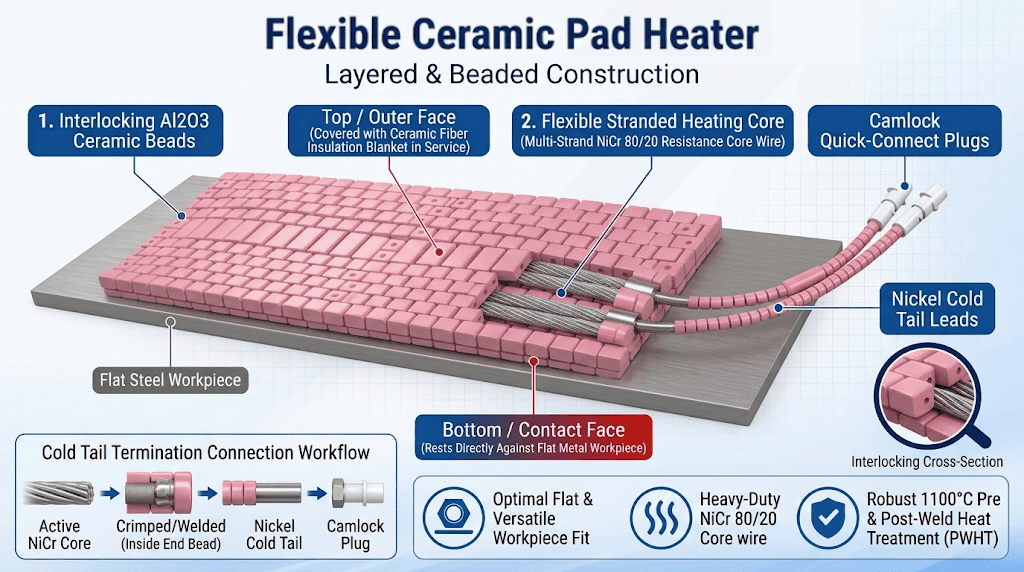
Core Structural Components
- Interlocking High-Alumina Ceramic Beads: Molded from sintered alumina (typically 95% Al2O3), these recessed beads interlock like chainmail. They allow the mat to bend cleanly along both longitudinal and transverse axes while providing high dielectric strength and mechanical protection against metal contact.
- Multi-Stranded NiCr 80/20 Resistance Wire: Instead of a single solid wire that work-hardens and snaps under repeated flexing, the heating core uses twisted multi-strand nickel-chromium wire (commonly 19-strand or 37-strand configurations) to withstand continuous wrapping, unwrapping, and thermal cycling.
- Low-Resistance Cold Tails & Connectors: Inside the ceramic end blocks, the active NiCr strands transition to heavy-gauge nickel or nickel-clad copper cold tails insulated with fiberglass or ceramic sleeves, typically terminated with twist-lock brass Camlock connectors or ring lugs for rapid field hookup.
2. Heating Principle & How It Differs from Other Ceramic Heaters
Understanding how a Flexible Ceramic Pad Heater transfers energy prevents misapplication in equipment design:
- Close-Proximity Conduction + Localized Radiation: When strapped tightly against a steel pipe or vessel wall, heat transfers through direct physical contact at bead touchpoints and short-range thermal radiation across the microscopic air gaps inside the ceramic grooves.
- High-Temperature Capability: Depending on power supply voltage, insulation backing, and duty cycle, flexible ceramic pads routinely heat metal workpieces up to 750°C–1050°C—far beyond the thermal limits of silicone rubber, polyimide, or mica band heaters.
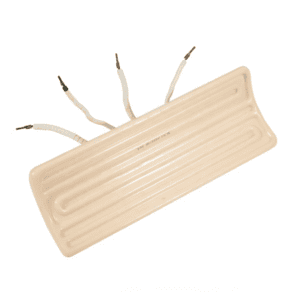
- Difference from Rigid Ceramic Infrared Heaters: Rigid glazed ceramic infrared heaters are non-contact radiant emitters mounted in reflector arrays for thermoforming or paint curing. By contrast, flexible ceramic pad heaters are contact heaters designed to wrap directly around conductive metal structures and must be backed with thermal insulation during operation.
3. Mounting Methods & Surface Conformity Best Practices
Because heat transfer relies on intimate proximity, poor surface contact causes localized hot spots inside the ceramic beads and uneven workpiece temperatures.
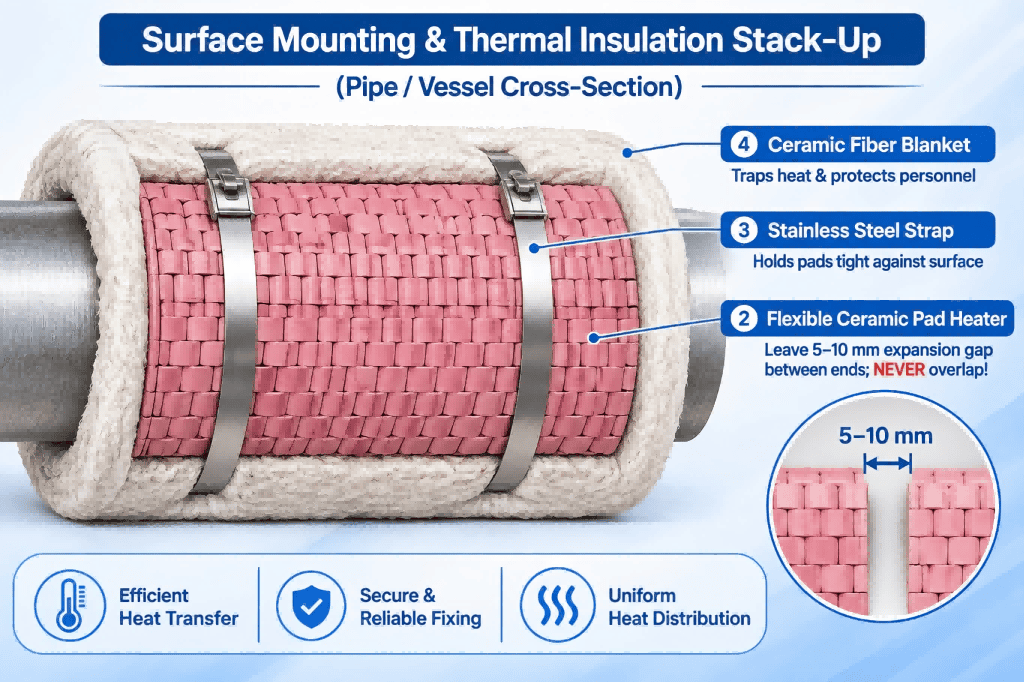
Critical Installation Rules
- Never Overlap Heating Pads: Adjacent pads must never overlap one another. Overlapping traps heat underneath the upper pad, rapidly melting the NiCr core wire. Leave a small expansion gap (typically 5 mm to 15 mm, depending on workpiece diameter) between pad edges.
- Secure Mechanical Fastening: On cylindrical pipes and tanks, secure pads tightly using stainless steel banding straps, nichrome tie wire, or spring-loaded toggle latches. For flat plates or large vertical walls, weld temporary stud pins onto the workpiece or use high-temperature magnets (only where workpiece temperatures stay well below the magnet’s Curie point).
- Mandatory Outer Thermal Insulation: Always cover the outside of the ceramic pads with a high-temperature ceramic fiber insulation blanket (typically 25 mm to 50 mm thick, encased in stainless steel mesh). Without outer insulation, over half the generated heat escapes into the surrounding air, preventing the workpiece from reaching target temperature.
- Control Thermocouple Placement: Spot-weld or clamp a Type K thermocouple directly onto the workpiece surface inside the small gap between two adjacent pads—never sandwich the sensor underneath a hot ceramic bead, which causes false high readings and premature power shutoff.
4. Power, Voltage & Size Selection Guide
Proper flexible ceramic heater selection balances physical coverage, electrical supply safety, and surface watt density:
| Selection Parameter | Engineering Options & Standard Ranges | Selection Rule for Engineers & Buyers |
| Operating Voltage | Low Voltage: 30V, 60V, 80V (standard for welding/PWHT) Line Voltage: 110V, 120V, 220V, 240V | Choose 60V or 80V when powering multiple pads from portable welding heat-treatment consoles; choose 120V/240V for fixed OEM industrial machinery cabinets. |
| Standard Wattage & Surface Load | Typically 1.0 kW to 3.6 kW per pad (approx. 3.5 to 5.5 W/cm² over pad footprint) | Thick-walled steel pipes and heavy vessels require higher wattage per unit area to overcome conductive heat sink losses along the pipe length. |
| Pad Dimensions (Width × Length) | Standard widths from 50 mm to 500 mm; lengths from 150 mm to 1,500+ mm | Select a pad length slightly shorter than the pipe circumference (leaving an expansion gap) and a width wide enough to cover the required heated band plus thermal gradient margins. |
| Minimum Bending Radius | Typically 35 mm to 50 mm (varies by bead size and orientation) | Confirm whether the pad must bend along its length or width, as interlocking bead geometry allows tighter radius bending in one primary direction. |
5. Key Industrial Ceramic Pad Heater Applications
Thanks to their ruggedness and contour-hugging flexibility, ceramic pad heater applications span heavy fabrication, energy, and OEM equipment integration:
- Preheating & Post-Weld Heat Treatment (PWHT): Wrapping circumferential pipe joints, headers, and pressure vessel seams in oil & gas, petrochemical, and power-generation piping to prevent hydrogen-induced cracking and relieve residual weld stresses.
- Process Piping & Valve Body Heating: Maintaining elevated temperatures on heavy-walled alloy piping, reactor nozzles, and large industrial valves where rigid band heaters cannot fit around flanges or irregular castings.
- Curved Tank, Hopper & Vessel Heating: Providing high-temperature process heat on cylindrical autoclaves, mixing vessels, and foundry ladles.
- Flat or Contoured Platen & Die Preheating: Heating large structural tooling, forming dies, and ship-hull weldments where portable, reusable surface heaters outperform fixed furnaces.
6. Custom Ceramic Pad Heater RFQ Checklist
When specifying a custom ceramic pad heater for an OEM machine or field project, provide your manufacturer with the following parameters to ensure exact fit and electrical compatibility:
- Workpiece Geometry & Target Temperature: Flat plate vs. cylindrical OD, minimum bend radius, wall thickness, and maximum target metal temperature (°C).
- Pad Dimensions & Orientation: Exact heated width × length (mm) and required bending direction (lengthwise wrap vs. widthwise wrap).
- Electrical Ratings: Supply voltage (V), per-pad wattage (W), resistance tolerance, and single-phase vs. three-phase grouping.
- Cold Tail & Connector Specs: Cold tail length (mm), insulation type (fiberglass sleeve vs. ceramic beads), and termination style (60A/300A Camlock plug, ring terminals, or bare leads).
- Accessories Needed: Matching ceramic fiber insulation blankets, stainless steel strapping, and Type K surface thermocouples.
Partner with Hongtai for Custom Flexible Ceramic Pad Heaters
Whether you are integrating high-temperature contact heaters into OEM process machinery or sourcing rugged pads for heavy pipe and vessel heat treatment,Hongtai Heater Factory manufactures custom Flexible Ceramic Pad Heaters built with 95% sintered alumina interlocking beads, flexible multi-strand NiCr 80/20 cores, and heavy-duty cold-tail terminations.
- Consult our Engineers: Send your wiring schematics to the Hongtai Heater Factory technical team for a free design review.
- Visit Us:: www.hongtai-heater.com