Customer Inquiry: “I need a high-accuracy Pt100 sensor for my chemical reactor.”
Our Question: “Define high accuracy. Do you need Class A? 1/3 DIN? Or a sensor with specific Callendar-Van Dusen coefficients?”
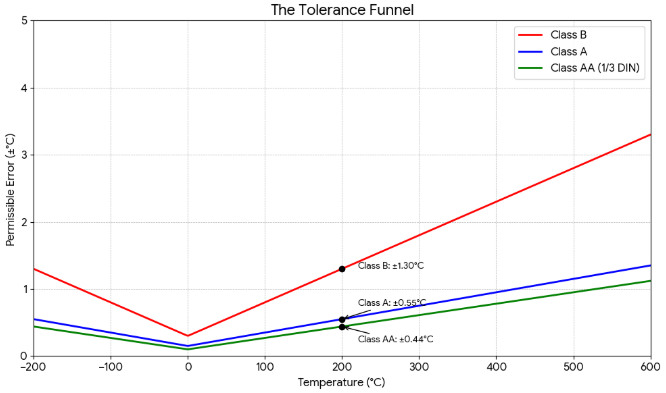
In the world of industrial metrology, “High Accuracy” is a meaningless marketing term. A sensor that is highly accurate at 0°C might be dangerously inaccurate at 200°C. Accuracy is not a fixed number (like ±0.1°C); it is a dynamic “Funnel” that widens as temperature moves away from zero.
If you are a Quality Manager in pharmaceuticals, food sterilization, or custody transfer, misunderstanding these tolerances can lead to regulatory non-compliance or thousands of dollars in wasted product.
This guide strips away the marketing fluff. We will analyze the IEC 60751 (2008) standard to calculate the real error of Pt100 sensors at your specific process temperature, helping you avoid paying for “over-spec” sensors you don’t need—or worse, installing sensors that aren’t good enough.
Definition: High precision, replacing the old “1/3 DIN” terminology.
Tolerance Formula: ±(0.10 + 0.0017 |t|)
Accuracy at 0°C: ±0.10°C
Constraint: Usually only valid in the range of 0°C to 150°C. Outside this range, it reverts to Class A behavior.
The “Funnel Effect”: Accuracy vs. Temperature
This is the most critical concept for engineers. Accuracy degrades as temperature rises.
Let’s do the math for a process running at 200°C:
Class B Error: ±(0.30 + 0.005 * 200) = ±1.30℃
Class A Error: ±(0.15 + 0.002 * 200) = ± 0.55℃
Class AA Error: ±(0.10 + 0.0017 * 200) = ± 0.44℃
The Lesson: If your SOP requires an accuracy of ±0.3°C at 200°C, even a Class AA sensor is not good enough off the shelf. You would need a system calibration (Sensor + Transmitter matching).
IEC 60751 Pt100 accuracy class tolerance funnel chart.
Beyond the Sensor: The “System Accuracy” Trap
A Ferrari engine in a go-kart won’t win F1. Similarly, a Class AA Pt100 connected to a cheap PLC via 100 feet of copper wire will yield poor results.
The Equation:
Total Error = Sensor Error + Lead Wire Error + Transmitter
1. The Wire Problem
In a 2-wire Pt100 circuit, the resistance of the lead wire is added to the sensor reading. 1 Ohm of lead resistance adds 2.6°C of error!
Solution: Always use 3-wire or 4-wire configurations for Class A applications.
2. The Transmitter Solution
Instead of running weak resistance signals over long distances, use a head-mounted 4-20mA Transmitter. It digitizes the signal right at the probe head, eliminating lead wire noise.
What is “1/10 DIN”? (Marketing Myth vs. Reality)
You will see expensive probes labeled “1/10 DIN.”
The Myth: It is an official IEC class. (It is not).
The Reality: It is a custom tolerance offered by manufacturers. It implies the tolerance at 0°C is 1/10th of Class B, or ±0.03°C.
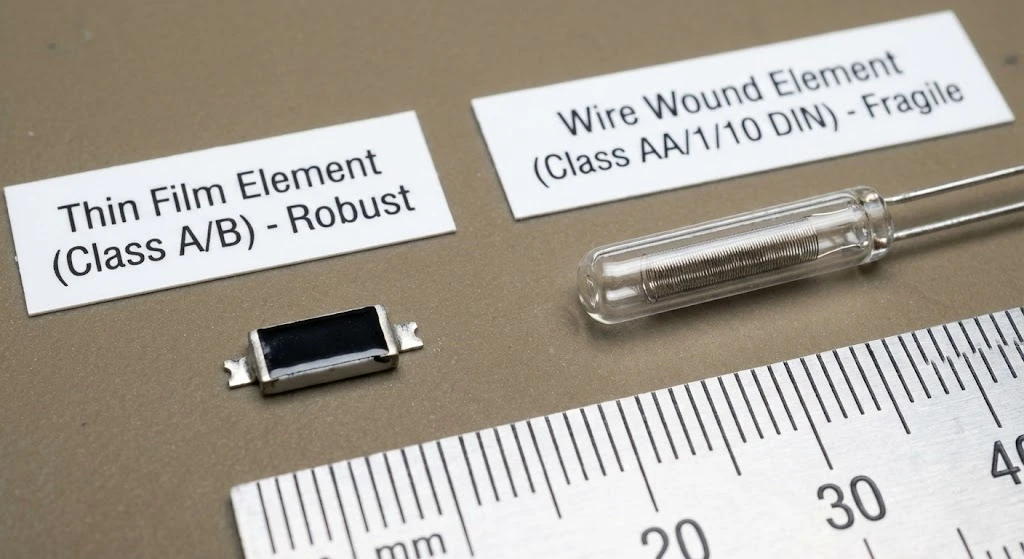
The Warning: Achieving this accuracy requires a delicate Wire Wound element. These are extremely fragile. Do not install a 1/10 DIN sensor in a high-vibration pump or compressor; the internal platinum wire will snap. They are for laboratories, not factory floors.
Calibration: The Ultimate Accuracy (CVD Coefficients)
For the absolute highest precision (approaching ±0.05°C), you cannot rely on standard interchangeability. You need System Calibration.
Platinum does not change resistance in a perfect straight line. It follows a curve defined by the Callendar-Van Dusen (CVD) equation.
We place the specific sensor in a high-stability calibration bath.
We measure its exact resistance at multiple points.
We calculate its unique R0, A, B, and C coefficients.
You enter these numbers into your “Smart” Transmitter.
The transmitter mathematically corrects the sensor’s curve to match reality perfectly.
Action: We can provide Pt100 probes with NVLAP/CNAS traceable calibration reports and CVD coefficients upon request.
Selection Matrix: Which Class do you need?
Use this table to specify the correct class for your Bill of Materials.
Application
Recommended Class
Why?
General HVAC / Water Cooling
Class B
Cost-effective. ±0.3$ to ±0.8℃ error is usually acceptable.
Autoclaves (Sterilization)
Class A
Regulatory requirement (FDA/EN285) usually demands <0.5℃.
Custody Transfer (Billing)
Class AA
Every degree of error is lost money. High accuracy pays for itself.
Laboratory Reference
1/10 DIN
Used to check other sensors. Must be handled with care.
High Vibration + Accuracy
Class A (Thin Film)
Thin film elements are robust; Wire wound (AA) breaks easily.
Difference between thin film and wire wound Pt100 elements.
Frequently Asked Questions (FAQ)
What is the difference between Class A and Class B Pt100?
Class A is more accurate than Class B. At the standard reference point of 0°C, Class A has a tolerance of ±0.15°C, while Class B has a tolerance of ±0.30°C. Class A is typically used in precision industrial applications (Food, Pharma), while Class B is standard for general purpose use (HVAC, Plastics).
Does Pt1000 have better accuracy than Pt100?
No. The accuracy class (A, B, AA) determines the tolerance, not the base resistance. However, a Pt1000 sensor (1000$\Omega$ at 0°C) is less affected by lead wire resistance errors in 2-wire circuits because the sensor’s resistance is so much larger than the wire’s resistance. This can make the total system more accurate in simple 2-wire setups.
What does 1/3 DIN mean?
“1/3 DIN” is a legacy term that largely corresponds to the modern Class AA in the IEC 60751 standard. It means the tolerance at 0°C is ±0.10°C, which is one-third of the Class B tolerance ($\pm0.30^\circ\text{C}$).
Can I use a Class A sensor above 300°C?
You can, but proceed with caution. Most Thin Film elements are only rated for Class A accuracy up to roughly 300°C. Above this temperature, the substrate can shift, causing the sensor to drift into Class B tolerances. Always check the manufacturer’s datasheet for the “valid temperature range” of the specific element type used.