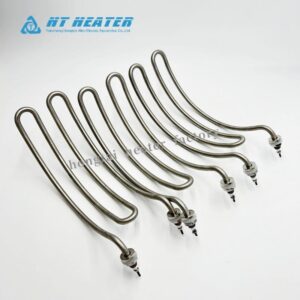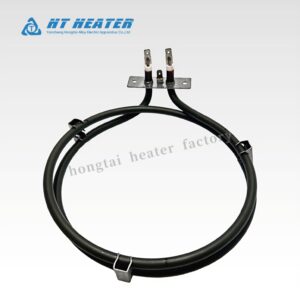

1. The Physics of Failure: Why Surface Load Matters
In thermal system design, the total wattage defines the energy input, but the Watt Density (Surface Load) defines the heater’s lifespan. Watt Density, expressed in Watts per Square Inch (W/in^2) or Watts per Square Centimeter (W/cm^2), represents the rate at which thermal energy is transferred from the heater sheath to the surrounding medium.
If this rate exceeds the medium’s ability to absorb heat (thermal conductivity), the sheath temperature rises uncontrollably, leading to oxidation, coking, or the melting of the internal resistance wire.
Design engineers must not only calculate the nominal density but also account for the manufacturing tolerances and unheated zones inherent in tubular heater construction.
2. The Core Formula: Correcting the “Total Length” Error
A critical engineering error is calculating surface area based on the total length of the heater. This dilutes the result and leads to an undersized, dangerous design.
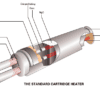
Inside a tubular heater, the resistance wire does not extend to the very ends. It is connected to an integral cold pin1, creating a “Cold Zone” at each terminal to protect electrical connections.
The Precise Formula
To calculate the True Watt Density (ω), use the Heated Length (Lh), not the Total Sheath Length (Lt).

Where:
- ω = Watt Density (W/in^2 or W/cm^2)
- P = Power (Watts)
- D = Sheath Diameter
- Lh = Heated Length (Total Length – Cold Zones)
Calculation Example:
A engineer specifies a 1000mm heater, 10mm diameter, 2000W.
- Incorrect Calculation (Total Length): Area = 10π*100 = 314 cm^2. Density = 6.3 W/cm^2.
- Correct Calculation (With 50mm Cold Zones): Lh = 1000 – (50 * 2) = 900mm. Area = 282 cm^2.
- Real Density: 7.1 W/cm^2.
- Impact: The real load is 12.7% higher than the rough calculation. In oil heating, this error causes coking.
3. Safety Thresholds: Limits by Medium
Once the true density is calculated, it must be compared against the maximum safe capability of the fluid and sheath material.
Liquid Heating Limits
- Water: High thermal conductivity allows for higher densities. Typically 8-10 W/cm^2 (approx 60 W/in^2) is acceptable for moving water using SS304 or Copper sheaths2.
- Oil: Oil has poor thermal conductivity. Standard practice requires Steel sheaths 3 to prevent reaction, but the density must be strictly controlled to 2-3 W/cm^2 (approx 15-20 W/in^2 ) to prevent carbonization (coking).
Air Heating Limits
- Still Air: Poor heat transfer requires low density (< 4 W/cm^2) or the use of high-temperature alloys like Incoloy 800 4 to withstand the resulting high sheath temperatures.
- Moving Air: Velocity increases the heat transfer coefficient, allowing for higher densities.
4. The Tolerance Factor: Designing for the “Worst Case”
In precision engineering, nominal values are insufficient. You must calculate based on the maximum possible output allowed by manufacturing standards.
Wattage Tolerance Risk
According to Hongtai manufacturing specifications, the standard Wattage Tolerance is +5% / -10%5.
- Engineering Rule: Always verify your design at Nominal Wattage + 5%.
- Example: A 1000W design might actually output 1050W. If your design is on the borderline of the safety threshold, this +5% can push the heater into failure.
Resistance & Voltage Physics
The Resistance Tolerance is +10% / -5%6. Furthermore, grid voltage fluctuations affect power output quadratically (P = V^2/R).
- If a 480V heater runs at 500V (common in industrial facilities), the power increases by 8.5%.
- Combined Safety Factor: Engineers should design with a 15% safety margin on Watt Density to account for positive tolerance (+5%) and potential voltage spikes.
5. Manufacturing Constraints & Electrical Specs
When specifying your heater, ensure your calculated parameters fall within feasible manufacturing boundaries.
Diameter & Length
We manufacture to precise tolerances (Dia +-0.15mm)7.
- Standard Diameters: 6.4mm, 8mm, 10mm, 12mm, 14mm, 16mm, 18mm, 20mm, 25mm8.
- Max Length: Up to 7000mm for diameters ≥ 14mm9.
Voltage Limitations
For high-power industrial applications, we can wind elements for voltages up to 550V10. This allows for lower current draw in high-kilowatt systems, reducing the gauge requirements for your wiring harness.
Quick Reference: Surface Area Constants (Per Meter)
Use this table to quickly estimate the surface area per meter of Heated Length.
| Diameter (mm) | Surface Area per Meter (cm2/m) | Max Voltage |
| 6.4 | 201 | 250V |
| 8.0 | 251 | 277V |
| 10.0 | 314 | 480V |
| 12.0 | 377 | 550V |
| 16.0 | 502 | 550V |
| 20.0 | 628 | 550V |
2026 Calculation Snippet (Featured Snippet)
How to Calculate Tubular Heater Watt Density
To determine the precise surface load of a heating element:
- Determine Heated Length: Subtract the unheated cold zones (typically 50-75mm at each end) from the total sheath length.
- Calculate Area: $Area = π*Diameter*Heated_Length.
- Apply Tolerance: Multiply your Nominal Wattage by 1.05 to account for the +5% manufacturing tolerance12.
- Final Calculation: Watt_Density = (Max_Wattage)/Area.
Unsure about your safety margins?
Don’t risk a field failure. Send your voltage, medium, and dimension requirements to the Hongtai Engineering Team. We will run a thermal simulation to verify your Watt Density against 2026 safety standards.
Need High-Temperature Resistance? Need Cost-Effective Solution?
Want to know how to select it? Our latest selection guide can help you.