Introduction & The Dilemma
Picture this: A process engineer installs high-power 2000W halogen lamps to dry a water-based coating on white plastic trays. The lamps fire up instantly, blindingly bright. Ten minutes later, the trays are warping and charring at the edges, yet the coating in the center is still tacky.
The engineer blames the PID controller. He blames the conveyor speed. But the real culprit is physics. By choosing a short-wave emitter (Tungsten) for a material that is transparent to short waves (plastic), he created a system where the heat passed through the product and cooked the conveyor belt below, while the coating merely air-dried.
The Core Argument:
In the world of industrial thermodynamics, there is no “better” heater, only the “correct” wavelength. 1000 Watts of Halogen energy behaves fundamentally differently than 1000 Watts of Carbon Fiber energy.
Engineering Definitions:
- Tungsten (Halogen): A metallic filament operating at ~2400K. It is a Short-Wave emitter (high transmission, high glare, instant response).
- Carbon Fiber: A woven non-metallic filament operating at ~1200K. It is a Medium-Wave emitter (high absorption, low glare, soft heat).
Engineering Context: To understand the foundational physics behind these spectral differences, we strongly recommend reviewing our comprehensive baseline guide first.
The Deciding Factor: Spectral Matching (Absorption Physics)
Don’t Fight the Laws of Physics
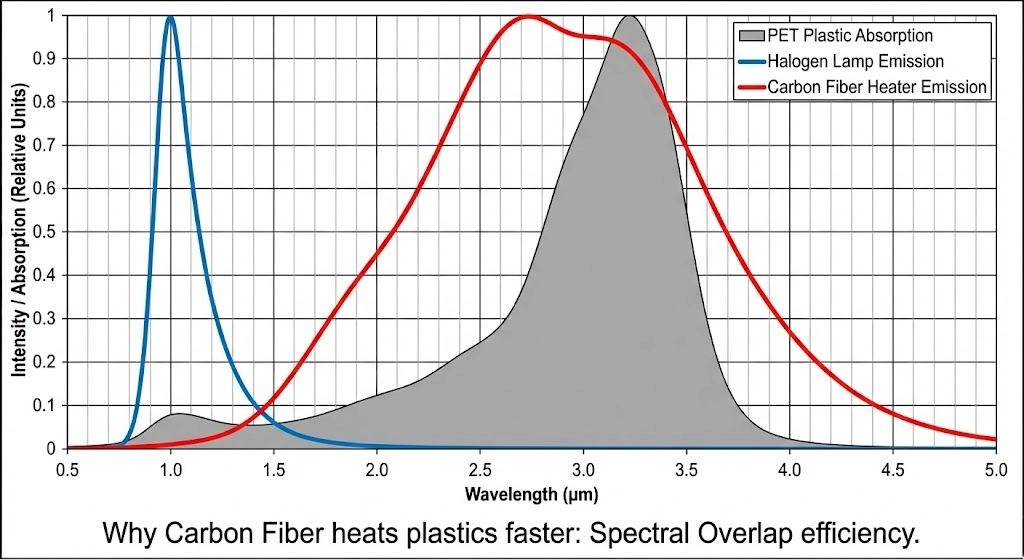
The most critical error in heater selection is ignoring Kirchhoff’s Law of Thermal Radiation: a material’s ability to absorb energy is directly tied to the wavelength of that energy. If the emitter’s peak wavelength does not align with the target material’s absorption spectrum, efficiency drops by up to 50%.
1. Tungsten / Halogen (Short Wave: 1.0 – 1.2μm)
- The “Transmission” Effect: Short-wave radiation behaves like visible light. It passes easily through clear materials like glass, quartz, and many thin plastics (PET, PC).
- Where it wins:
- Metals: Shiny metals reflect most infrared, but short-wave radiation has the highest photon energy density, allowing for faster surface heating of steel or aluminum molds.
- Penetration: It drives heat deep into thick, dark materials (e.g., rubber tires) before the surface overheats.
2. Carbon Fiber (Medium Wave: 2.5 – 3.5μm)
- The “Absorption” Effect: This specific bandwidth is the “sweet spot” for organic chemistry.
- Water (H₂O): Water molecules have a massive absorption peak at 3.0μm.
- Plastics (C-H Bonds): Polymers like Polyethylene and Polypropylene absorb energy efficiently at 3.4μm.
- The Result: When you use Carbon Fiber on wet paint or plastic sheets, the energy is grabbed by the molecules immediately. It doesn’t pass through; it converts to heat within the material.
Thermal Response & Control: How Fast is Your Line?
Speed isn’t just about production rate; it’s about control loop stability and electrical safety.
1. Tungsten: The Sprinter
- Thermal Inertia: < 1 Second.
- The Application: Ideal for systems that require frequent start-stop cycles (e.g., a sensor-triggered conveyor). When the line stops, the heater turns off instantly, preventing product scorch.
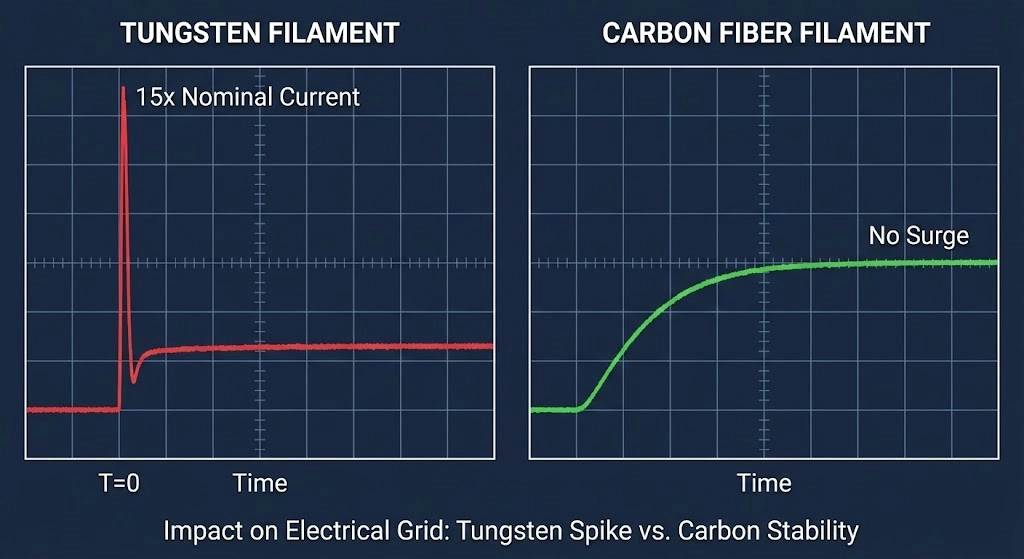
- The Hidden Cost (Inrush Current): Tungsten has a Positive Temperature Coefficient (PTC). Its cold resistance is 1/15th of its hot resistance.
- Scenario: A 20A heater will pull 300 Amps for a few milliseconds upon startup.
- Requirement: You must use expensive SCR power controllers with “Soft Start” or Phase Angle firing to ramp up the voltage. Mechanical contactors will weld shut or trip breakers.
2. Carbon Fiber: The Marathon Runner
- Thermal Inertia: 3 – 5 Seconds.
- The Application: Best for continuous processes like drying ovens or laminating lines where temperature stability is key.
- The Engineering Advantage (Zero Inrush): Carbon fiber’s resistance is thermally stable.
- Scenario: A 20A heater pulls ~20A at startup.
- Requirement: You can use standard, low-cost Solid State Relays (SSRs) or even simple contactors. This significantly lowers the complexity and cost of your electrical cabinet.
Durability & Mechanics: Brittleness vs. Flexibility
1. Tungsten Brittleness (Recrystallization)
Over time, the tungsten filament undergoes Recrystallization. The grain structure of the metal changes, becoming brittle.
- The Risk: If your machine vibrates (e.g., a punch press nearby), an old halogen lamp filament can shatter simply from the resonance.
- Mounting Rule: Halogen tubes must generally be mounted Horizontally. Vertical mounting causes the sagging filament to coil on itself, creating a hot spot and failure (unless specific “pinched” supports are engineered).
2. Carbon Fiber Flexibility
Carbon fiber is a woven textile. It does not suffer from grain growth or metal fatigue.
- The Benefit: It is naturally shock-resistant.
- Mounting Rule: Universal Burning Position. You can mount Carbon Fiber tubes vertically, diagonally, or horizontally without affecting their lifespan.
Life Cycle Data
- Tungsten Halogen: ~5000 Hours. (Life is heavily dependent on voltage stability; +5% voltage = -50% life).
- Carbon Fiber: 6000 – 8000 Hours. (Less sensitive to voltage fluctuations and on/off cycling).
Engineer’s Decision Matrix: The Ultimate Comparison
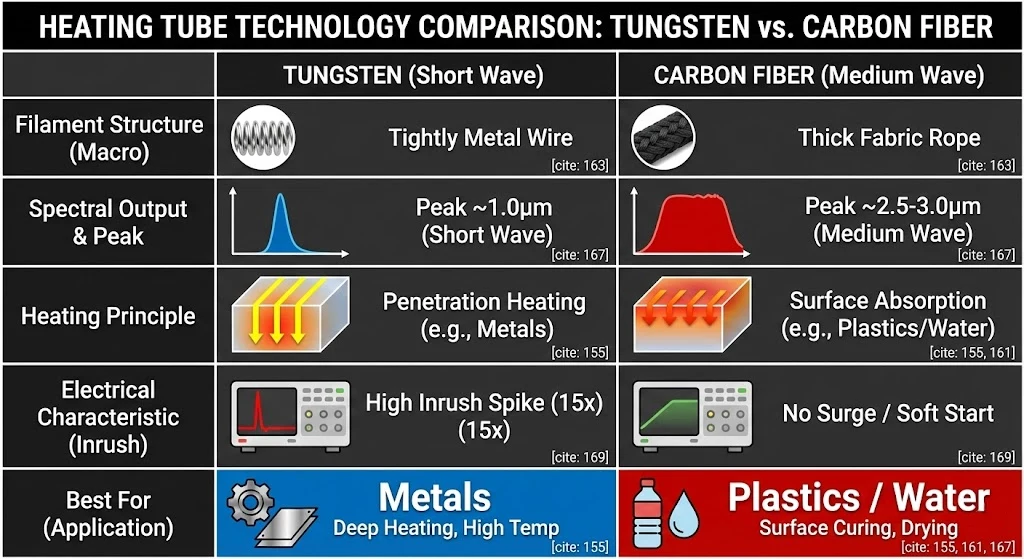
Here is the cheat sheet for your procurement and engineering teams.
| Parameter | Tungsten (Halogen / Short Wave) | Carbon Fiber (Medium Wave) |
| Peak Wavelength | 1.0 – 1.2 μm (Short Wave) | 2.5 – 3.5 μm (Medium Wave) |
| Response Time | < 1 Second (Instant) | 3 – 5 Seconds (Slow) |
| Color Temperature | ~2400 K (Bright White) | ~1200 K (Orange Glow) |
| Inrush Current | High (10x – 15x Nominal) | None (1x Nominal) |
| Primary Mechanism | Transmission / Penetration | Absorption / Surface Heat |
| Best For | Metals, Thick Rubber, PET Blowing | Plastics, Water Drying, Paint Curing |
| Glare (Visible Light) | High (Eye Protection Needed) | Low (Comfortable) |
| Mounting | Horizontal Only (mostly) | Universal (Vertical OK) |
| Control Requirement | SCR / Thyristor Required | Contactor / Relay OK |
Scenario Walkthrough: If I Were the Engineer…
Let’s apply this logic to three real-world manufacturing scenarios.
Scenario A: Automotive Bumper Paint Curing
- The Goal: Dry water-based paint on a plastic bumper without overheating the plastic substrate.
- The Choice: Carbon Fiber (Medium Wave).
- The Logic: You need to heat the water in the paint, not the plastic underneath. Carbon fiber’s 3.0μm wavelength is absorbed perfectly by the water molecules. It dries the paint “from the inside out” (evaporation) rather than “outside in” (skinning), preventing solvent pop and orange peel defects.
- Why not Halogen? Halogen would penetrate the paint, heat the black plastic bumper to 150°C, and potentially warp the part before the paint is dry.
Scenario B: High-Speed PET Bottle Blowing
- The Goal: Heat a thick PET preform to 100°C in 2 seconds flat.
- The Choice: Tungsten (Halogen Short Wave).
- The Logic: PET preforms are thick (3-4mm). You need deep penetration to soften the core. Short wave radiation penetrates the wall thickness. Plus, the machine runs at 40,000 bottles/hour; if the conveyor stops, the lamps must turn off instantly to prevent a fire. Only Halogen has the speed.
- Why not Carbon? Carbon fiber is too slow to respond and its energy would be absorbed by the outer skin of the preform, burning the surface while leaving the core cold and hard.
Scenario C: Outdoor Patio Heating
- The Goal: Keep customers warm in a windy outdoor restaurant.
- The Choice: Carbon Fiber (or Ruby Halogen).
- The Logic: Human skin is mostly water. We absorb medium-wave energy very efficiently. Carbon fiber provides a “soft” heat that feels like sunlight.
- Why not Clear Halogen? It is too bright. Customers don’t want to sit under a spotlight. The glare ruins the ambiance.
FAQ: Common Engineering Questions
Can I replace my halogen tubes with carbon fiber directly?
Electrically, yes. You can usually swap them out without changing wiring (verify voltage and length first). In fact, you can often remove the expensive soft-start controllers. Process-wise, be careful. Since the wavelength is different, the heating rate will change. You may need to adjust your conveyor speed or temperature setpoints. A 1000W Carbon tube will heat plastic faster than a 1000W Halogen tube, potentially burning it if you don’t lower the power.
Which one is more energy efficient?
In terms of converting electricity to radiation, both are >90% efficient. However, Process Efficiency depends on the material. If you use Halogen to heat water, 30% of the energy might pass through unused. If you use Carbon Fiber, 95% is absorbed. Choosing the right wavelength can save you 30% on your energy bill.
Conclusion: Stop Guessing, Start Matching
The debate between Tungsten and Carbon Fiber isn’t about quality; it’s about chemistry.
- If you need Speed, Penetration, or are heating Metals $\rightarrow$ Choose Tungsten Halogen.
- If you need Efficiency, Absorption, or are heating Plastics/Water $\rightarrow$ Choose Carbon Fiber.
Still unsure about your material’s absorption spectrum?
Don’t guess with your production line. Send us a sample of your material. Hongtai’s thermal laboratory will run a spectral absorption test and recommend the precise emitter type for your specific application.
[Contact Hongtai Laboratory for a Free Thermal Test]