The Engineering Dilemma: Fit, Heat, or Budget?
For a mold designer or maintenance manager, choosing the right heating element is a balance of three constraints: Space, Temperature Uniformity, and Cost of Ownership.
While both Cartridge Heaters and Tubular Heaters rely on Joule heating, their application logic is fundamentally different.
- Cartridge Heaters are the “Snipers” — designed for high-intensity, localized heat in tight spaces requiring precision drilling.
- Tubular Heaters are the “Infantry” — versatile, robust, and capable of covering vast surface areas with complex geometries.
At Hongtai, we manufacture both. However, we often see engineers over-specifying expensive cartridge heaters when a robust tubular solution would have offered a longer lifespan and simpler wiring. This guide breaks down the physics to help you make the ROI-positive choice.
1. The “Zero-Click” Decision Matrix
Don’t have time to read the physics? Use this cheat sheet to determine your direction.
| Feature | Cartridge Heater | Tubular Heater |
| Primary Application | Small dies, injection nozzles, precision heating. | Large platens, manifolds, liquid immersion, air heating. |
| Installation Tolerance | Critical (H7 Fit). Requires reamed holes. | Forgiving. Pressed into grooves or clamped. |
| Max Length | Typically < 1 meter (Rigid). | Up to 7000mm (Bendable). |
| Heat Distribution | Localized / Zoned. | Distributed over large areas (2D/3D shapes). |
| Watt Density | High (Up to 25 W/cm²). | Medium (Up to 8-10 W/cm²). |
| Wiring Complexity | High (Multiple units = multiple wire pairs). | Low (One long element = single pair of terminals). |
| Cost Efficiency | Expensive for large areas. | Economic for large molds/tanks. |
2. Heat Transfer Physics: Conduction vs. Contact
The primary cause of heater failure is not voltage spikes, but poor heat transfer. The two heaters handle this differently.
The Cartridge Trap: The “Air Gap” Killer
Cartridge heaters are designed to operate at high watt densities. They rely on tight-fit conduction.
- The Risk: If your drilled hole is just 0.1mm oversize, the resulting air gap acts as an insulator. The heater core can’t dissipate its energy, internal temperatures spike, and the wire burns out in hours.
- The Cost: You aren’t just paying for the heater; you are paying for high-precision gun-drilling and reaming of your mold.
The Hongtai Tubular Advantage: Surface Contact
Tubular heaters are more forgiving. They are typically pressed into milled grooves or clamped onto surfaces.
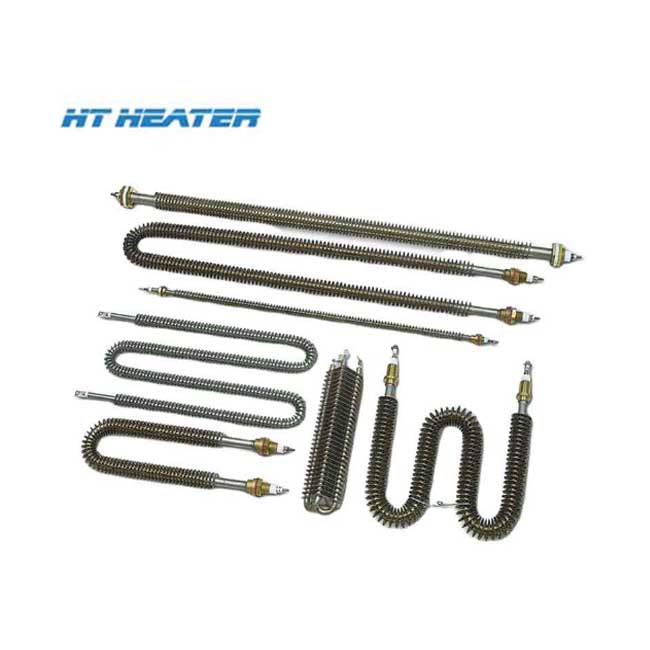
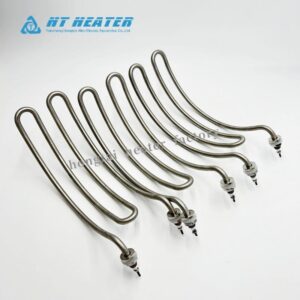
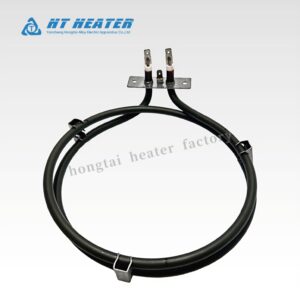
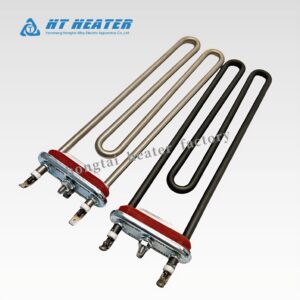
- The Mechanism: Because tubular heaters can be formed into shapes (U, W, Spiral), they maximize the contact surface area.
- Why Hongtai: Our tubular elements feature high purity magnesium oxide (MgO) powder compacted to rock-hard density. This allows them to withstand the mechanical pressure of being pressed into a groove without damaging the dielectric insulation, ensuring efficient heat transfer even in older, less precise molds.
3. Large Scale Heating: The “Wiring Nightmare”
Imagine you need to heat a $1m \times 1m$ packaging platen.
- Scenario A (Cartridge): You might need 20 separate cartridge heaters to ensure even heating. That means 40 lead wires to manage, bundle, and protect. If one fails, the “cold spot” ruins your product consistency.
- Scenario B (Tubular): You use a single, 6-meter long Hongtai Tubular Heater bent into a serpentine pattern.
- The Spec: We manufacture elements up to 7000mm in length.
- The Result: You have one entry point and one exit point. The heat is continuous, the wiring is clean, and the installation time is cut by 90%.
[Image suggestion: A CAD drawing showing a “Snake” or “Manifold” layout of a tubular heater on a plate vs. a grid of many small cartridge holes.]
4. Durability & Terminals: The Weakest Link
In vibrating machinery (like packaging lines or presses), the connection point is where heaters die.
Cartridge Weakness: The Lead Wire
Standard cartridge heaters have flexible lead wires exiting the sheath. Constant movement causes fatigue and breakage at the exit point.
Hongtai Tubular Strength: The Cold Pin & Screw Terminal
We engineer our tubular heaters for mechanical abuse.
- Integral Cold Pin: We use an integral cold pin fusion welded to the resistance wire. This ensures the electrical connection is deep inside the tube, away from the heat and mechanical stress.
- Positive Connection: Unlike fragile leads, we utilize threaded screw terminals with ceramic insulators. This allows you to bolt your wiring harness securely. It is vibration-resistant and allows for easy cable replacement without changing the heater.
5. Environmental Resilience: Corrosion & Atmosphere
Cartridge heaters are almost exclusively used for metal heating (dry). Tubular heaters are the “Swiss Army Knife” of thermodynamics.
- Fluid & Air Capable: If your application involves heating oil, water, or corrosive chemicals, Cartridge heaters are generally unsuitable due to sealing limitations.
- Material Science: Hongtai Tubular Heaters are available in a range of ASTM-standard sheaths.
- Incoloy 800: For high-temperature radiant heating (up to 800°C) or corrosive atmospheres.
- SS316: For corrosive liquids or pharmaceutical applications.
6. Conclusion: When to Choose Hongtai Tubular?
Stop forcing a Cartridge Heater to do a Tubular Heater’s job.
Choose a Cartridge Heater IF:
- You have extremely limited installation space (e.g., a nozzle tip).
- You require extremely high Watt Density (> 20 W/cm²).
- The heated part is small and requires a single-ended insertion.
Choose a Hongtai Tubular Heater IF:
- You are heating a large surface: Use our 7000mm length capability to reduce wiring complexity.
- You need durability: The threaded terminal and cold pin design outlast flexible leads in rough environments.
- You have complex geometry: You need to bend the heat source around corners or into 3D shapes.
- You need versatility: The same heater type can be stocked for immersion, air heating, and clamp-on applications.
Still designing your thermal loop?
Send your platen drawing or tank dimensions to Hongtai Engineering. We will simulate the thermal distribution and recommend the most cost-effective element path.
Frequently Asked Questions (FAQ)
Can a tubular heater replace a cartridge heater?
In many “blind hole” applications, no, because tubular heaters typically require access to both ends (or a U-bend return). However, for surface heating platens or molds where you can mill a groove on the surface, a tubular heater is often a superior, more durable replacement that eliminates multiple wiring points.
What is the minimum bending radius for Hongtai tubular heaters?
To protect the compacted Magnesium Oxide (MgO) insulation, the minimum bending radius is typically 3 times the sheath diameter (3xØ). For example, an 8mm diameter tube needs a minimum 24mm radius bend. Never bend the heater at the “Cold Pin” junction (usually the first 2-3 inches from the terminal).
Why do you recommend Tubular heaters for large platens instead of multiple Cartridge heaters?
Reliability and Simplicity. A large platen might require 10-20 cartridge heaters to heat evenly. This creates 20 potential failure points and a messy bundle of wires. A single Hongtai tubular heater can be manufactured up to 7 meters long and bent to cover the entire plate, requiring only one pair of electrical connections and one temperature controller zone.
Can I use tubular heaters in vacuum or corrosive environments?
Yes. Unlike standard cartridge heaters, Hongtai tubular heaters can be manufactured with specialized sheath materials like Incoloy 800 or Stainless Steel 316. We also offer sealed terminal options to maintain high insulation resistance in vacuum or humid conditions.