When a production line stops because a silicone heater has blackened, bubbled, or tripped a breaker, the immediate reaction is often to blame the part. “This heater was defective.”
But in our 30 years of manufacturing experience, 95% of heater failures are not caused by manufacturing defects. They are caused by application errors—trapped air pockets, incorrect watt density, or mechanical stress.
Simply replacing the heater without finding the Root Cause guarantees it will fail again.
This guide is your diagnostic manual. We will teach you how to read the “burn patterns,” use a multimeter to verify integrity, and fix the underlying design flaws so your next heater lasts 10 years, not 10 minutes.
Visual inspection is the first step. A localized black spot usually indicates installation error, not wire failure.
The physical condition of the failed heater tells a story.
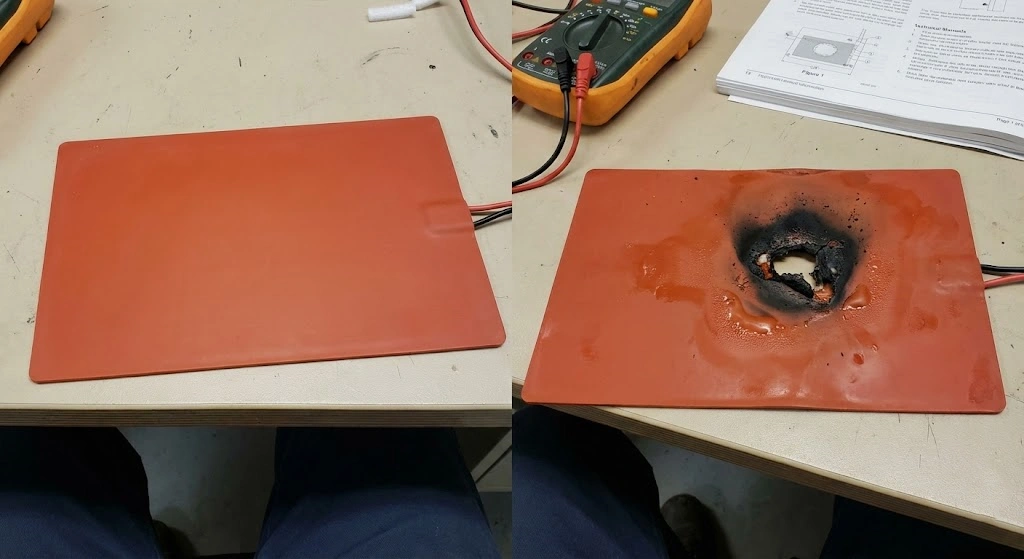
A. Localized Carbonization (Black Spots)
Symptom: The heater looks mostly new, but there is one specific coin-sized black spot or a hole burned through the center.
Root Cause:The Air Pocket Effect.
Silicone rubber transfers heat efficiently only through contact. If there was a bubble in the adhesive, or a speck of dust under the heater, heat could not escape into the metal part. The energy accumulated at that spot, spiked past 300°C, and burned the insulation.
Solution: Improve your installation process. Use a rubber roller for PSA application. [See our Mounting Guide].
B. Bubbling & Delamination
Symptom: The silicone rubber has puffed up like a balloon, separating the layers.
Root Cause:
Over-Wattage: The entire heater was running too hot for the material limits.
Moisture Ingress: The heater absorbed water (humidity) over time. When powered up rapidly, the water turned to steam and expanded.Solution: Lower the watt density or switch to a Vulcanized bond.
2. Electrical Testing: The Multimeter Check
A simple resistance check confirms if the internal circuit is intact.
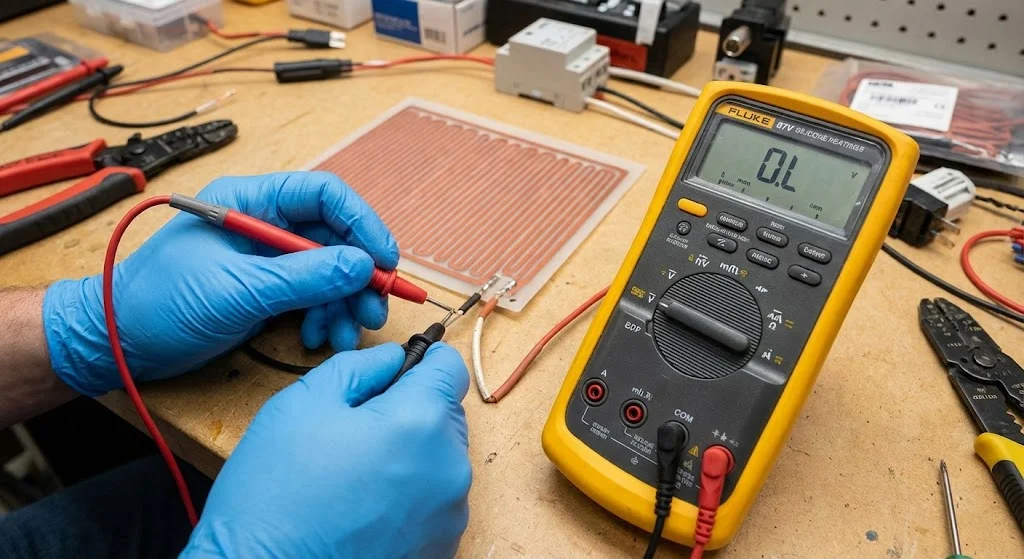
Before you discard a heater, measure the resistance (Ohms/Ω) between the two power leads.
Case A: Open Circuit (Reading: ∞ / O.L)
Diagnosis: The circuit is broken. Current cannot flow.
Common Causes:
Lead Wire Strain: The user pulled the cord, snapping the connection at the exit point. (Fix: Use our Molded Cap strain relief).
Thermal Fatigue: The internal foil cracked due to constant expansion/contraction cycles (usually from “Bang-Bang” on/off control).
Case B: Short Circuit (Reading: ~0 Ω)
Diagnosis: Direct path from Line to Neutral. Dangerous.
Common Causes:
Pinch Point: The heater was clamped too tightly, piercing the insulation and touching the resistance wire to the metal case.
Carbon Tracking: Severe overheating turned the silicone into carbon (which is conductive), creating an arc path.
3. Design Failure: The Silent Killer
Sometimes the heater works “perfectly” for a week, then dies. This is usually a design flaw.
The Watt Density Trap
Scenario: A client orders a 5W/cm² heater (very high power) but mounts it on a plastic tank or suspends it in air.
Result: The heater generates heat faster than the plastic can absorb it. The heater burns out, and the plastic melts.
The Fix: Use our [Watt Density Calculator]. Generally, keep air-heating applications below 0.4 W/cm².
The Voltage Mistake
Scenario: Connecting a 110V heater to a 220V power supply.
Physics: Power $P = V^2 / R$. Doubling the voltage quadruples the power. A 100W heater becomes 400W instantly.
Dynamic applications require specialized “High-Flex” lead wires.
Dynamic Bending Fatigue
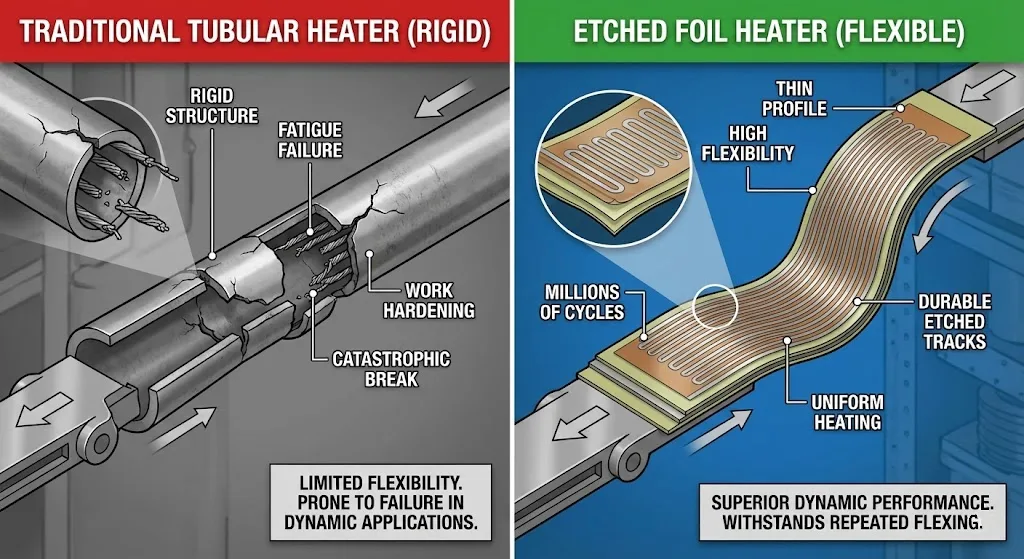
If the heater is mounted on a moving part (e.g., a sealing bar that moves up and down), standard wire-wound elements will eventually work-harden and snap.
Solution: Switch to Etched Foil technology. The flat, thin foil tracks can withstand millions of flex cycles if designed with the grain of the metal.
Chemical Attack
Silicone is resistant to water, but vulnerable to:
Strong Acids (Sulfuric).
Ketones (Acetone).
Oils (swelling over long periods).Solution: For chemically aggressive environments, we laminate a Teflon (PTFE) layer over the silicone for protection.
Frequently Asked Questions (FAQ)
My heater has a hole burned in it. Can I patch it with silicone glue?
No. A burn-through means the internal electrical insulation is compromised and the live circuit is exposed. Patching it does not restore the dielectric strength. Using a damaged heater risks electrocution and fire. It must be replaced immediately.
Why is the resistance different when hot vs. cold?
This is normal physics. The resistance of Nickel-Chrome alloy increases slightly as it heats up (Temperature Coefficient of Resistance). However, for standard silicone heaters (<250°C), this shift is small (<5%). Always measure resistance at room temperature (20°C) to compare against the datasheet.
How do I store spare heaters?
Store them flat, in a dry environment. Do not crumple or tightly fold them, as this can crease the internal foil. If stored in high humidity for years, bake them at 80°C for 2 hours before full-power use to drive out moisture.
Tired of replacing heaters?
Let us analyze your failed part. We can re-engineer the watt density, strain relief, or mounting method to solve the problem for good.