Introduction: The Engineering Challenge of “Cold Resistance”
Integrating high-performance quartz infrared emitters into an industrial control system presents a unique set of electrical challenges that standard resistive loads (like nichrome wire) do not. The primary engineering hurdle is the physical property of Tungsten: Cold Resistance.
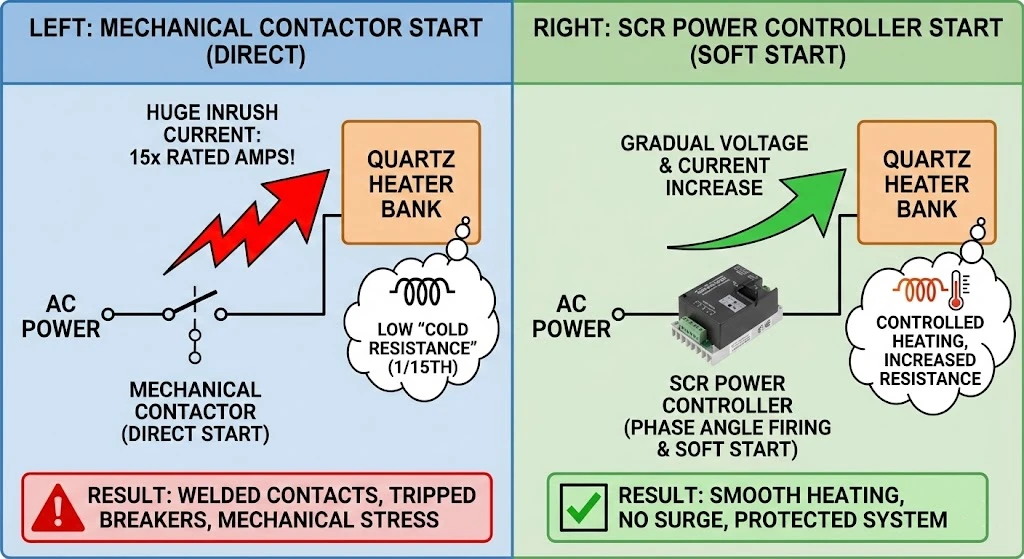
A tungsten filament at room temperature has an electrical resistance roughly 1/15th of its resistance at operating temperature (2400K). This means that if a bank of halogen heaters is switched on directly via a mechanical contactor, it will draw an instantaneous Inrush Current up to 15 times its rated amperage. This surge can weld relay contacts, trip main circuit breakers, and cause catastrophic mechanical stress on the lamp filaments.
To safely manage this dynamic load and achieve precision temperature stability, a standard contactor is insufficient. The mandatory solution is the integration of a dedicated SCR power controller (Silicon Controlled Rectifier) capable of Phase Angle Firing and Soft Start ramping.
An SCR power controller is not just a fancy switch; it is a solid-state device that acts as a throttle for your electricity. It is the only reliable way to tame the inrush current of short-wave halogen heaters.
1. Phase Angle Firing & Soft Start
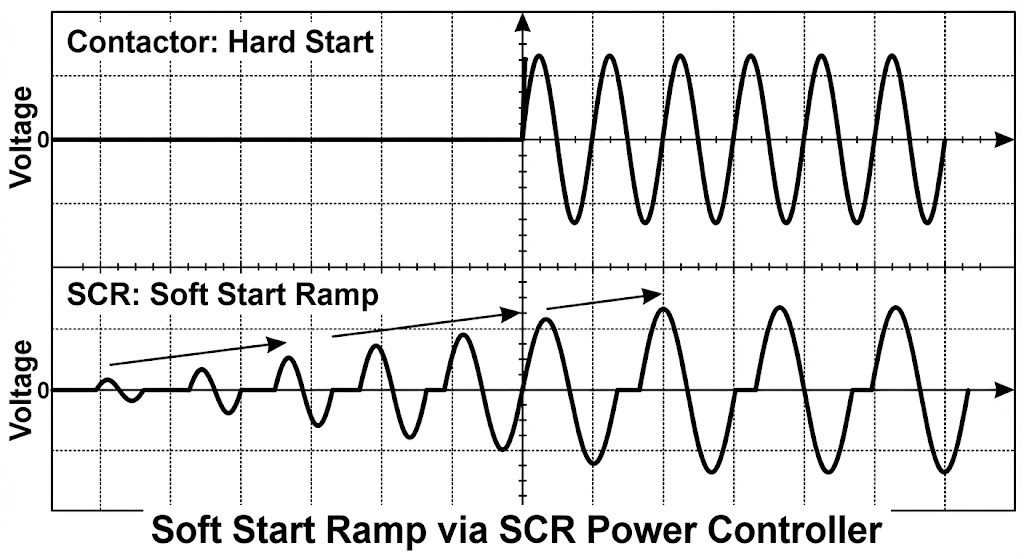
Unlike a mechanical relay that is either “ON” (100% voltage) or “OFF” (0V), an SCR chops the AC sine wave.
The Soft Start Mechanism: When the system powers up, the SCR automatically ramps the voltage from 0V to the full line voltage over a preset period (typically 300ms to 1 second).
The Benefit: This gentle ramp allows the tungsten filament to heat up and increase its resistance naturally before full power is applied. This eliminates the destructive current spike, protecting your fuses and extending the heater’s lifespan.
2. Precision PID Control
An SCR allows for variable output (0-100%). When paired with a PID temperature controller, it can hold the emitter’s temperature within ±1℃. This eliminates the “Overshoot/Undershoot” saw-tooth temperature profile caused by standard On/Off thermostats, which is critical for sensitive processes like medical device manufacturing or semiconductor drying.
Once you have selected your SCR power controller, the next critical step is the wiring architecture of the heater array.
1. Parallel Connection (The Industry Standard)
Recommendation: Always wire infrared heaters in Parallel.
In a parallel configuration, each tube receives the full line voltage. If one tube fails, the rest of the array continues to operate, allowing production to continue until a scheduled maintenance window.
2. The Danger of Series Pairing
Some engineers attempt to wire two 240V lamps in Series to run on a 480V supply.
The Risk: Infrared filaments do not age identically. As one tube ages, its resistance rises. In a series circuit, the tube with higher resistance will “hog” the voltage (e.g., receiving 300V instead of 240V), leading to rapid burnout. Once one fails, the entire zone goes dark.
3. 3-Phase Load Balancing
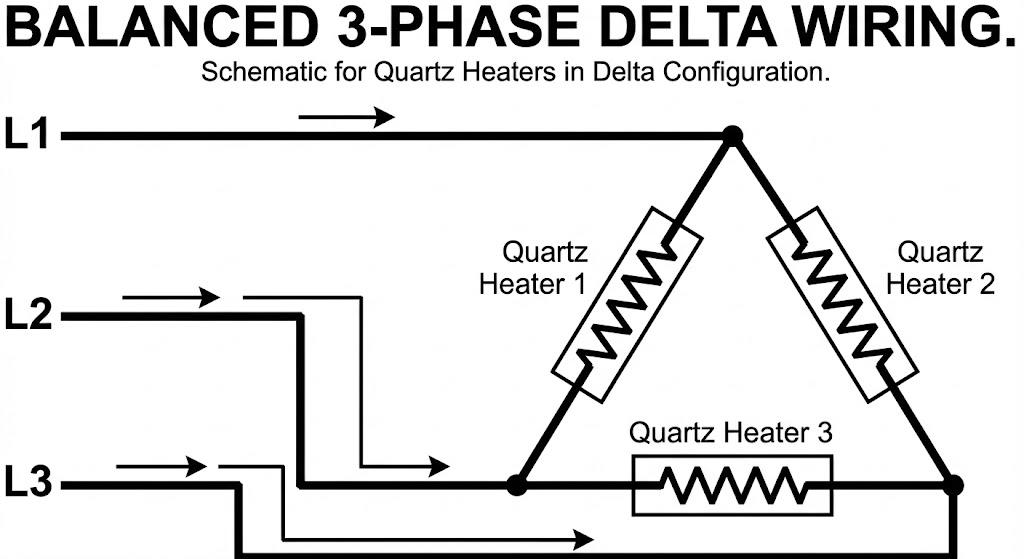
For systems exceeding 10kW, heaters should be distributed evenly across a 3-phase supply (Star or Delta) to prevent neutral imbalance.
Calculation: For a balanced 3-phase resistive load:$$I_{phase} = \frac{P_{total}}{V_{line} \times 1.732}$$
Sensor Integration: Closing the Loop
To utilize the full potential of your SCR power controller, you must feed it accurate temperature data.
1. Thermocouples (Contact)
Constraint: You cannot attach a thermocouple directly to a quartz tube (it will detach or melt).
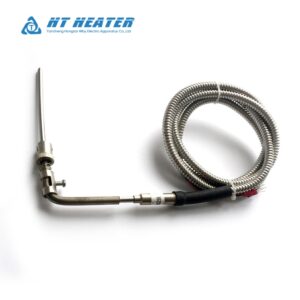
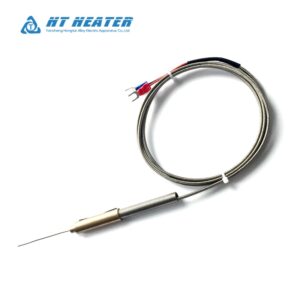
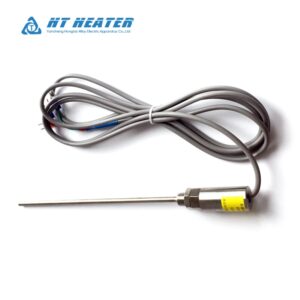
Solution: Place the thermocouple (Type K or J) on the product itself, or embed it in a “Dummy Element” (a ceramic block with similar thermal mass to your product) placed in the oven.
2. Infrared Pyrometers (Non-Contact)
For moving targets like conveyor belts, an optical Infrared Pyrometer is superior. It reads the surface temperature of the passing material and sends a 4-20mA signal to the SCR/PID controller, allowing for real-time dynamic power adjustment.
Installation Best Practices: Fuses & Cooling
1. Semiconductor Fuses (High Speed)
Standard circuit breakers (MCBs) are too slow to protect solid-state electronics. If a heater shorts out, the SCR chips will vaporize before a standard breaker trips.
Requirement: You must install High-Speed Semiconductor Fuses (Class aR) upstream of the SCR. These have an ultra-low $I^2t$ rating, blowing in microseconds to save your expensive controller.
2. Cabinet Cooling
SCRs generate heat—approximately 1.5 Watts per Amp. A 50A unit generates 75W of waste heat. Ensure your electrical cabinet has sufficient ventilation fans or air conditioning to keep the ambient temperature below 45°C.
FAQ: Electrical Engineering Questions
Q: Can I use a standard solid-state relay (SSR) instead of an SCR?
A: Standard SSRs are typically “Zero-Cross” switching. While they work for medium-wave (Carbon Fiber) heaters, they cannot perform Phase Angle Soft Start. Using a standard SSR on a large Halogen load will likely result in breaker trips due to inrush current. You need a dedicated SCR power controller with phase-angle capability.
Q: Why do my heaters buzz?
A: This is Magnetostriction. The rapid switching of the SCR creates magnetic vibrations in the heater filament. It is physically harmless.
Q: What wire should I use for quartz heaters?
A: Never use PVC wire. Use MG (Mica-Glass) or TGGT (Teflon-Glass) high-temperature wire for the connection to the ceramic end caps, rated for at least 250°C.
Conclusion: The Final Link in the Chain
A high-performance thermal system is a chain: it starts with the high-purity Quartz Material (No.14), relies on the correct Spectral Selection (No.04), and is secured by robust Electrical Control (No.15).
Buying the best heating tubes is meaningless if your control system cannot manage the load. By integrating a proper SCR power controller and following industrial wiring standards, you ensure that your Hongtai heaters deliver their full 5,000-hour lifespan with absolute precision.
Need a Wiring Schematic?
Send your heater layout and total power requirements to the Hongtai Electrical Engineering Team. We will provide a free SCR Selection Guide and a custom wiring diagram to ensure your installation is safe and compliant.