Introduction & The “Fake Glass” Misconception
In the industrial heating market, a dangerous misconception persists: many procurement managers believe that a quartz heating tube is simply a high-quality “heat-resistant glass,” similar to Borosilicate (Pyrex) kitchenware.
This assumption is technically incorrect and operationally hazardous.
Fused Silica Quartz is not merely glass; it is the purest form of Silicon Dioxide (SiO2) known to engineering. Unlike standard borosilicate glass, which softens around 820°C and blocks infrared radiation, fused quartz maintains its structural integrity up to 1680°C and is nearly perfectly transparent to infrared energy.
Choosing the wrong glass material for your heater doesn’t just lower efficiency by creating a “greenhouse effect” that traps heat inside the tube; it can lead to catastrophic explosion when the tube is subjected to rapid temperature changes.
Material selection is the first step in heater design. Once you understand the thermal limits of quartz, verify which filament type suits your application in our Industrial Quartz Heating Tubes: The Complete Engineering Guide.
Thermal Shock Resistance: Fire & Ice
The most defining physical property of fused quartz—and the reason it is irreplaceable in industrial heating—is its near-zero thermal expansion.
1. The Coefficient of Thermal Expansion (CTE) Miracle
Standard glass expands significantly when heated. If you heat one side of a glass plate while keeping the other side cool, the internal stress will shatter it.
Fused Quartz has an incredibly low Coefficient of Thermal Expansion (CTE) of just 5.5 * 10^{-7} /℃.
- Comparison: This is roughly 1/30th the expansion rate of standard soda-lime glass and 1/7th that of borosilicate glass.
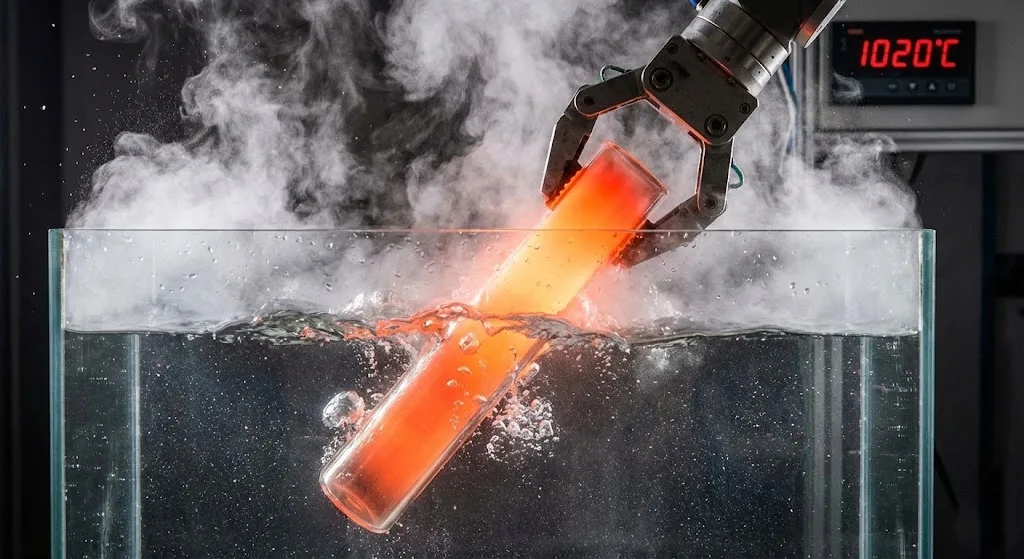
2. The Ultimate Stress Test (The Ice Water Dunk)
To demonstrate this property, Hongtai quality engineers perform a standardized destructive test:
- A quartz tube is heated in a furnace until it reaches a glowing red-hot temperature of 1000°C.
- It is immediately plunged into a bucket of 0°C Ice Water.
- The Result: The tube does not crack, shatter, or deform. It remains perfectly intact.
- The Engineering Value: This extreme thermal shock resistance means a quartz heater can survive water splashes in a food processing plant or rapid air cooling cycles in a semiconductor chamber without failure.
Optical Transmission: The Infrared “Invisible Highway”
A heater’s efficiency is determined by how much energy actually leaves the tube. If the glass envelope absorbs the infrared radiation, it heats up the glass (conduction) instead of heating your product (radiation).
1. The Greenhouse Effect of Standard Glass
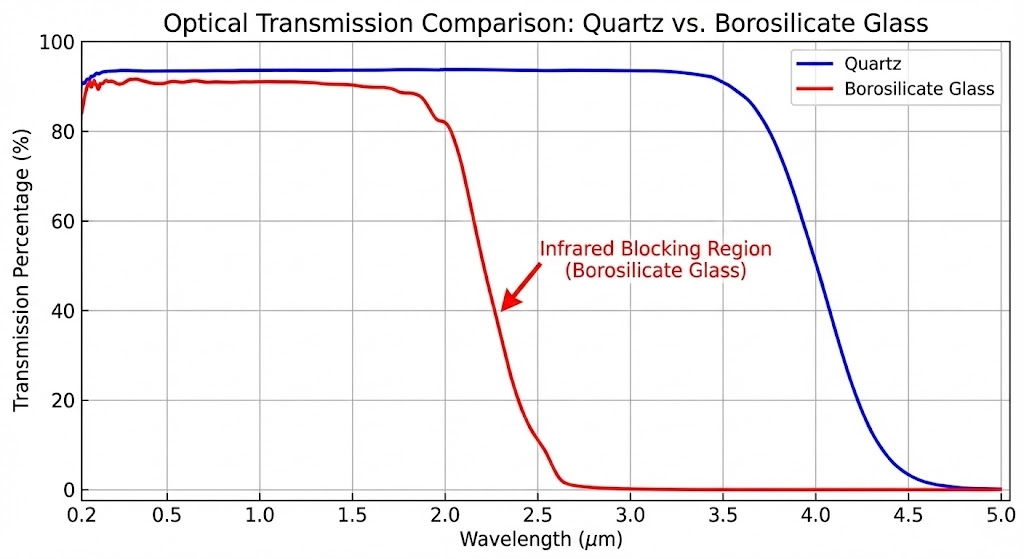
Standard glass is opaque to infrared radiation longer than 2.5 μm. It acts like a greenhouse: short-wave energy gets in, but medium-wave heat cannot get out. This trapped energy superheats the glass wall, leading to devitrification and premature failure.
2. The Quartz Advantage (JGS1 to JGS3)
High-purity fused quartz is optically transparent from the ultraviolet (0.2 μm) deep into the medium-wave infrared (4.0 μm).
- Transmission Rate: > 90% efficiency across the entire active heating spectrum.
- The OH Content Factor: In high-grade quartz (JGS1 / JGS2), we strictly control the hydroxyl (OH) content. High OH content creates a strong absorption peak at 2.73 μm—exactly where many industrial heaters operate. Hongtai uses Low-OH (< 5ppm) quartz to ensure maximum transmission in the critical medium-wave band.
Purity & Chemical Inertness: Semiconductor Standards
In industries like Photovoltaics (PV) and Semiconductor Wafer processing, contamination is measured in parts per billion. A standard heater sheds sodium and potassium ions when heated, which destroys silicon wafers.
1. 99.99% Silicon Dioxide
Our industrial quartz tubes are manufactured from high-purity natural quartz sands.
- SiO2 Content: > 99.99%
- Trace Metallic Impurities: Total alkali metals (Na, K, Li) are kept below < 10 ppm. This purity ensures that the heating element does not become a source of contamination in a cleanroom environment.
2. The King of Acid Resistance
Quartz is virtually chemically inert to almost all acids.
- Resistant: Hydrochloric, Nitric, Sulfuric, and Aqua Regia.
- Vulnerable: Only Hydrofluoric Acid (HF) and hot Phosphoric Acid will etch quartz.
- The Application: This makes quartz heaters the only viable solution for heating acid baths in wet-bench chemical processing stations.
Softening Point & Devitrification: The End of Life
Even the perfect material has limits. For quartz, the enemy is not heat itself, but “Devitrification.”
1. Temperature Limits
- Softening Point: ~1680°C. (The glass begins to physically deform).
- Annealing Point: ~1215°C. (Internal stresses relax).
- Continuous Working Temp: 1100°C. (Safe for long-term operation).
2. What is Devitrification (White Haze)?
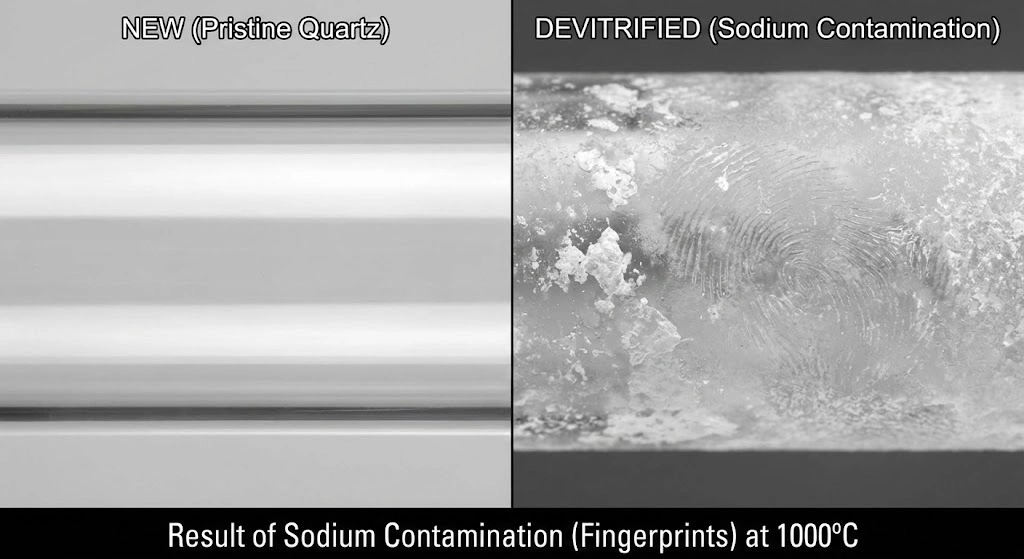
Have you ever seen an old quartz tube turn cloudy, milky white, or flake off white powder? This is Devitrification.
It occurs when the amorphous (random) molecular structure of the glass attempts to reorganize into a crystalline structure (Cristobalite).
- The Cause: It is almost always catalyzed by surface contamination. Sodium (salt) from a human fingerprint is the #1 cause. At 1000°C, the salt reacts with the silica, creating a nucleation point that spreads like a cancer, turning the clear glass into opaque, brittle ceramic.
- The Solution: Always handle quartz tubes with cotton gloves. If touched, wipe with isopropyl alcohol before firing.
Surface Treatments: Beyond Clear Glass
While clear quartz is the standard, we modify the surface properties for specific applications:
- Opaque (Milky) Quartz: Created by trapping micro-bubbles in the glass matrix. It scatters light and blocks direct radiation, often used as a thermal insulator backing.
- Frosted (Satin) Quartz: Acid-etched surface. Diffuses the harsh filament image into a soft glow, ideal for consumer patio heaters.
- Ruby (Red) Quartz: Doped with trace elements to filter out visible glare while passing infrared heat.
- Gold / Ceramic Coating: Sintered reflectors for directional control.
FAQ: Quartz Engineering Questions
Can quartz glass be tempered like safety glass?
No, and it doesn’t need to be. “Tempering” adds pre-stress to standard glass to improve its strength. Quartz naturally has such a low thermal expansion coefficient that it does not suffer from the thermal stress that tempering is designed to fix. Its mechanical strength is determined purely by wall thickness and purity.
How do I cut a quartz tube?
You cannot use a standard glass scorer. Quartz has a Mohs hardness of 7.0 (harder than steel). You must use a diamond-impregnated saw blade or a laser cutter to achieve a clean edge without chipping.
Is quartz resistant to alkali (bases)?
No. While it loves acid, quartz is vulnerable to strong alkaline solutions (like Sodium Hydroxide) at high temperatures. The alkali will etch the silica surface, reducing its transmission efficiency and mechanical strength over time.
Conclusion: It Looks Like Glass, But Behaves Like Ceramic
Quartz is not a commodity; it is a precision engineering material. Its unique combination of optical transparency, extreme thermal shock resistance, and chemical purity makes it the only viable envelope for high-performance infrared heating.
Need a Material Certificate?
Don’t guess about purity. Contact the Hongtai Quality Department to request a full Material Data Sheet (COA) for our JGS1/JGS2 quartz, including trace impurity analysis and thermal transmission curves.