In life sciences, a temperature deviation of just 1°C isn’t a minor inefficiency—it’s a failed diagnosis, a denatured reagent, or a compromised patient safety protocol.
Standard industrial heaters are simply not built for the sterile, high-precision environment of a hospital or laboratory. They lack the response speed, the biocompatibility, and the fail-safe redundancy required by IEC 60601 standards.
HT-Heater bridges this gap. We provide OEM-grade, medical-compliant silicone heating solutions designed to maintain ±0.1°C stability for In Vitro Diagnostics (IVD) and patient care devices.
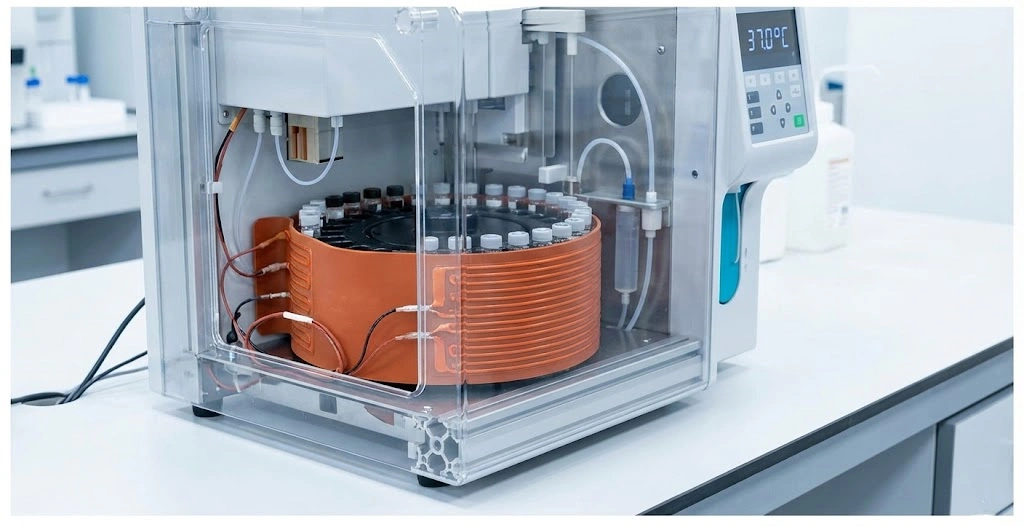
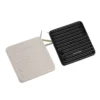
Custom contoured silicone heaters ensure reagents remain at exactly 37°C within clinical analyzers.
Why do top-tier medical device manufacturers (OEMs) choose custom silicone heaters over off-the-shelf components? It comes down to three non-negotiable engineering pillars.
1. Precision: The ±0.1°C Standard
For a blood analyzer, “warm” is not enough. The reagent disc must stay exactly at 37°C regardless of ambient room changes.
We achieve this through Etched Foil Technology. Unlike wire-wound elements, etched foil allows us to create high-resistance circuit patterns that cover 80% of the surface area. When paired with a PID controller, this eliminates thermal gradients and hot spots, ensuring the entire surface heats uniformly.
2. Hygiene & Biocompatibility
Medical environments demand sterility. Our medical-grade silicone rubber is formulated to be low-volatile and non-porous.
Chemical Resistance: It withstands repeated cleaning with isopropyl alcohol, bleach, and hospital-grade disinfectants without degrading.
Cleanroom Ready: The smooth surface prevents bacterial harborages often found in ceramic or mica heaters.
3. Redundant Safety Architectures
In patient-connected devices (like IV warmers), a “single fault” cannot lead to a thermal runaway.
We integrate dual-layer safety systems directly into the heater mat:
Layer 1: A precision NTC Thermistor (e.g., 10K or 100K) for active temperature control.
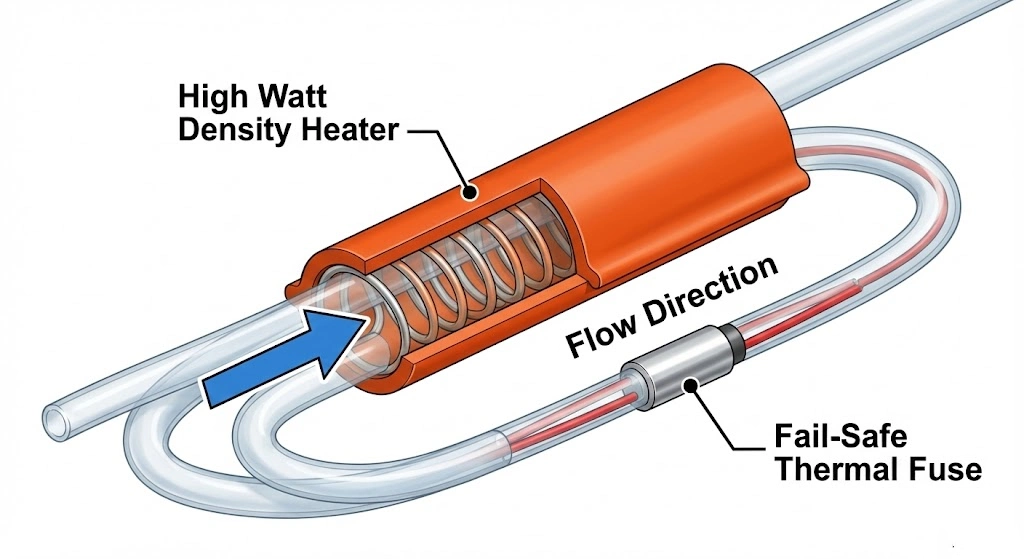
Layer 2: A mechanical bi-metal thermostat or thermal fuse wired in series. If the primary electronics fail, this hard-switch cuts power physically at a pre-set limit (e.g., 42°C).
Core Application Sectors
1. Blood & Biochemical Analyzers
The Challenge: Reagents and samples must be incubated at body temperature (37°C) for accurate enzymatic reactions. The heating element must fit complex, curved carousels or cuvette holders.
The Solution: We design multi-zone heaters. We can shape the silicone mat to fit the exact curvature of your carousel, with specific watt densities profiled to compensate for heat loss at the edges of the metal holder.
2. IV Fluid & Blood Warming
IV warming requires high power density to heat fluids instantaneously as they flow to the patient, strictly capped at 42°C for safety.
The Challenge: Preventing hypothermia during surgery requires heating fluids from room temperature (20°C) to body temperature (37°C) at high flow rates.
The Solution: High Watt Density design. Because the fluid acts as an excellent heat sink, we can push the heater’s power density higher (up to 2-3 W/cm²) to achieve instantaneous heat transfer, ensuring fluids exit the line at the correct temperature even at high flow volumes.
3. Respiratory Care (Humidifiers)
The Challenge: Generating consistent water vapor for ventilators without melting the plastic water chamber.
The Solution: Etched foil heaters provide a gentle, widely distributed heat flux. This prevents localized overheating that could degrade the medical-grade plastic container while maintaining the water at the evaporation point.
Case Study: Portable PCR Thermal Cycling
Note: The following is an engineering case study based on typical OEM projects.
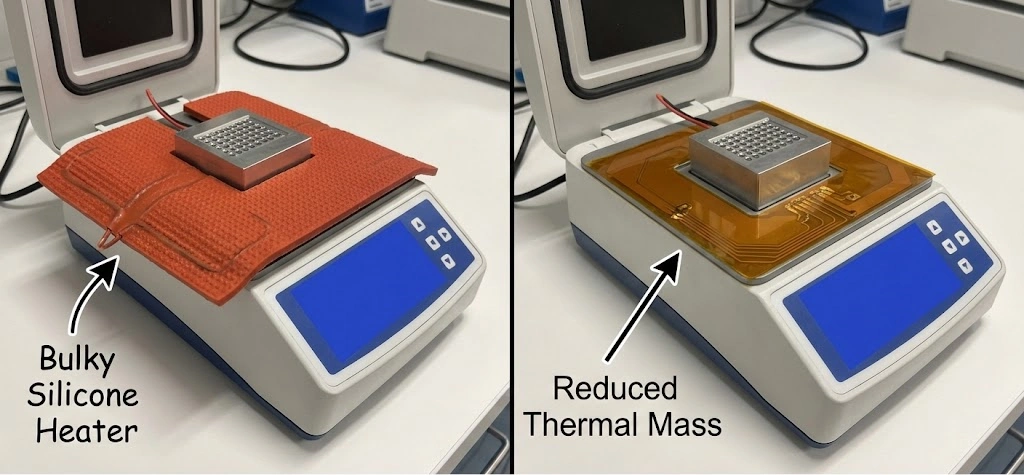
For rapid thermal cycling (PCR), switching from Silicone to Polyimide (Kapton) reduces thermal lag and improves battery life.
The Challenge: A client developing a handheld PCR (Polymerase Chain Reaction) device needed to cycle DNA samples between 55°C, 72°C, and 95°C.
Constraint: The device ran on battery power, and the total heating/cooling cycle had to happen in under 90 seconds.
Problem: Standard silicone heaters were too thick (1.5mm) and held too much residual heat (thermal mass), making the “cooling” phase too slow.
The HT-Heater Solution:
We switched the substrate from Silicone to Polyimide (Kapton).
Thickness Reduced: From 1.5mm to 0.2mm.
Thermal Mass: Almost zero. The heater stopped emitting heat the instant power was cut.
Sensor Integration: We surface-mounted a miniature RTD sensor directly onto the heater circuit for millisecond-response feedback. [See our Guide to Temperature Sensors].
The Result: The device achieved a 30% faster ramp-up rate and met the strict battery life requirements for field use.
Technical Specifications & Customization Options
When writing your [Request for Quote (RFQ)], please reference these medical-grade capabilities:
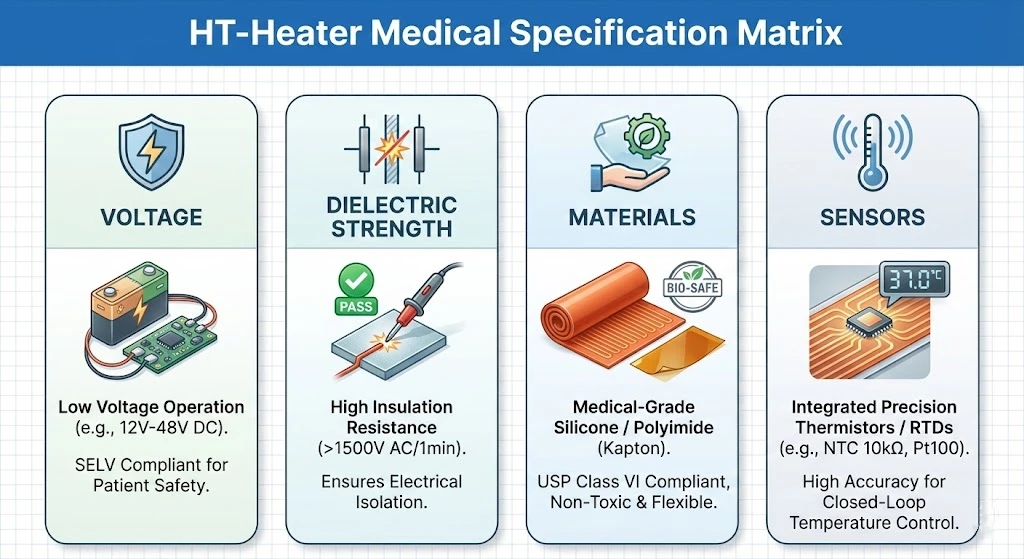
HT-Heater Medical Specification Matrix.
Feature
Specification Range
Medical Relevance
Voltage
12V / 24V DC (Portable) 110V / 220V AC (Benchtop)
Low voltage is preferred for patient safety (SELV compliance).
FDA 21 CFR 177.2600 compliant materials available.
Sensors
NTC 10K / 100K / PT100
Integrated directly into the heater mat.
Adhesive
Medical-Grade PSA (Acrylic)
Non-allergenic, compliant with skin-contact device requirements.
Quality Control & Traceability
In the medical industry, you don’t just buy a part; you buy a paper trail.
HT-Heater understands the burden of validation.
Batch Serialization: Every shipment of medical heaters is labeled with a unique batch number, allowing full traceability back to the raw silicone and resistance wire batches.
Testing Reports: We provide individual resistance testing, dielectric breakdown testing, and dimension verification reports with every OEM lot.
Frequently Asked Questions (FAQ)
Can silicone heaters be used in MRI (Magnetic Resonance Imaging) environments?
Standard silicone heaters cannot, as the internal resistance wire (Nickel-Chrome) is ferromagnetic and will disrupt the MRI field. However, we can custom engineer non-magnetic heating solutions using specialized non-ferrous alloys or conductive ink technologies. Please consult our engineering team for MRI-safe designs.
How do I disinfect the heater surface?
Our vulcanized silicone heaters are sealed to IP65/IP67 standards. They are impervious to moisture and can be safely wiped down with isopropyl alcohol (IPA), mild bleach solutions, or standard hospital disinfectants without damaging the insulation.
What is the maximum surface temperature for an IV fluid warmer?
To prevent hemolysis (damage to blood cells) or denaturing of proteins, IV warmers are typically software-locked to never exceed 42°C. We assist this by integrating a hard-wired thermal fuse or bimetal thermostat set to 43°C or 45°C as a physical fail-safe to prevent any risk to the patient.
Do you need a heating partner who understands “Patient Safety”? Stop sourcing from generic traders. Work directly with a factory that speaks the language of ISO 13485 and IEC 60601.