When your mechanical design allowance is tight—say, a Z-axis clearance of less than 0.5mm—or when your operating environment is a high-vacuum chamber, traditional thermal solutions hit a wall.
Silicone rubber is too thick (>1.5mm) and risks outgassing. Ceramic heaters are too brittle and bulky.
For engineers in optics, aerospace, and medical diagnostics, the solution lies in Polyimide (Kapton®) Heaters. These are not just “heaters”; they are flexible thermal circuits. With a profile as thin as 0.15mm and the ability to deliver precise heat flux via etched foil technology, they bridge the gap between PCB electronics and thermal management.
This guide explores the material science of Polyimide, the photolithographic manufacturing process, and how to design for applications requiring rapid thermal response and zero outgassing.
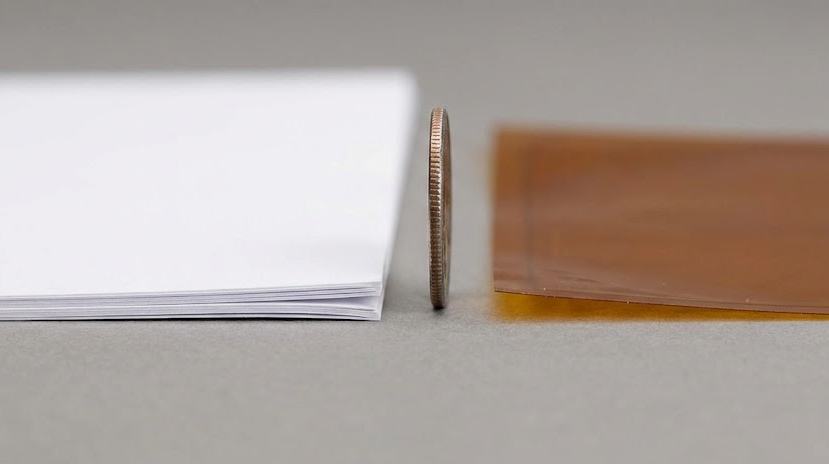
At 0.15mm – 0.2mm, a Kapton heater is thinner than two sheets of paper, allowing it to fit into extremely tight mechanical assemblies.
Kapton® (Polyimide) is an organic polymer film known for its high dielectric strength and thermal stability. But for a thermal engineer, its value proposition comes down to three physical properties.
A. Ultra-Thin Profile & Low Thermal Mass
The Spec: Standard thickness is 0.15mm to 0.2mm.
The Physics: Because the material mass is negligible, the heater has almost Zero Thermal Inertia.
The Benefit: It heats up instantly when powered and cools down instantly when power is cut. This makes it ideal for applications requiring fast ramp rates or tight PID control loops (e.g., DNA amplification cycling).
B. Vacuum Compatibility (Low Outgassing)
The Pain Point: In a vacuum chamber (e.g., a satellite test rig or SEM microscope), standard silicone rubber can release volatile silicones (outgassing), creating a film that condenses on sensitive lenses or sensors. The Solution: Polyimide is chemically stable and has extremely low Total Mass Loss (TML) and Volatile Condensable Material (VCM) ratings. It is the industry standard for cleanroom and space-flight thermal management.
C. Radiation & Chemical Resistance
Polyimide is inherently resistant to:
Radiation: Suitable for X-ray equipment and nuclear environments (108 Rads).
Solvents: Impervious to most organic solvents, acids, and oils, making it safe for medical device cleaning protocols.
2. Core Technology: The Etched Foil Process
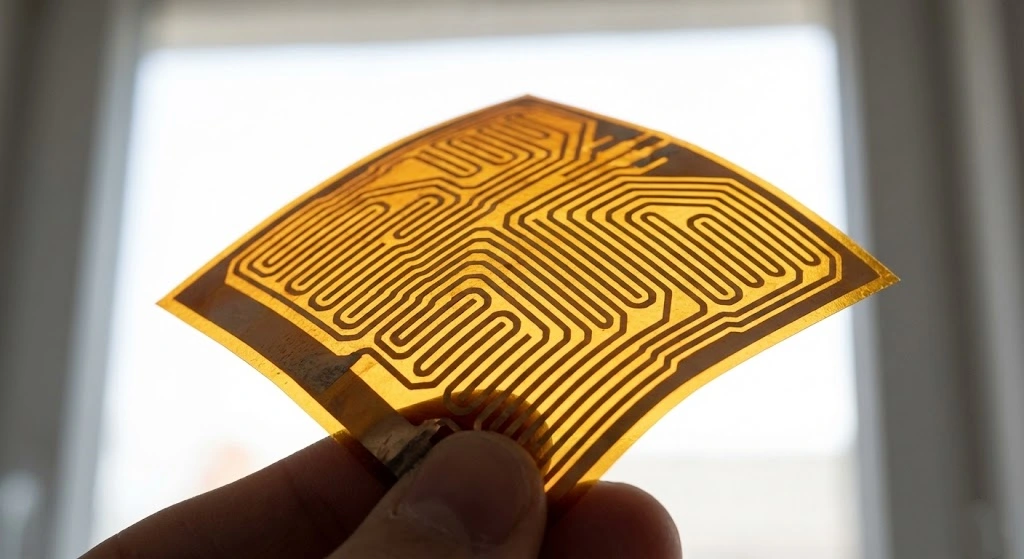
Figure 2: Etched foil technology allows for complex circuit paths, enabling “Multi-Zone” heating on a single film.
Unlike wire-wound silicone heaters, Kapton heaters are manufactured using a process similar to Printed Circuit Boards (PCBs).
Photolithography & Acid Etching
We laminate a micro-thin layer of resistance alloy (Inconel or Nickel) to the Kapton base.
We apply a photoresist mask in the pattern of the desired circuit.
Acid etches away the unmasked metal, leaving behind a flat, precise resistance track.
The Engineering Advantages
High Power Density: The flat track has a larger surface area ratio than round wire. This allows for better heat transfer to the substrate, permitting watt densities up to 2-3 W/cm² (with proper heat sinking), compared to 0.8 W/cm² for silicone.
Precision Distribution: We can design variable pitch circuits. For example, we can concentrate more circuit lines at the edges of the heater to compensate for edge-loss, ensuring a perfectly uniform temperature across the surface.
Complex Geometries: Need a heater shaped like a donut with 15 screw holes? Etched foil makes this easy and repeatable.
3. High-End Application Scenarios
A. Optics & Security (De-fogging)
Scenario: Outdoor security cameras or LiDAR sensors on autonomous vehicles. Challenge: Condensation or frost blinds the sensor. Solution: A ring-shaped Kapton heater adheres directly to the back of the lens assembly. Its low mass ensures it doesn’t affect the gimbal’s mechanical balance, while providing just enough heat to keep the lens above the dew point.
B. Medical Diagnostics (Microfluidics)
Scenario: Portable blood analyzers or PCR devices. Challenge: Fluids moving through micro-channels must be heated to exact temperatures for reactions to occur. Solution: The Kapton heater acts as the channel floor. Its transparency allows optical sensors to read the fluid status through the heater itself (amber tint permits IR/Visible light transmission).
C. Laboratory Vacuum Chambers
Scenario: Baking out moisture from samples in high vacuum. Solution: Kapton heaters provide clean, contaminant-free heat without introducing particulate matter or outgassing into the vacuum environment.
4. Installation: Challenging the 0.2mm Limit
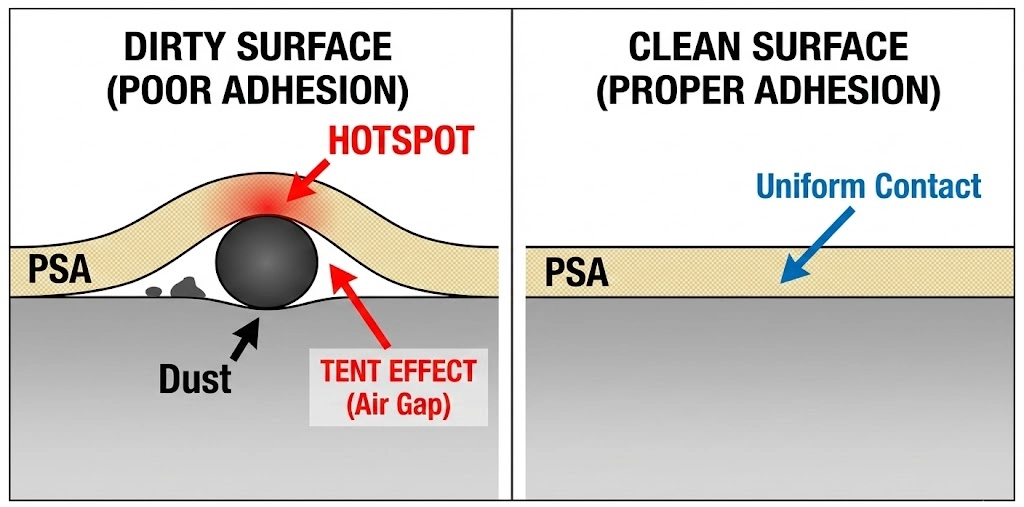
Surface preparation is critical. A single dust particle under a 0.2mm film creates a stress point and a thermal void.
Installing a film this thin requires precision.
Pressure Sensitive Adhesive (PSA)
We typically apply 3M 467MP (2 mil / 0.05mm) adhesive. It is “transfer tape” (adhesive only, no carrier), preserving the ultra-thin profile.
Critical Warning: The mating surface must be surgically clean. Any dust, burr, or grease will create a “tenting” effect. This creates an air gap (insulator) under the foil, which causes a Hot Spot and eventual burnout.
Mechanical Clamping
For higher temperatures (>150°C) where PSA fails, Kapton heaters can be clamped between two metal plates.
Note: You must use a thin elastomeric pad (like a 0.5mm silicone sheet) as a buffer to ensure even pressure distribution and prevent the metal plate from crushing the etched circuits.
5. Limitations: When NOT to Use Kapton
To ensure reliability, engineers must recognize the constraints of Polyimide.
No Elasticity (Stretch): Kapton is Flexible (it can wrap around a cylinder), but it is not Elastic (it cannot stretch). Do not use it on compound curves (like a sphere) or surfaces that expand/contract significantly, as the foil circuit will crack.
Moisture Ingress: While the film is waterproof, the edges are layered. In submerged applications, water can eventually wick into the layers. For underwater use, Vulcanized Silicone is the superior choice.
Impact Resistance: The film is thin and fragile. It offers zero mechanical protection against sharp objects or impact.
Technical Comparison: Silicone vs. Kapton
Feature
Silicone Rubber Heater
Polyimide (Kapton) Heater
Selection Rule
Thickness
1.5mm – 4.0mm
0.15mm – 0.2mm
Limited Z-Space? Choose Kapton.
Max Temp
250°C
200°C (PSA limited)
High Temp? Choose Silicone.
Vacuum
Poor (Outgassing)
Excellent (Low TML)
Vacuum/Space? Choose Kapton.
Durability
Rugged, Shock Absorbent
Fragile, Thin
Harsh Environment? Choose Silicone.
Elasticity
Slight Elasticity
Zero Elasticity
Compound Curves? Choose Silicone.
Frequently Asked Questions (FAQ)
Can you make the Kapton heater completely transparent?
Standard Kapton is an amber-colored, semi-transparent film. You can see fluid levels or structures through it, but it is not optically clear. If you need 100% transparency (e.g., for a display screen overlay), you require Transparent Conductive Film (using ITO technology), not Kapton.
Can I cut the heater with scissors to fit my part?
Absolutely not. The internal element is a precise, continuous circuit loop. Cutting the film anywhere will sever the circuit (Open Loop) and ruin the heater. All dimensions and holes must be tooled during the manufacturing process.
What is the smallest sensor you can integrate?
To maintain the ultra-thin profile, we recommend using Surface Mount Device (SMD) NTC Thermistors or extremely fine-gauge Thermocouples (Type T or K). These can be bonded directly to the heater surface without adding significant bulk.
Designing for the microns? Don’t let bulky thermal components ruin your sleek design. Contact HT-Heater for precision thin-film solutions.