Introduction: The “Silent Killer” of Heat Treatment
Your furnace controller reads 1100°C. Your chart recorder reads 1100°C. But your Rockwell hardness test just failed.
Why? Because your process temperature was actually 1085°C.
You are the victim of Thermocouple Drift. Unlike a catastrophic open-circuit failure where the system shuts down safely, drift is a silent killer. It allows the process to run ostensibly “normal” while the sensor slowly loses calibration, ruining batches of product over weeks or months.
For 50 years, the Type K thermocouple has been the default choice for industrial temperature measurement. But metallurgy has advanced since the 1970s.
This guide analyzes the physics behind Type K failure modes—specifically “Green Rot” and Short Range Ordering—and provides the engineering data to justify why upgrading to Type N (Nicrosil-Nisil) is the single highest ROI decision you can make for high-temperature process control.
To understand why Type K fails, we must look at its metallurgy. Type K consists of a positive leg (Chromel: 90% Nickel, 10% Chromium) and a negative leg (Alumel: 95% Nickel, 2% Manganese, 2% Aluminum).
While robust, this alloy combination has two fatal flaws inherent to its atomic structure.
The Phenomenon of “Green Rot” (800°C – 1050°C)
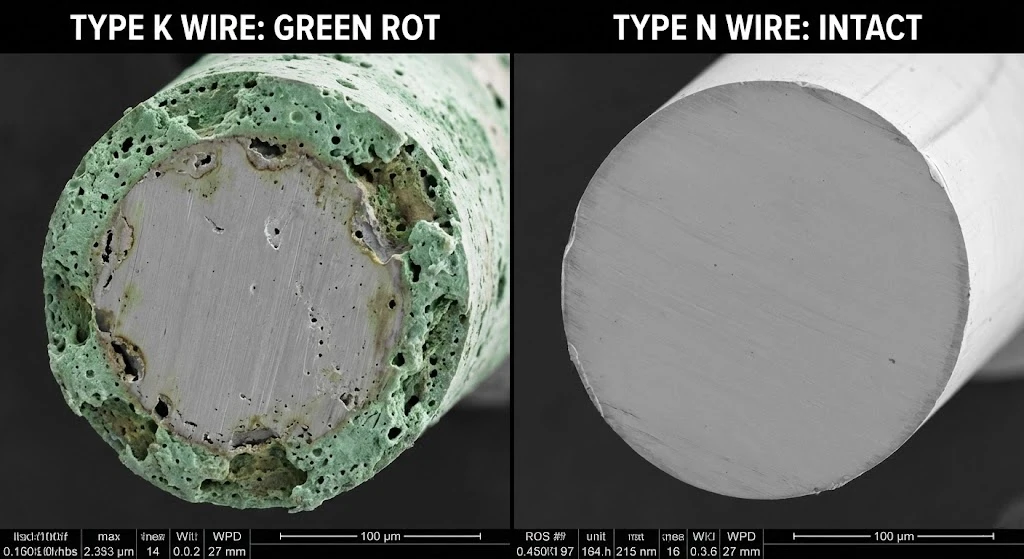
The most insidious failure mode of Type K thermocouples is preferential oxidation, known in the industry as “Green Rot.”
The Physics: In environments with low oxygen (reducing atmospheres) or in long, narrow protection tubes where air circulation is poor, the Chromium in the positive leg oxidizes, but the Nickel does not.
The Reaction: The Chromium is depleted from the alloy to form chromium oxide Cr2O3. This effectively changes the alloy composition from Ni-Cr to pure Nickel.
The Consequence: As Chromium is depleted, the Seebeck voltage generated by the sensor drops drastically.
The Danger: The controller sees a lower voltage and interprets it as a temperature drop. It responds by increasing power to the heating elements. Result: Your furnace overheats while the controller thinks everything is fine.
Microscopic analysis of Green Rot corrosion on Type K thermocouple vs intact Type N wire.
Hysteresis & Short Range Ordering (300°C – 500°C)
Even at lower temperatures, Type K is unstable.
Between 300°C and 550°C, the Nickel-Chromium lattice undergoes a structural change called Short Range Ordering (SRO). The atoms rearrange themselves into a more ordered state, which alters the magnetic properties and the Seebeck coefficient.
The Symptom: Hysteresis. The temperature reading during the heating cycle will differ from the reading during the cooling cycle, even if the actual temperature is identical. This can introduce errors of +4°C to +6°C.
The Impact: For precise annealing or aging processes, this unrepeatable error margin is unacceptable.
Enter Type N: The Better Mousetrap
Developed by the Defence Science and Technology Organisation (DSTO) in Australia, the Type N (Nicrosil-Nisil) thermocouple was specifically engineered to solve the chemical flaws of Type K.
Nicrosil-Nisil Chemistry
Type N changes the alloy recipe:
Positive Leg (Nicrosil): Nickel + 14% Chromium + 1.5% Silicon.
Negative Leg (Nisil): Nickel + 4.5% Silicon + 0.1% Magnesium.
The Key Innovation: Silicon.
In Type N, the addition of silicon creates a continuous, protective diffusion barrier of Silicon Dioxide (SiO2) on the surface of the wire. Think of this as a “ceramic shield” or a bulletproof vest for the metal.
This SiO2 layer forms almost immediately upon heating and effectively seals the wire, preventing oxygen from penetrating deep into the core to cause Green Rot.
10x Stability Improvement
The stability difference is not theoretical; it is proven by NIST and ASTM data.
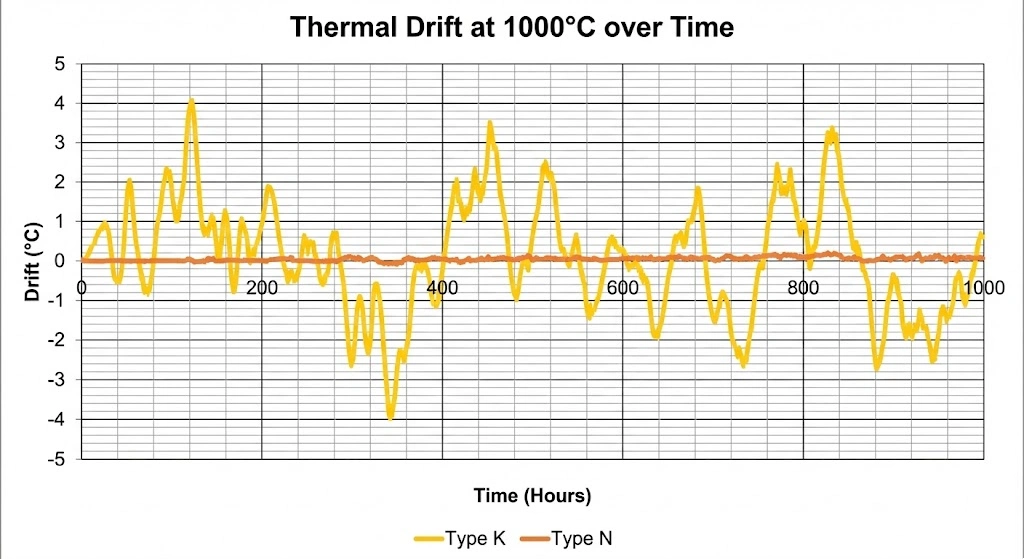
Test Data (1000°C for 1000 hours):
Type K Drift: Typically swings from +5°C to -10°C, showing unpredictable volatility.
Type N Drift: Typically maintains stability within ±0.5°C.
For a Quality Assurance Manager, this means the difference between calibrating your sensors every month (Type K) vs. every 6 months (Type N).
NBS Monograph 161 drift comparison chart Type K vs Type N at 1000 degrees Celsius.
Comparative Analysis: K vs. N
If you are building a BOM (Bill of Materials) for a new kiln or upgrading an existing line, use this decision matrix.
Feature
Type K (The Legacy)
Type N (The Modern Standard)
Temp Range
-200°C to 1250°C
-270°C to 1280°C (Slightly Higher)
Stability (>900°C)
Poor. Prone to drift and oxidation.
Excellent. 10x more stable.
Atmosphere
Vulnerable to Reducing Gas (Green Rot).
Highly Resistant to Oxidation.
Hysteresis (300-500°C)
Yes. Short Range Ordering errors.
No. Virtually eliminated.
Standard Cost
Low ($)
Moderate ($ – ~15% Premium)
Availability
Ubiquitous.
Common in Industrial Markets.
The Verdict: Total Cost of Ownership (TCO)
While Type N raw wire may cost 10-15% more than Type K, the service life is typically 300% longer. When you factor in the cost of downtime to replace a failed sensor, and the labor cost of frequent recalibration, Type N is significantly cheaper over the lifecycle of the machine.
Migration Guide: Switching from K to N
Warning: You cannot simply unscrew a Type K probe and screw in a Type N probe. The physics of the voltage generation are different. To upgrade successfully, you must follow this protocol:
1. It’s Not Plug-and-Play
Type N and Type K have different Seebeck Coefficients (mV output per degree).
If you connect a Type N sensor to a Type K controller, you will get a massive error in the reading.
Action: You must enter the PID Controller or PLC settings menu and change the Input Type from “K” to “N”.
2. Replace the Extension Wire
You cannot use existing Type K extension wire (Yellow/Red) with Type N sensors. This creates “parasitic junctions” that destroy accuracy.
Action: Rip out the old wire. Install Type N Extension Wire.
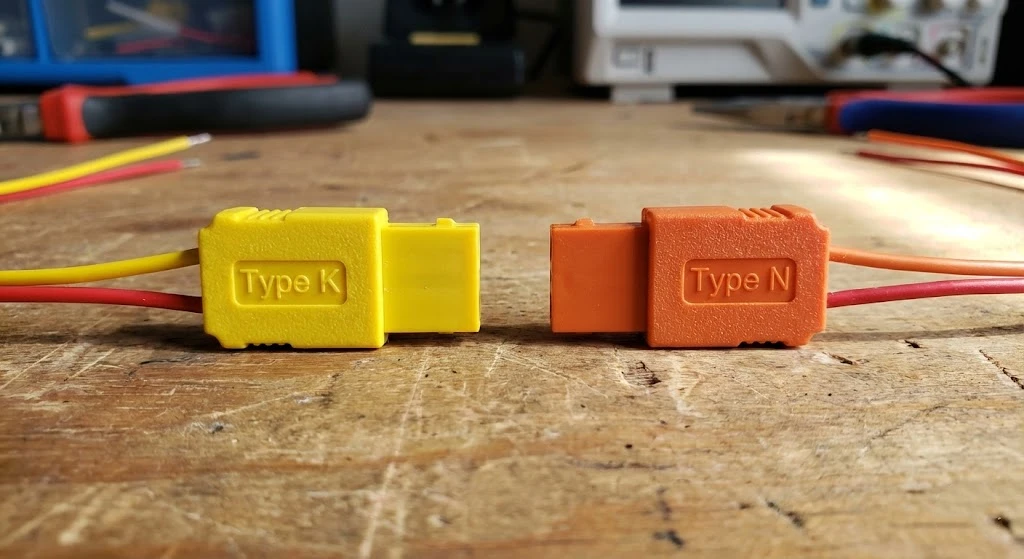
Visual ID: Look for ORANGE jackets (ANSI standard).
Type K: Yellow (+) / Red (-)
Type N: Orange (+) / Red (-)
Visual difference between Type K yellow and Type N orange thermocouple connectors.
3. Mineral Insulated (MI) Cable Specs
For high-temperature applications (>1000°C), the sheath material is just as important as the wire.
Recommendation: When ordering Type N, specify Nicrobell or Inconel 600 sheathing. Nicrobell is a specialized alloy that matches the thermal expansion coefficient of the Type N wire, reducing mechanical stress during thermal cycling.
When should you STAY with Type K?
We are engineers, not salespeople. Type N is superior for high heat, but Type K still has its place.
Scenario 1: Low Temperature, Non-Critical Apps
If you are measuring an oven at 200°C or a simple water tank, Type K is perfectly adequate. The “Green Rot” and “Ordering” issues are negligible or non-existent at these temperatures.
Scenario 2: Legacy Infrastructure Constraints
If your factory has 50,000 feet of Type K extension wire embedded in concrete or conduit, the cost to rewire for Type N might be prohibitive. In this case, use Type K but implement a stricter calibration schedule.
Scenario 3: Nuclear Applications
Type K has a longer history of data regarding performance under neutron radiation. While Type N is catching up, some nuclear regulatory specifications still mandate Type K due to the volume of historical validation data.
Frequently Asked Questions (FAQ)
What is the main advantage of Type N over Type K?
The main advantage is significantly better stability at high temperatures (600°C – 1200°C) and resistance to “Green Rot” oxidation. Thanks to the silicon-enriched Nicrosil-Nisil alloy, Type N creates a protective oxide layer that reduces drift by up to 10x compared to Type K.
Can I connect a Type N thermocouple to a Type K instrument?
No. They have different Seebeck coefficients. Connecting a Type N sensor to a Type K input will result in significant temperature errors. You must reprogram the controller to “Type N” and use matching Type N extension wires (Orange jacket).
Is Type N more expensive than Type K?
Slightly. Type N raw wire typically costs 10-15% more than Type K. However, because Type N sensors last significantly longer and require less frequent calibration, the Total Cost of Ownership (TCO) is often 50% lower than Type K.
What is the maximum temperature for Type N thermocouples?
Type N can continuously operate up to 1260°C (2300°F) in oxidizing atmospheres. This is slightly higher than Type K’s reliable limit, but the real benefit is the stability at these temperatures, not just the range.