Winter in an industrial warehouse brings a predictable, expensive problem: honey crystallizes, epoxy resin becomes un-pourable, and heavy oil turns into sludge.
Trying to pump these high-viscosity fluids cold is a recipe for disaster. It leads to pump cavitation, motor burnout, and production line stoppages. The old methods—open flames, hot water baths, or space heaters—are inefficient, unsafe, and non-compliant with modern OSHA standards.
This guide compares the three dominant industrial heating solutions: Silicone Band Heaters, Base Heaters, and Insulated Full-Coverage Jackets. We will teach you how to select the right wattage density and control strategy based on your material properties (e.g., heat-sensitive chocolate vs. high-temp asphalt) to restore flow in under 20 minutes.
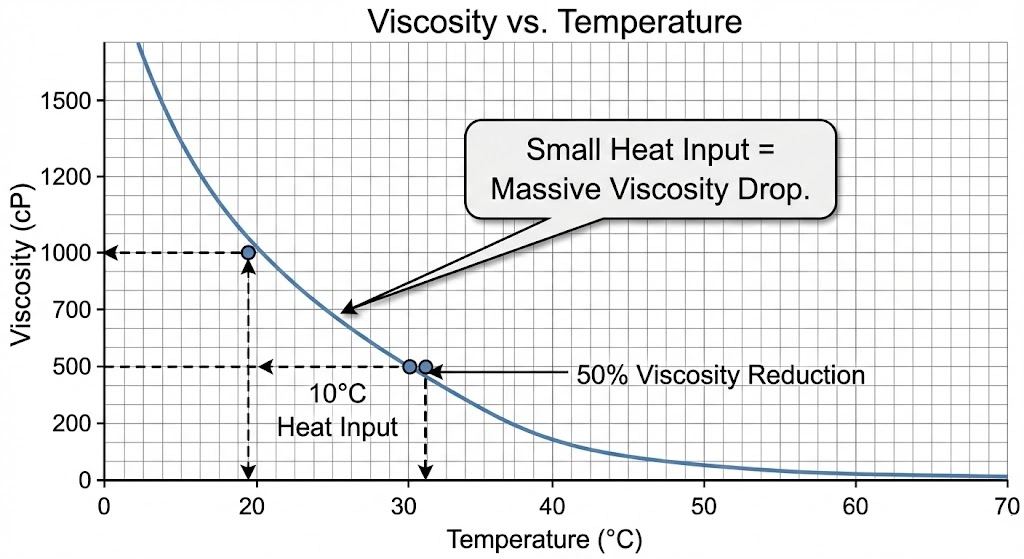
Heating heavy oil by just 10°C can reduce viscosity by 50%, significantly lowering pump load.
Why invest in a dedicated drum heater? It’s not just about getting the liquid out; it’s about Asset Protection.
The Physics of Flow
Fluid viscosity increases exponentially as temperature drops. When you force a pump to move cold, thick fluid, the suction pressure drops below the fluid’s vapor pressure, causing Cavitation—the formation and violent collapse of bubbles that pit the pump impeller.
The Solution: By applying controlled heat, you reduce the fluid’s shear resistance. As noted in our [technical documentation], “heating reduces viscosity uniformly, decreasing the power requirement of the pump and extending equipment life.”
Melting vs. Maintaining
Melting (Phase Change): Converting solids (wax, lard, asphalt) to liquid requires high energy input, ideally from the bottom up.
Maintaining (Temperature Holding): Keeping a liquid from freezing (water, urea/DEF) requires low, steady heat to offset ambient loss.
2. 55-Gallon (200L) Drum Heater Showdown
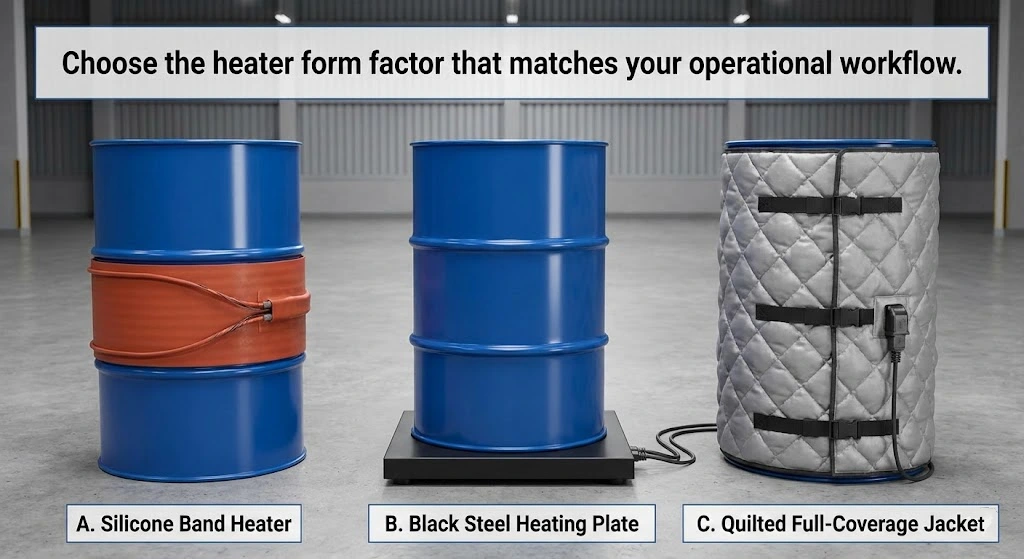
Choose the heater form factor that matches your operational workflow.
Which style fits your process?
Option A: Silicone Band Heaters (The Flexible Workhorse)
Design: A reinforced silicone rubber strip with an integrated spring fastener.
Best For: Liquids, maintenance heating, and observing fluid levels.
Pro Tip: You can install 1, 2, or even 3 bands on a single drum to create “Heat Zones.” For example, turn off the top band as the liquid level drops to prevent burning the residue.
Option B: Base Drum Heaters (The Bottom-Up Approach)
Design: A heavy-duty steel platen with an etched foil element inside. You place the drum on top of it.
Best For:Solids and Waxes. Since solid blocks melt and slide to the bottom, applying heat here is the most efficient way to liquefy the entire mass without creating an air cavity on top.
The “Power Combo”: For fastest melting of asphalt or heavy grease, use a Base Heater + Side Band.
Option C: Full-Coverage Insulated Jackets
Design: A nylon/polyester jacket with built-in insulation cotton and heating wires.
Best For: Outdoor use (wind protection) and safety (cool-to-touch exterior). The insulation retains heat, cutting energy consumption by up to 30%.
3. Material Alert: Steel vs. Plastic (Poly) Drums
WARNING: This is the most common safety error.
Steel Drums: Built for Speed
Steel conducts heat efficiently. You can use standard high-wattage silicone bands (e.g., 2000W) with high watt densities to heat materials quickly.
Poly (Plastic) Drums: The Meltdown Risk
Plastic acts as a thermal insulator. If you apply a high-power steel drum heater to a plastic drum, the heat cannot dissipate into the fluid fast enough. The heater surface temperature will rise until it melts the plastic wall.
HT-Heater Solution:
We manufacture specialized Poly-Drum Heaters.
Watt Density: Strictly limited to < 0.6 W/cm².
Thermostat: Includes a secondary safety limiter set to 130°C to prevent wall softening.
Rule: Never use a heater marked “Steel Only” on a plastic container.
4. The IBC Tote Strategy (1000L)
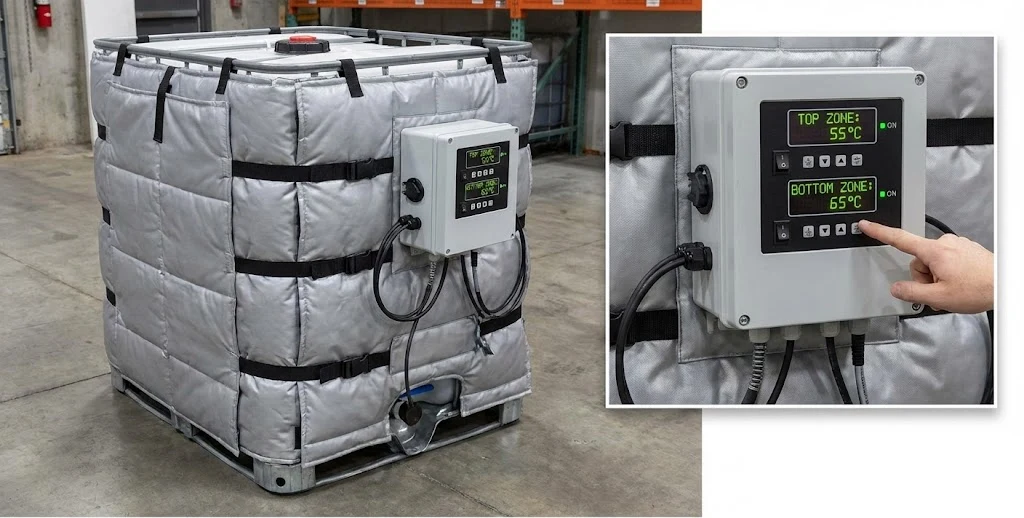
Dual-zone control on IBC heaters prevents energy waste as the container empties.
Heating 1000 liters (275 gallons) of fluid requires a massive amount of energy (BTUs).
External Jacket vs. Immersion
Immersion Heaters: Effective, but they require opening the lid (contamination risk) and are a nightmare to clean between batches.
HT-Heater External Jacket: A non-invasive “wrap” solution. Zero contact with the product means zero contamination.
Why Dual-Zone Control Matters
An IBC heater covers a large vertical area.
Scenario: You have used half the tank.
Problem: If the heater is one single circuit, the top half is now heating empty air (wasting energy and risking overheating).
Solution: Our IBC jackets feature Independent Top & Bottom Zones. You can switch off the top zone once the fluid level drops, maintaining the bottom heating for the remaining product.
5. Technical Specs & Application Table
When ordering, specify your control method:
Mechanical Dial (Knob): Rugged, simple, ranges 30-150°C. Best for dirty gloves and rough handling.
Digital PID: For precision chemical processing requiring ±1°C accuracy.
Application Quick-Reference Table
Material
Target Temp
Recommended Heater Setup
Critical Notes
Honey / Syrup
40°C – 50°C
Full Coverage Jacket (Low Watt)
DO NOT OVERHEAT. Sugars will caramelize and burn above 60°C.
Lube Oil / Motor Oil
50°C – 70°C
Silicone Band Heater
Use 2 bands for faster flow rates.
Resin / Epoxy
30°C – 60°C
Silicone Band w/ Thermostat
Consistent temp required for proper curing/mixing.
Asphalt / Heavy Oil
80°C – 120°C
Base Heater + Side Band
Needs maximum power density to liquefy.
Vaseline / Wax
60°C – 80°C
Base Heater
Heat from bottom to melt solid block efficiently.
6. Conclusion: Don’t Let Cold Freeze Your Profit
Calculate the ROI: An industrial drum heater costs a few hundred dollars. Replacing a seized positive displacement pump or scrapping a batch of crystallized resin costs thousands—plus the downtime.
Ready to protect your process?
Don’t guess between 1500W and 2000W. Tell us your material and tank size, and our engineers will specify the safe thermal solution within 1 hour.
Yes, provided it has a built-in thermostat (which all HT-Heater models do). The thermostat will cycle power on and off to maintain the set temperature. However, for energy efficiency and safety, we recommend turning the setpoint down to a “maintenance” level (e.g., 30°C) once the material is fully melted, rather than keeping it at high process temps overnight.
Are your heaters certified for explosion-proof areas?
Standard silicone and jacket heaters are NOT explosion-proof. If you are operating in a Class I, Div 1 or 2 environment (presence of flammable gases/vapors), you must use our certified ATEX / IECEx hazardous area heaters. Please explicitly state this requirement in your RFQ.
How long does it take to melt a 200L drum of solid grease?
This depends on the grease’s thermal conductivity and ambient temp. With a “Base + Side Heater” combination (approx. 3000W total), typical melting time is 4 to 6 hours. Using a single side band alone may take 12-24 hours because solids conduct heat poorly from the sides compared to the bottom.